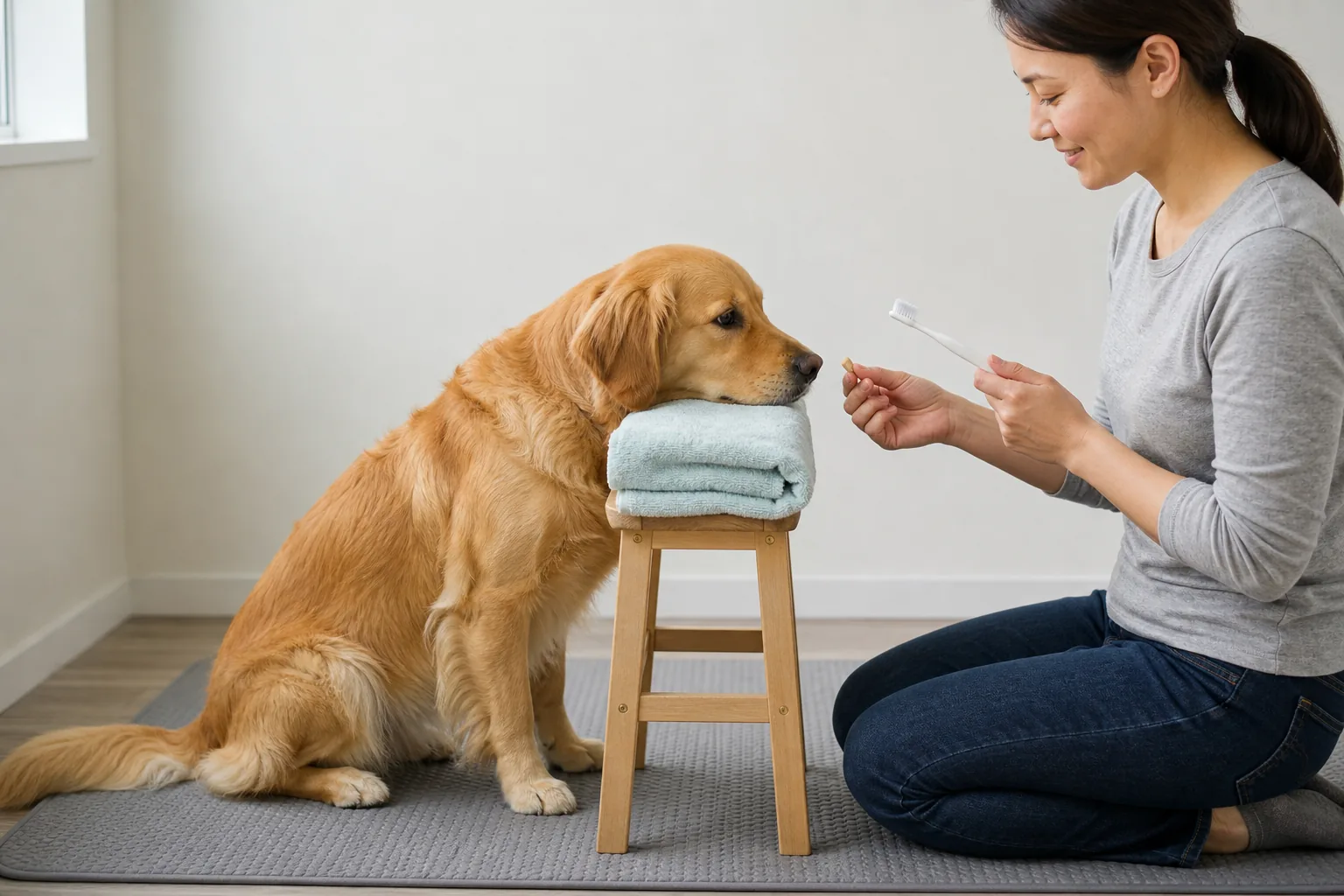

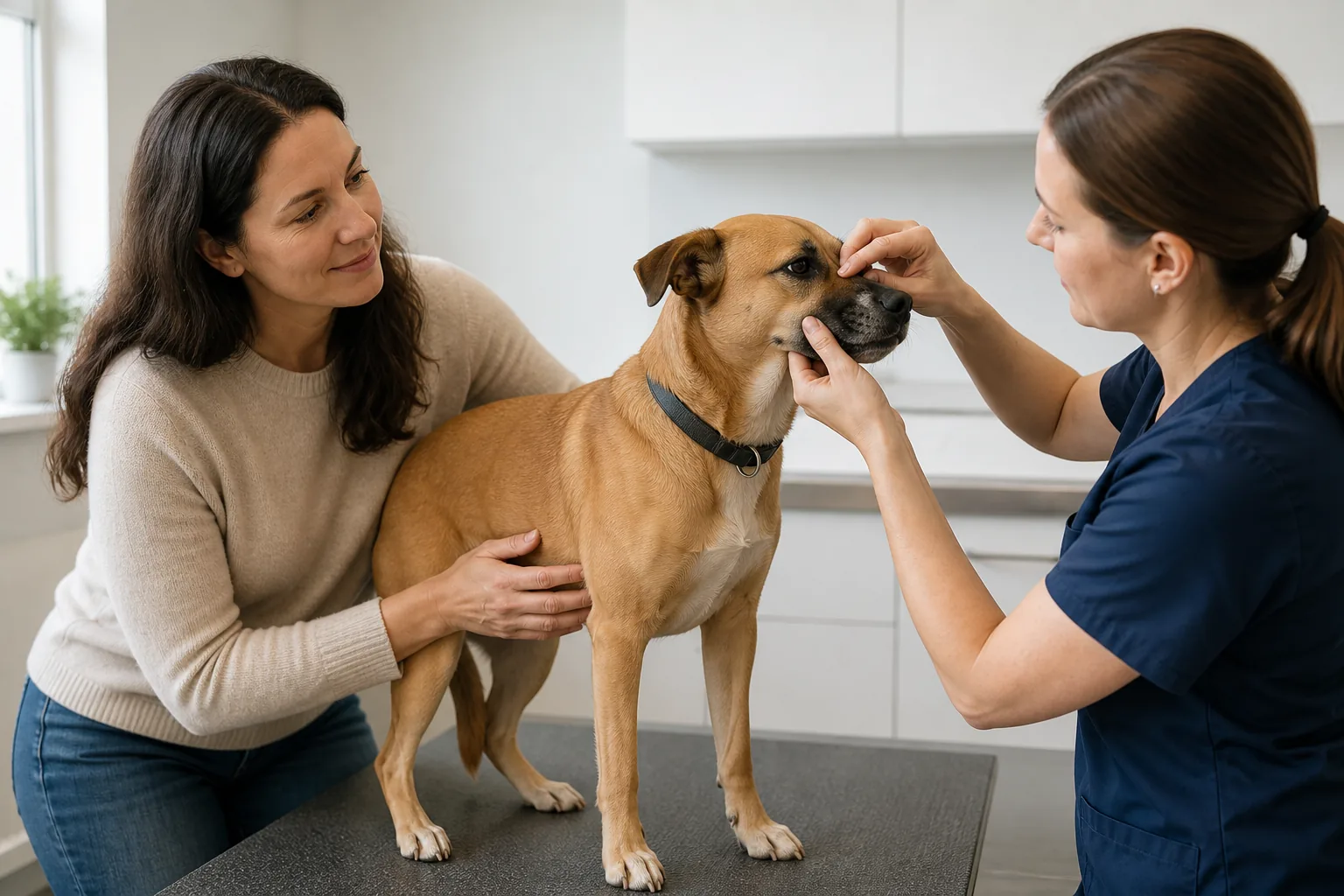
Toothbrushing is most useful when it becomes a brief, predictable daily routine rather than an occasional struggle. A dog who has never experienced it should not begin with a brush pushed around the entire mouth. Start with comfort near the face, then a lip lift, a touch at the gumline, and only later a few gentle brush strokes.
Home brushing removes soft plaque from reachable tooth surfaces. It does not remove hardened calculus, treat periodontal disease, reveal disease below the gumline, or replace veterinary examination and dental treatment. Brushing inflamed gums can hurt and create lasting handling fear. A veterinary oral check should come before starting if the dog has signs of disease, an unknown dental history, or new resistance around the mouth.
The aim is cooperation and effective plaque control, not holding the mouth open until every surface is polished. One comfortable section today is better than a forced full-mouth session that prevents tomorrow’s care.
Arrange a veterinary mouth check first
Ask the veterinarian to examine the mouth during routine care and sooner if there are concerns. Visible tooth crowns are only part of oral health; important disease can sit below the gumline or inside a tooth.
Do not begin brushing over:
- red, swollen, or bleeding gums
- broken, loose, discolored, or missing teeth
- facial swelling
- mouth bleeding
- pus or unusual discharge
- marked bad breath that is new or persistent
- dropping food, chewing on one side, or reluctance to eat hard food
- pawing at the mouth or sudden touch sensitivity
- a visible mass, ulcer, or object
- unexplained weight loss or appetite change
Contact a veterinarian. Dogs can continue eating despite substantial oral pain, so appetite alone does not clear the mouth for brushing.
Sudden facial swelling, uncontrolled bleeding, breathing difficulty, major trauma, inability to close the mouth, or a chemical/electrical burn needs urgent veterinary direction. Do not probe, pull a lodged object, or give human pain medication.
If professional dental treatment is recommended, ask when home brushing may safely resume. Surgical sites and extractions need healing according to discharge instructions.
Understand what brushing can accomplish
Plaque is a soft bacterial film that reforms continually. Mechanical brushing disrupts it. Calculus, sometimes called tartar, is mineralized material firmly attached to teeth; a home brush does not safely scrape it away.
Daily brushing offers the most consistent plaque control because plaque returns between sessions. If daily care is not immediately possible, gradual training still has value. Ask the veterinary team for an achievable plan and evidence-supported alternatives while training progresses.
Even excellent daily brushing does not eliminate the need for professional oral exams, dental radiographs, or treatment when indicated. The surfaces visible to an owner cannot reveal every pocket, root, fracture, or lesion.
Do not use metal scalers or sharp instruments at home. Scraping visible calculus can damage enamel or gums, miss disease below the gumline, introduce injury, and create a false appearance of health.
Choose dog-safe tools
Use toothpaste specifically formulated for dogs and recommended by the veterinary team. Dogs swallow toothpaste rather than rinsing and spitting. Human toothpaste may contain ingredients unsuitable or dangerous for ingestion, including xylitol in some products, and should not be used. Baking soda is also inappropriate.
Select a soft-bristled brush that fits the dog’s mouth and the handler’s hand. Options include:
- a small pet toothbrush
- a long-handled angled pet brush
- an appropriately sized soft human brush when the veterinarian approves
- a finger brush for a dog who can safely tolerate a finger near the teeth
A finger brush is not automatically safest. It places a finger inside the bite area and may be bulky in a small mouth. Dogs with guarding, pain, snapping, or uncertain handling need veterinary and behavior guidance before anyone places fingers near the mouth.
Have tiny diet-compatible rewards, a nonslip mat, good light, and a quiet location. Keep each dog separate where food or close handling could cause conflict.
Replace a frayed or chewed brush and prevent dogs from swallowing pieces. Store every animal’s toothbrush separately, allow it to dry, and do not share it.
Learn the dog’s comfort signals
Train when the dog is relaxed and free to move away. Early stress may appear as head turns, lip licking unrelated to toothpaste, a suddenly closed mouth, leaning away, paw lift, stillness, panting, lowered posture, refusal of food, or harder food-taking. Stronger responses include escape attempts, growling, snapping, or biting.
Pause at the first change. Do not scold a growl or tighten restraint. New resistance in a previously comfortable dog can indicate oral, neck, ear, or other pain and should prompt veterinary review.
A chin rest or position on a mat can serve as a voluntary start signal. When the dog lifts away, hands stop. That pattern gives the dog predictable control and helps the handler notice when a step became too difficult.
Taking flavored toothpaste does not prove that brushing is comfortable. Read the whole body before continuing.
Build the routine in small stages
Stay at each stage until the dog approaches readily and remains loose. That may take one session or many days. Sessions can last ten to thirty seconds at first.
Stage 1: The care station
Place a mat in a calm area. Reward the dog for approaching and standing or sitting. Release and walk away. Do not begin mouth handling every time; the station should not become a trap.
Stage 2: Hands near the face
Move one hand toward the cheek, stop before the dog moves away, mark, reward, and withdraw. Progress to a one-second touch on the side of the muzzle. Avoid looming over the dog or gripping under the jaw.
Stage 3: A brief lip lift
Touch the cheek, lift the lip enough to see one canine or premolar, then release and reward. The mouth stays closed and relaxed. There is usually no need to pry the jaws apart.
Practice both sides separately. If one side causes a different response, stop and consider pain rather than assuming stubbornness.
Stage 4: Introduce toothpaste
Offer a tiny sample of dog toothpaste from a clean utensil or as directed by the veterinarian. Confirm that its ingredients suit the dog’s allergies, medical diet, and health conditions. Do not allow unlimited licking from the tube or contaminate the nozzle.
Stage 5: Introduce the brush
Show the brush, reward, and put it away. Touch the handle to the cheek. Later touch the bristles briefly to one outer tooth without movement. Reward and end.
Stage 6: One or two strokes
Lift the lip and make one gentle stroke along the outer surface near the gumline. Release immediately. Build to two or three strokes in the same area before adding another tooth.
Stage 7: Expand by sections
Work one quadrant at a time: upper left, lower left, upper right, lower right. The large cheek teeth and canine teeth deserve attention, but comfort determines order. Add duration in seconds rather than trying to finish the whole mouth.
Stage 8: Build a sustainable daily routine
Once all sections are comfortable, use a consistent sequence and brief duration. End with the same reward or enjoyable activity. Daily practice should remain gentle; more pressure is not more effective.
If progress stalls, return to the last comfortable step. Do not skip several stages because the dog tolerated them once.
Use an effective brushing technique
Ask the veterinary team to demonstrate on your dog. A common approach is:
- Position beside the dog rather than face-to-face.
- Stabilize lightly at the cheek without squeezing the muzzle.
- Lift the lip while the jaws remain naturally closed.
- Hold the brush at an angle that lets soft bristles contact the outer tooth and gum margin.
- Use small, gentle circular or back-and-forth motions.
- Focus on outer surfaces, where plaque control is most practical.
- Move systematically through comfortable sections.
- Stop for body-language change or pain.
Do not scrub until gums bleed. Do not force the mouth open to reach inner surfaces. The tongue helps reduce buildup on some inner surfaces, and forcing access may create more harm than benefit.
Use only a small amount of pet toothpaste according to label and veterinary guidance. More foam or flavor does not substitute for mechanical contact.
Troubleshoot without adding force
The dog chews the toothbrush
Begin with bristles touching for less than a second, reward stillness, and withdraw before chewing. Use a different brush shape if the veterinarian recommends it. The brush is not a chew toy; replace damaged equipment.
The dog backs away
Check the surface and body position. Work beside the dog with an open exit. Reduce the step from brushing to a cheek touch or brush presentation. If avoidance is sudden or one-sided, arrange an oral examination.
The dog dislikes lip lifting
Start farther away, touching shoulder and cheek. Lift only a few millimeters for a fraction of a second. A chin rest may help. Do not hook fingers deeply into the lips.
The dog accepts front teeth but not back teeth
Do not reach farther immediately. Touch the cheek over the back teeth from outside, then pair a tiny lip lift with a reward. Progress millimeter by millimeter. Painful back teeth are possible, so persistent asymmetry deserves veterinary review.
The dog becomes excited by toothpaste
Use a smaller amount and reinforce a stationary position separately. Allow a sample before brushing, then keep the tube out of reach. Excited grabbing can make fingers and brushes unsafe.
The dog growls or snaps
Stop and create distance. Do not punish the warning, muzzle the dog solely to force brushing, or ask someone to hold the dog down. Contact the veterinarian to assess pain and discuss a safe behavior plan.
Make daily care realistic
Attach brushing to a stable cue such as the last evening walk or a household bedtime routine. Keep supplies together but inaccessible to the dog. Use a simple tracker so caregivers do not duplicate or skip sessions.
A sample week during training might look like:
- day one: three comfortable lip lifts
- day two: toothpaste taste and two lip lifts
- day three: brush shown and touched to cheek
- day four: bristles touch one tooth
- day five: two strokes on one side
- day six: repeat rather than increase difficulty
- day seven: rest or return to the easiest successful step
This is an example, not a deadline. Some dogs progress faster; others need weeks or a veterinary behavior plan. The dog’s response determines pace.
Count toothpaste and food rewards within dietary needs. For a dog with food allergy, pancreatitis history, kidney disease, diabetes, or a prescription diet, ask which product and rewards are appropriate.
Choose other dental products carefully
Dental diets, chews, wipes, gels, rinses, and water additives vary in evidence and suitability. Look for products accepted by the Veterinary Oral Health Council when the veterinarian agrees they fit the dog. Acceptance applies to the product’s demonstrated plaque or tartar claim; it is not proof that the item is safe for every individual.
Choose chews appropriate to size, chewing style, calories, allergies, and dental condition. Supervise and remove pieces that could be swallowed. Very hard items can fracture teeth. A product that causes vomiting, diarrhea, choking, guarding, bleeding, or pain should be stopped and discussed with a veterinarian.
Alternatives can complement or temporarily bridge training, but they do not automatically equal daily mechanical brushing. Ask the veterinarian which surface or problem each product addresses.
Do not confuse cosmetic scaling with complete dentistry
Periodontal disease develops below as well as above the gumline. A comprehensive veterinary dental procedure can include an anesthetized examination, dental radiographs, probing, scaling above and below the gumline, polishing, pain control, and treatment of diseased teeth.
So-called anesthesia-free cleaning generally removes visible material from some surfaces of an awake, restrained animal. It cannot provide the same complete examination and subgingival treatment, may miss painful disease, and can create an appearance of cleanliness without addressing the cause.
Anesthesia has risks, which a veterinary team assesses for the individual through history, examination, testing, monitoring, and a tailored plan. Choosing surface scraping instead does not deliver equivalent care. Discuss concerns directly with the veterinarian rather than delaying necessary treatment.
Never scrape teeth yourself or hire an unqualified person to do it.
Watch for oral disease between visits
During comfortable lip lifts, note changes without probing:
- red or receding gums
- bleeding
- yellow or brown calculus
- broken, loose, or discolored teeth
- swelling or a mass
- material trapped between teeth
- worsening odor
- altered chewing or food preference
- drooling or pawing
Take a clear external photograph if it can be done without forcing the mouth, and contact the clinic. Do not wait for the dog to stop eating.
Puppies also need oral checks. Retained baby teeth, trauma, abnormal bite, or inappropriate chewing can require veterinary assessment. Do not dismiss every mouth problem as teething.
Protect people and the dog
Mouth handling carries bite risk. Children should not brush a dog’s teeth unsupervised or place fingers in the mouth. An adult must manage both dog and supplies, and a dog with any guarding or bite history needs a professional plan.
Do not corner the dog, straddle them, clamp the muzzle, or use punishment. A basket muzzle that has been positively conditioned may serve a veterinarian-directed safety purpose in some contexts, but it should not be used to force daily brushing through fear or pain.
Wash hands and rinse the brush after use. Do not use the dog’s brush on another animal or person. Store toothpaste away from children and pets, and follow the label if accidental ingestion of a large amount occurs. Suspected xylitol exposure is an urgent poison-control/veterinary matter; do not wait for symptoms.
Know when to ask for more help
Contact the veterinary team when:
- the mouth has not been examined recently
- the dog has any disease sign or apparent pain
- brushing causes bleeding
- resistance is new or localized
- calculus is already established
- the dog cannot tolerate early training steps
- you need product or technique guidance
- professional dental treatment or a recheck is due
For fear without untreated pain, ask for a reward-based cooperative-care plan. A qualified trainer or behavior professional can coordinate with the veterinarian. Avoid anyone who recommends flooding, dominance, forced restraint, or punishing warnings.
The best routine is gentle, frequent, and medically informed
Begin with an oral assessment, dog-safe toothpaste, a soft appropriately sized brush, and a dog who can opt out. Build from seconds of cheek and lip handling to a few strokes, then gradually cover the outer tooth surfaces near the gumline. Stop at discomfort and investigate change.
Daily brushing is preventive home care, not a cure for existing dental disease. Pair it with regular veterinary examinations and recommended treatment. When the dog trusts the sequence and the handler respects early signals, a once-daunting task can become a short part of ordinary care.