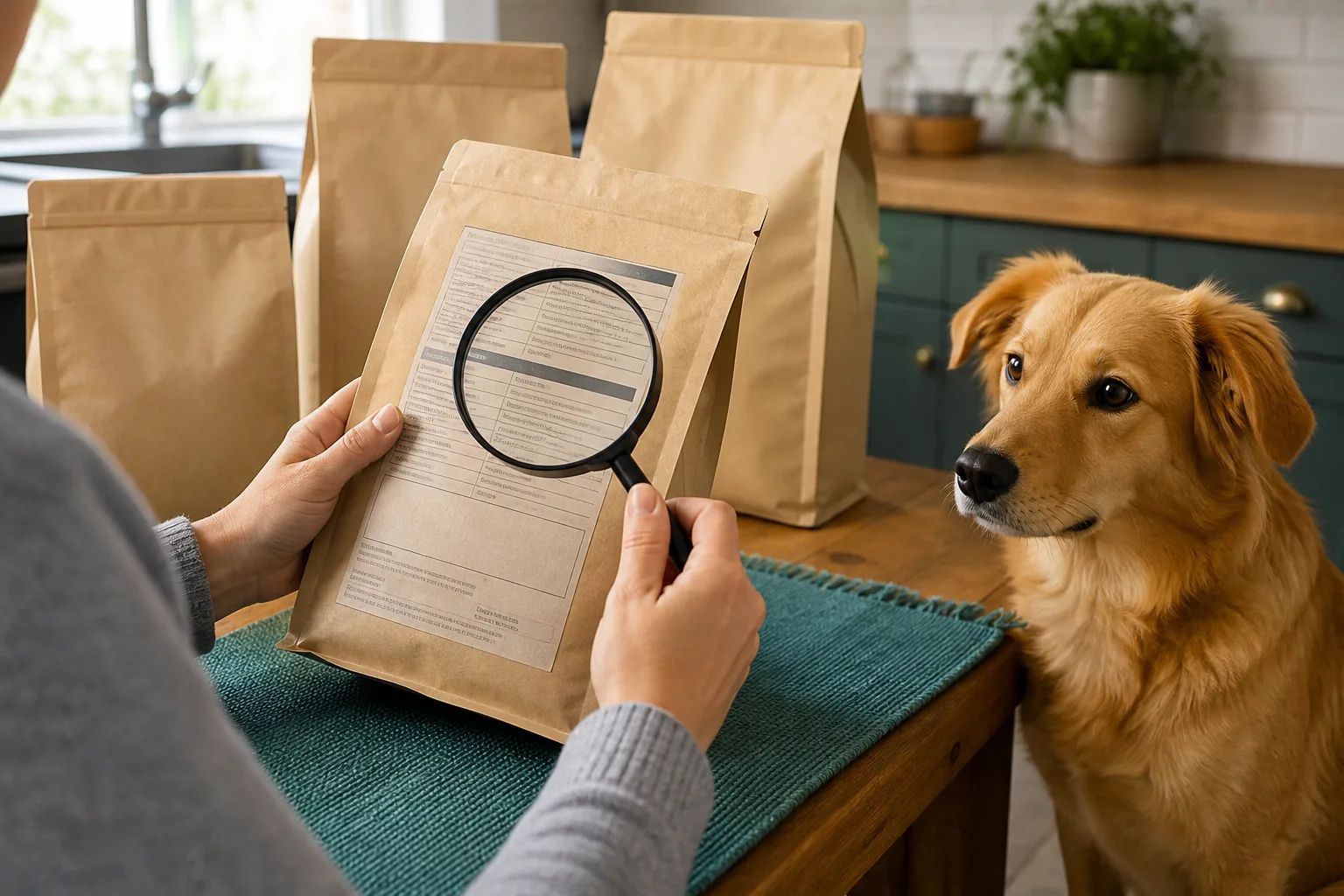


The front of a dog-food package is built to catch attention. It may show roasted meat, vegetables, a wolf, a farm, or words such as “premium,” “holistic,” “ancestral,” “clean,” and “human grade.” Some descriptions have regulated meanings in a particular market; others contribute little to a nutritional decision. None of them, by itself, tells you whether the diet is complete for your dog’s life stage, who formulated it, how the finished product is tested, or whether the company can answer technical questions.
A better selection process begins on the less glamorous parts of the label and continues with the manufacturer. It also begins with the dog. A healthy adult with no dietary problem, a rapidly growing puppy, a pregnant dog, and a dog with kidney disease do not share one definition of “best.” The goal is not to crown a universal winner. It is to identify a diet that is nutritionally appropriate, made with credible controls, practical to feed consistently, and suitable for the individual animal.
This guide is for comparing commercial foods for dogs. It does not design a home-prepared diet or replace a therapeutic recommendation. If your dog has a disease, persistent digestive signs, suspected food allergy, poor growth, unexplained weight change, or a previous diet-related problem, involve a veterinarian before changing foods.
The five-question screen
Before studying a long ingredient list, answer five questions:
- Is the food complete and balanced for the dog’s relevant life stage?
- Who formulated the product, and what are that person’s qualifications and role?
- How does the company verify ingredients, nutrient content, food safety, and consistency?
- Can the company provide useful calorie and nutrient information and answer questions directly?
- Does the food work for this dog when fed and monitored appropriately?
If a product fails the first question, it is not a suitable sole diet for the stated use. If the company cannot answer the next three, attractive ingredients do not repair the information gap. The fifth question matters because even a well-formulated food must be palatable, tolerated, affordable, available, and usable within the household’s feeding plan.
Start with the nutritional adequacy statement
In the United States, look for a statement that identifies the product as complete and balanced for a particular life stage. The FDA explains that this claim is generally supported by one of two routes: the food is formulated to meet an AAFCO Dog Food Nutrient Profile, or animal feeding tests using AAFCO procedures substantiate nutritional adequacy. Read the full statement rather than stopping at the phrase “complete and balanced.”
The stated life stage may be:
- adult maintenance
- growth, including a statement about growth of large-size dogs when applicable
- gestation and lactation
- all life stages
- intermittent or supplemental feeding only
These phrases are not interchangeable. Adult maintenance does not claim to meet the needs of growth or reproduction. A product labeled for intermittent or supplemental use is not intended to replace a complete daily diet unless it is being used under professional direction. Treats, toppers, and supplements often fall into this category.
“All life stages” may sound automatically superior, but broader is not always better. It indicates that the food is intended to meet nutrient levels for the most demanding included life stages. A healthy adult may do well on such a food, but the label does not prove that its calorie density, feeding amount, or nutrient profile is the best match for every adult. Choose for the actual dog rather than treating the broadest claim as a quality ranking.
For a puppy expected to reach a large adult size, check the exact growth statement and ask the veterinarian to confirm suitability. Growth rate and mineral balance matter; adding calcium or other supplements to an already complete growth diet can disrupt the intended balance.
Understand what the adequacy route does—and does not—tell you
A formulation statement and a feeding-test statement are both recognized ways to substantiate nutritional adequacy. They answer a defined question, not every question about long-term performance or manufacturing quality.
A food formulated to meet a nutrient profile may be designed with nutrient data and analysis. A feeding trial tests the diet through an AAFCO protocol for a specified life stage and period. Neither wording means the product is perfect for every dog. Neither substitutes for knowing who formulated it, how ingredients and finished batches are checked, or how the company handles deviations and complaints.
Do not turn label wording into an unsupported hierarchy. Instead, record the route and use it as one part of the evidence. If the dog has a complex nutritional need, ask the veterinary team whether more specific data are needed.
Ask who formulated the food
The WSAVA Global Nutrition Committee recommends asking whether the company employs an appropriately qualified nutritionist, such as someone with a doctorate in animal nutrition or board certification in veterinary nutrition. The useful details are the person’s name, qualifications, and employment status.
Why does employment status matter? A full-time expert may have ongoing influence over formulation, ingredient changes, manufacturing, quality review, and product follow-up. A consultant may be highly qualified but involved within a narrower scope. The question is not designed to disqualify every company using consultants; it clarifies who is responsible and how deeply that expertise is integrated.
Avoid accepting vague responses such as “formulated by veterinarians” without names, relevant qualifications, or an explanation of the formulation process. Veterinarians receive nutrition education, but a general veterinary degree is not the same as specialist training in formulating complete commercial diets. Conversely, a qualified animal nutritionist may not be a veterinarian. Ask about the expertise relevant to the job rather than relying on a broad professional label.
Investigate quality control beyond the recipe
A good formula on paper can still be undermined by inconsistent ingredients, contamination, processing problems, or a finished product that does not match its specification. WSAVA’s selection guide suggests asking about quality-control procedures for ingredients and finished products. Useful areas include:
- supplier and ingredient verification
- nutrient analysis of the finished food
- testing for relevant contaminants or microbes
- packaging and shelf-life evaluation
- procedures for identifying and isolating affected lots
- where the food is manufactured and who owns or operates the facility
- how recipe or supplier changes are reviewed
“Made in our own facility” is not proof of quality by itself, and using a contract manufacturer is not proof of poor quality. The important questions are who controls the process, what specifications apply, how compliance is tested, and whether the company can trace a problem to a lot.
Ask what the company means by “tested.” Testing a nutrient database during formulation is different from chemically analyzing finished batches. Testing one pilot batch is different from routine verification. A responsible answer should be specific enough to show that the company understands the question, even if it does not release proprietary details.
Look for accessible technical support
The label should identify the manufacturer or distributor and provide contact information. Use it. A company should be able to answer reasonable questions about the product, including:
- who formulates it
- the adequacy statement and intended life stage
- typical or average nutrient analysis when a guaranteed minimum/maximum is not enough
- calorie content
- where it is made
- quality-control approach
- whether a recipe change has occurred
- how to report an adverse event or quality concern
Save the response with the product name and date. A polished customer-service answer is not independent proof, but willingness and ability to provide meaningful information is more useful than marketing copy alone. If a company cannot or will not answer basic formulation and quality questions, WSAVA advises caution.
Read the ingredient list in the right context
Ingredients are required to be listed by weight before processing. That creates several limits.
First, fresh meat contains substantial water. It may appear high on the list partly because of moisture, while a dry rendered ingredient contains less water and may contribute concentrated nutrients despite appearing later. Second, ingredients can be divided into related components, which changes their individual positions. Third, the list gives ingredient names, not the digestibility, bioavailability, batch consistency, contamination controls, or nutrient balance of the finished food.
This does not make ingredients irrelevant. They matter for a confirmed dietary intolerance, a veterinary elimination trial, personal feeding constraints, and specific nutrient or formulation questions. The mistake is using the first five ingredients as a complete quality score.
Be cautious with rules such as “the first ingredient must be meat” or “never feed a by-product.” These slogans ignore formulation and nutrient contribution. A named ingredient can be used well or poorly. What matters is whether the total diet reliably provides required nutrients in appropriate amounts for the intended dog.
Treat front-label terms as prompts, not conclusions
Words such as “premium” or “holistic” may have little practical value for nutritional assessment. “Natural,” “organic,” “human grade,” and ingredient claims can have definitions or regulatory conditions depending on the jurisdiction, but none replaces the adequacy statement and manufacturer assessment.
When a package makes a compelling claim, translate it into a question:
- “High protein” — How much protein is present on an appropriate comparison basis, and is more useful for this dog?
- “Grain-free” — What nutritional or medical need is this intended to address? What replaces the grain ingredients?
- “Limited ingredient” — Is the formula appropriate for a controlled veterinary elimination trial, or is it simply a shorter retail recipe?
- “Sensitive stomach” — What evidence supports the intended benefit, and have medical causes of persistent signs been evaluated?
- “Weight control” — How many calories per cup or can, and can the feeding plan provide adequate nutrients at the target intake?
- “Breed-specific” — Which nutrient or physical characteristics differ, and is evidence available?
The aim is not to assume every claim is deceptive. It is to require the claim to connect to a relevant need and measurable information.
Compare calories and feeding practicality
Calorie density affects how much food the dog receives. A very energy-dense food may require a surprisingly small portion for a small or inactive dog. That can make measurement errors more important and may leave some dogs with a small food volume. A less calorie-dense product may provide more volume, but “lower calorie” is not automatically appropriate for a dog who needs high energy intake.
Find kcal per cup, can, tray, or gram. Check whether the feeding chart describes a total daily amount. Consider whether the household can measure it consistently, afford the required quantity, store it safely, and obtain it without frequent unplanned substitutions.
Convenience is a legitimate criterion. A nutritionally suitable food that is constantly unavailable or too expensive to feed as directed may produce a less stable diet than a suitable, well-supported alternative the household can maintain.
Do not compare wet and dry guaranteed analyses directly
The guaranteed analysis usually lists minimum crude protein and fat and maximum fiber and moisture on an as-fed basis. A wet food contains much more water than dry food, so the printed percentages are not directly comparable.
The FDA describes converting nutrients to a dry-matter basis when comparing foods with very different moisture. Subtract moisture percentage from 100 to estimate dry matter. Divide the as-fed nutrient percentage by the dry-matter percentage and multiply by 100. For example, a wet food with 10 percent protein and 75 percent moisture has 25 percent dry matter; 10 divided by 25, multiplied by 100, is 40 percent protein on a dry-matter basis.
Even that calculation has limits. Guaranteed values are minimums or maximums, not a complete typical analysis, and protein percentage does not describe amino-acid balance or digestibility. Use dry matter to avoid an obvious moisture comparison error—not to manufacture a universal ranking from one nutrient.
Recognize when retail comparison is the wrong tool
Do not self-select a diet to treat disease from packaging alone. A urinary claim, kidney support claim, allergy claim, low-fat claim, or diabetes claim may require diagnosis, specific nutrient targets, clinical monitoring, or a veterinary therapeutic product.
Persistent itching is not proof of food allergy. Recurrent vomiting is not simply a “sensitive stomach.” Excessive thirst, weight loss despite appetite, greasy or bulky stool, difficulty chewing, and muscle loss can reflect conditions a new retail food will not diagnose. The veterinarian may recommend examination, testing, a controlled diet trial, or a therapeutic diet with precise instructions.
Home-prepared diets also require a different process. Combining meat, rice, vegetables, and a multivitamin does not reliably create a complete diet. If home preparation is necessary or strongly preferred, ask for a recipe formulated for the individual by a qualified veterinary nutrition professional and follow it exactly, including specified supplements and cooking methods.
Use your dog’s response as monitored evidence
After choosing an appropriate product and transitioning as advised, evaluate the dog over time. Record:
- measured daily amount and treat intake
- body weight and body condition
- muscle condition
- appetite and ability to eat
- stool frequency and consistency
- vomiting or regurgitation
- skin and coat changes
- energy and activity
- any medication or supplement changes
One soft stool or one skipped meal does not necessarily establish intolerance. A repeated pattern matters. Do not keep a dog on a food simply because the label looked ideal if the dog is losing weight, vomiting, developing persistent diarrhea, refusing it, or showing another concerning change. Contact the veterinary team and bring the diet history.
Palatability matters, but intense enthusiasm is not proof of superior nutrition. Likewise, a dog eating slowly is not automatically rejecting the food. Judge intake with condition and health rather than a single behavior.
Keep the package and lot information
The FDA recommends storing dry food in its original bag, even when the bag is placed inside another container. This preserves the product name, manufacturer, UPC, lot number, and best-by date if a complaint or recall occurs. If food must be poured into a container, save that information and clean and dry the container between bags.
Do not top up old food with a new bag indefinitely. Residual fats and crumbs can remain, and the mixed lots make tracing a problem harder. Keep canned or pouched leftovers refrigerated as directed and discard them when storage guidance says to do so. Wash bowls and measuring tools regularly.
If food has a foul odor, swollen or leaking packaging, a foreign object, or another defect—or if the dog becomes ill after eating it—stop using the product and contact a veterinarian. Preserve the packaging and report the concern to the manufacturer and, where applicable, the regulator.
A comparison worksheet for two or three foods
Create columns for each candidate and fill these rows:
- full product and recipe name
- intended species and life stage
- complete-and-balanced wording
- adequacy route
- large-size growth wording, if relevant
- kcal per cup, can, or gram
- named formulator, qualifications, and role
- manufacturer and manufacturing location
- quality-control information provided
- typical nutrient analysis available
- company contact route and response quality
- package size, cost per day, and availability
- storage needs
- reason this formula matches the dog
- questions for the veterinarian
Do not award points merely for longer answers. Flag missing information and decide which gaps matter for the dog. A healthy adult choosing among established complete diets may require less investigation than a growing puppy or a dog with previous nutrition-related disease.
The decision to take away
Choose dog food from the inside out. Start with nutritional adequacy and life stage. Ask who formulated the diet and how the company checks ingredients and finished products. Use calorie and typical nutrient information, not a photograph of meat, to understand what will be fed. Treat ingredient lists and promotional terms as clues that may generate questions, not as stand-alone proof.
Then evaluate the fit: can the household obtain, measure, store, and afford the food consistently, and does the dog maintain appropriate condition and health while eating it? When disease or persistent symptoms enter the picture, stop shopping by slogan and move the decision into the veterinary relationship.
The best defensible choice is rarely the package with the most dramatic story. It is the product whose purpose, formulation, controls, information, and real-world use can all be explained.