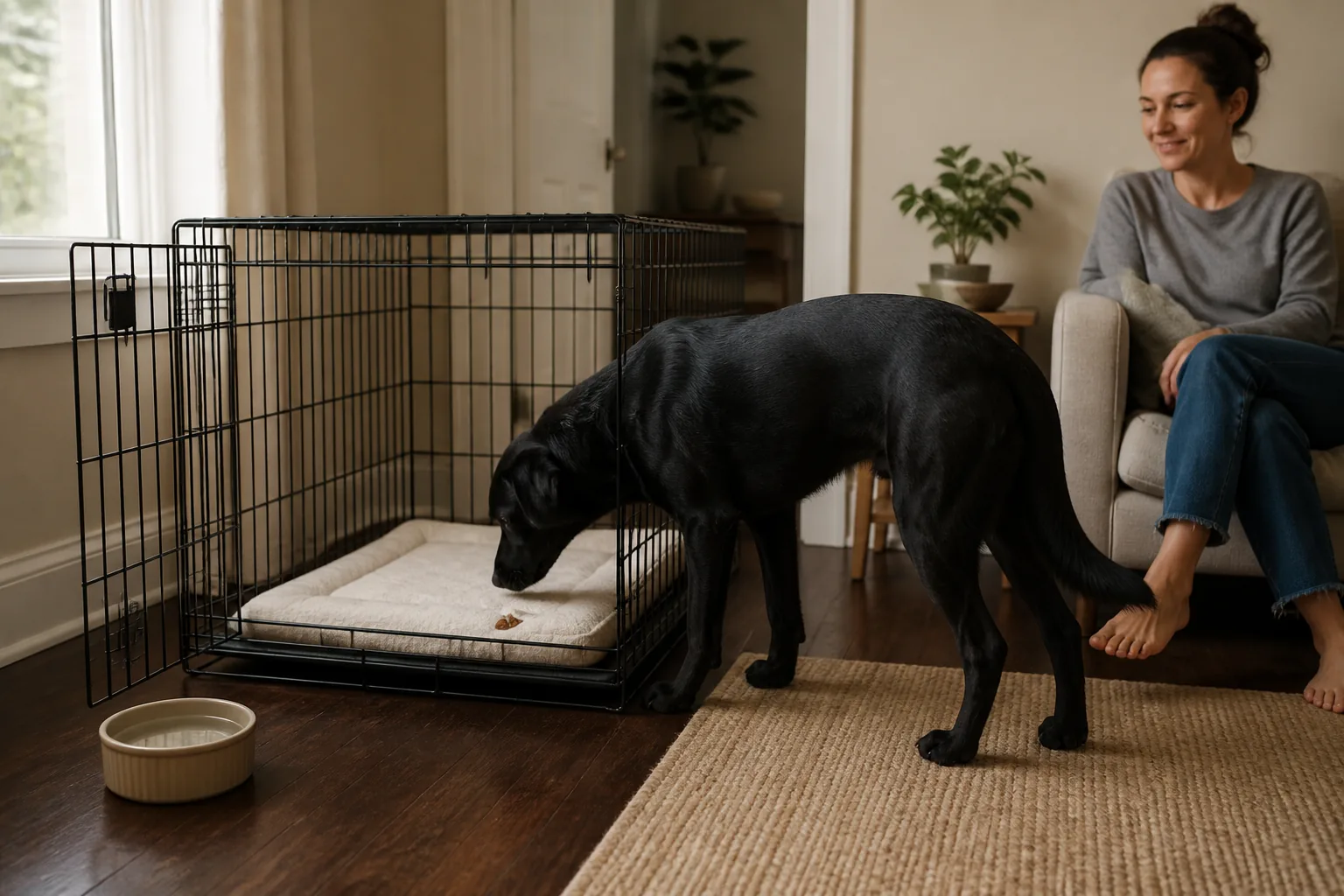
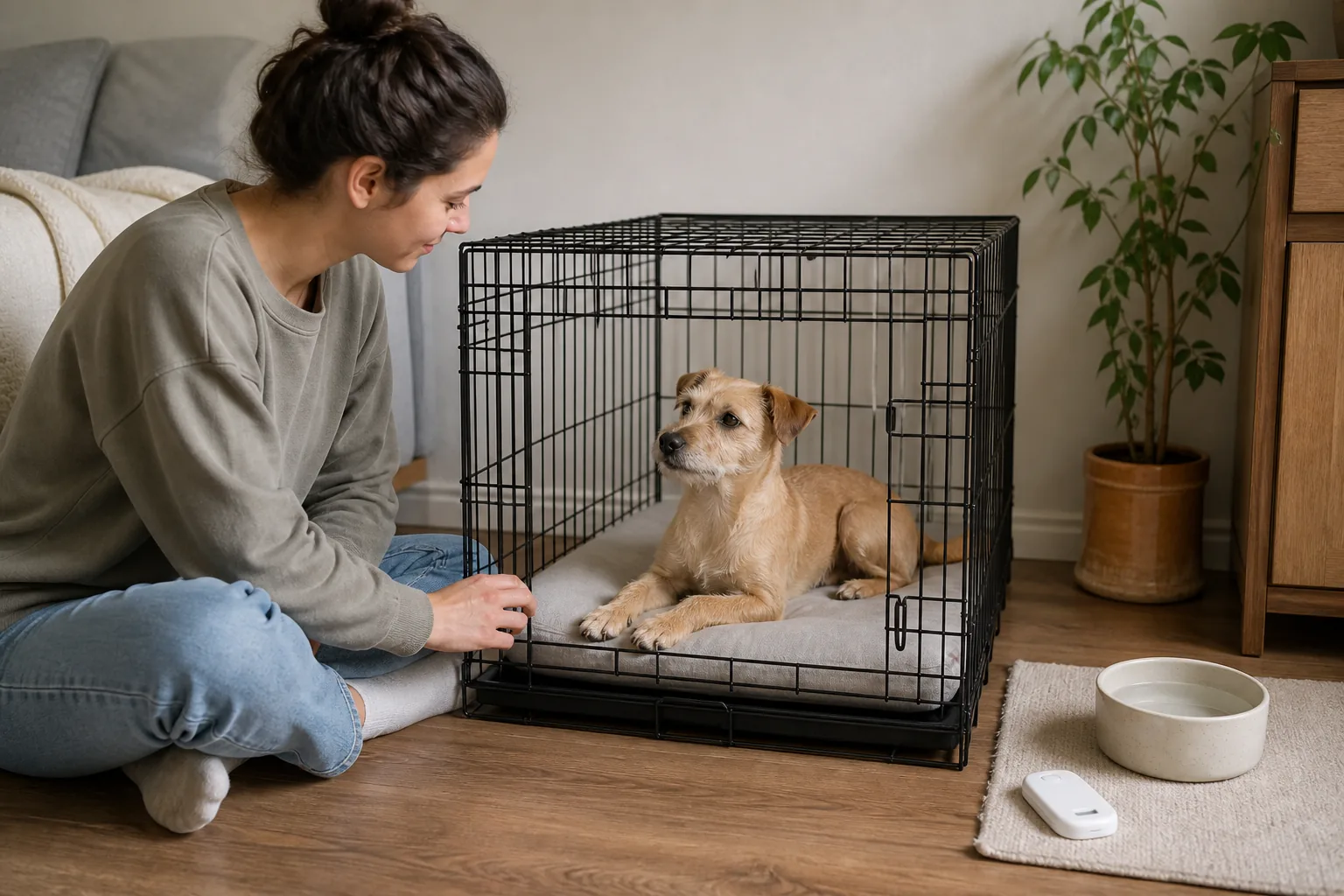
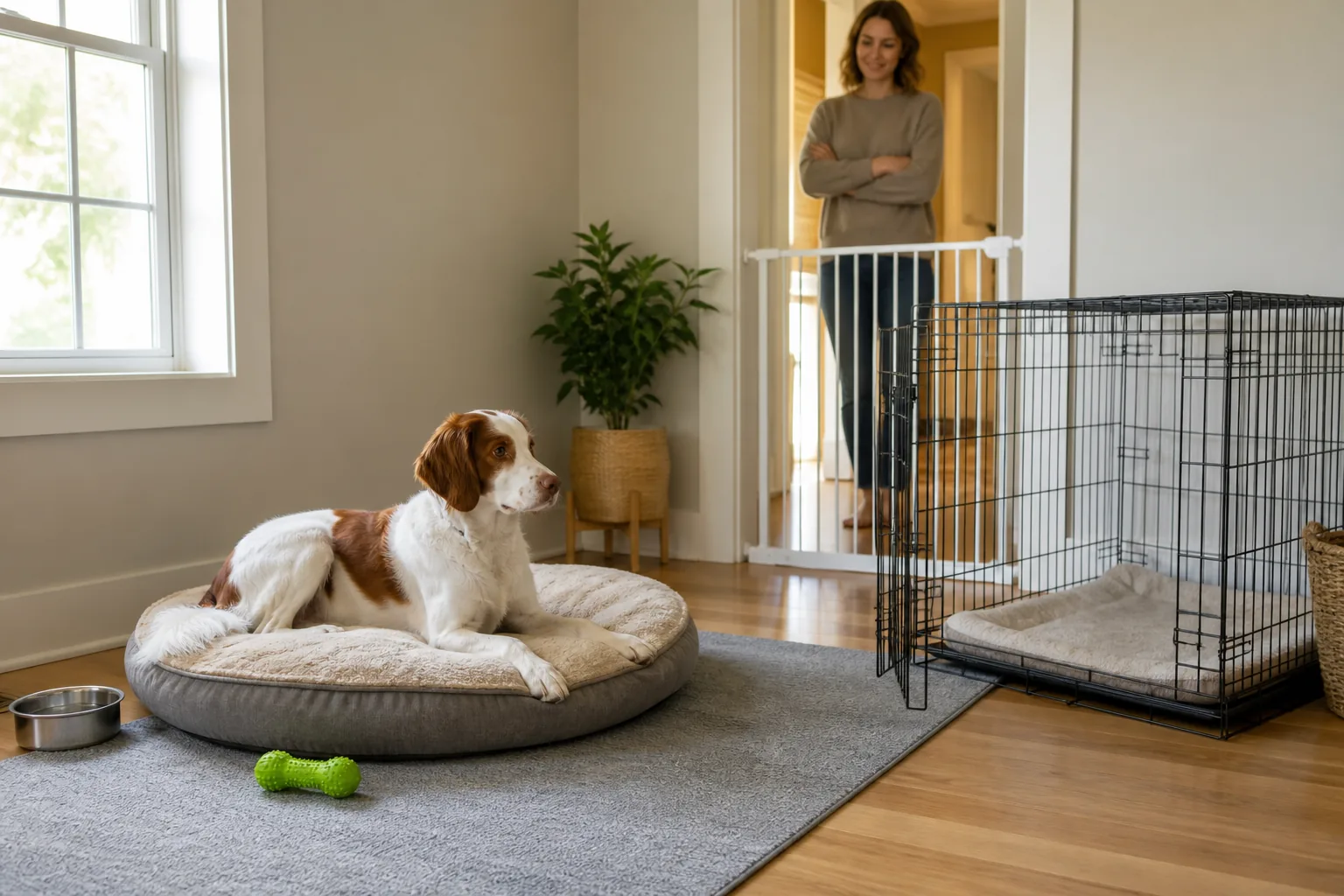
A crate can become a comfortable resting and travel space for some dogs. It can also become a source of panic when the door closes too soon, the dog is left longer than trained, or confinement is used to suppress behavior whose cause has never been addressed. The difference is not the crate’s marketing label. It is the dog’s learned emotional response and the way the space is used.
Good crate training begins with an open door and voluntary choice. Food, rest, and short calm sessions build value inside. Door movement, duration, handler distance, and real absence are introduced as separate difficulty levels. At every stage, relaxed behavior allows progression; reluctance or distress means the plan must become easier or change.
A crate is optional. A gated room, exercise pen, or dog-proofed area may be safer and more comfortable for an individual. The objective is not to prove every dog can tolerate a closed crate. It is to create appropriate confinement only when the dog can remain physically and emotionally safe.
Decide what problem you are trying to solve
Crate training may support:
- a portable familiar resting area
- short periods of safe management after proper training
- transport in a correctly secured travel crate
- veterinary-prescribed movement restriction after surgery
- preventing unsupervised access while a puppy’s household skills develop
- a quiet retreat the dog can choose during family activity
It is not a complete solution for:
- separation anxiety or panic when alone
- inadequate exercise, toileting, sleep, or social needs
- destructive behavior caused by fear, pain, boredom, or medical change
- guarding, aggression, or conflict between animals
- an adult workday of routine confinement
- punishment after a household mistake
Define a realistic use. “Dog walks into the open crate to rest” is different from “dog remains relaxed for 20 minutes while I shower” and very different from “dog is alone for two hours.” Train the requirement you actually need without skipping intermediate steps.
Screen for reasons not to close the door
Do not begin confinement if the dog has injured teeth, nails, nose, or body trying to escape; bends bars; screams; salivates heavily; pants intensely without heat; eliminates from distress; refuses normally valued food; or becomes frantic when a door moves. These signs require a veterinarian and qualified reward-based behavior professional. A stronger crate can intensify injury rather than treat the cause.
Crate avoidance may also reflect pain, overheating, respiratory difficulty, urinary or gastrointestinal urgency, a frightening previous experience, unstable flooring, noise, or an uncomfortable surface. Sudden change deserves veterinary assessment.
Dogs with separation anxiety may become more distressed in a crate. The ASPCA advises monitoring behavior and using another area, such as a room behind a gate, when crate confinement produces heavy panting, excessive drooling, persistent vocalization, or frantic escape attempts. Crate comfort while people are present does not prove comfort during absence.
Choose an appropriate crate
The dog should be able to stand naturally, turn around, lie on the side, and stretch without being compressed. For travel or medically restricted movement, exact size and construction may have different safety requirements; follow the carrier manufacturer, veterinarian, and transport rules.
Select sturdy construction suited to the dog’s chewing style and supervise initial use. Wire, rigid plastic, fabric, and furniture-style crates have different ventilation, visibility, portability, and damage risks. A fabric crate is not suitable for a dog who scratches, chews, or could collapse it.
Check for sharp edges, pinch points, loose clips, wire gaps, damaged welds, and removable pieces. Remove collars, tags, harnesses, or equipment that could snag when the dog is unsupervised, unless a veterinarian or transport protocol specifically requires otherwise. Discuss this with the relevant professional because identification and travel restraint needs can differ.
Place it in a livable location
Begin in an area where the household spends calm time. The dog can observe without being in a walkway. Avoid direct sun, heaters, drafts, speakers, slamming doors, and places where children or other animals can crowd the crate.
Use stable nonslip flooring. Add bedding only if the dog does not shred or swallow it and the material suits temperature and medical needs. Some dogs prefer a flat mat or bare tray. Comfort is individual, not decorative.
Covering one or more sides can reduce visual stimulation for some dogs, but it can reduce ventilation or make others feel trapped. Trial a partial breathable cover while supervised and watch the dog.
Water access depends on duration, age, environment, medical needs, and spill risk. A secure clip-on bowl may help. Never limit necessary water solely to reduce accidents.
Make the door unable to surprise the dog
Secure the door fully open so it cannot swing, rattle, or close behind the dog. Let the dog inspect from any distance. Do not push, carry, drag by leash, or block the exit.
Mark and reward small voluntary choices:
- looking toward the crate
- stepping closer
- sniffing the threshold
- placing one paw inside
- placing two paws inside
- entering fully
- turning around
- remaining briefly
Deliver rewards where you want value to grow—often inside—then toss a reset reward outside so the dog can choose to return. Three voluntary approaches are more useful than one forced stay.
If the dog will not approach, move food farther away and reward calm behavior at that distance. Check placement and history. Progress may take minutes, days, or longer.
Add a cue after entry is predictable
When the dog is already entering readily, say a cue such as “crate” just before the familiar movement begins. Mark once the dog is inside and reward there. Use a release cue to invite exit.
Do not repeat the cue while the dog hesitates. That teaches that the word can be ignored and may add pressure. Make the next setup easier.
Keep the door open. A cue should first mean “go to a rewarding place,” not “the exit disappears.”
Build time with the door still open
Feed several tiny rewards one after another while the dog stands or lies inside, then release. Place a safe chew or part of a meal inside while the dog can leave. Sit nearby and read or work quietly.
Capture voluntary rest. If the dog enters and lies down, place a reward calmly between the paws without calling the dog out. Avoid exciting praise that ends the relaxation.
Measure seconds, not ambition. Ten relaxed seconds builds a better foundation than five tense minutes.
Introduce door movement in tiny pieces
Door movement is its own stimulus. With the dog voluntarily inside and relaxed:
- touch the door, mark, reward, release
- move it one inch, mark, reward, reopen
- move it halfway, mark, reward, reopen
- swing it closed without latching, reward, reopen immediately
- touch the latch, reward, reopen
- latch for one second, reward, reopen
Change only one feature at a time. The handler remains beside the crate, duration stays very short, and valuable reinforcement continues.
Open before concern develops. Do not wait for vocalization so you can teach that crying “doesn’t work.” The more useful lesson is that calm confinement never becomes frightening.
If a single whine occurs without other stress, calmly reduce the next repetition. If vocalization persists or is accompanied by panting, drooling, scratching, cowering, freezing, aggression, or frantic movement, end safely and reassess. Waiting for silence during panic does not treat panic.
Add duration, distance, and absence separately
These are three different challenges.
Duration with handler beside crate
Increase from one second to three, five, eight, and other small intervals only while the dog remains relaxed. Vary easier repetitions between harder ones. Reward and release.
Handler movement in view
With duration reduced, shift weight, stand, take one step, sit down, or move around the room. Return and reward before the dog becomes concerned.
Brief out-of-sight movement
With the dog comfortable during visible movement, step behind a doorway for one second and return. Build by seconds, not large jumps. Use a camera when the dog cannot be seen.
Real departure
Leaving the home adds keys, shoes, doors, vehicle noise, and actual isolation. Begin only after the earlier pieces are easy. Simulate one departure cue at a time, then make an absence of seconds. Return calmly before distress.
Success at ten minutes with someone visible does not justify a one-hour absence. Context changed.
Use meals carefully
Meals can create positive value inside. Start with the bowl near the entrance if the dog hesitates and move it deeper across sessions. Keep the door open until full voluntary entry is easy.
When beginning door closure, close for a second during eating and reopen before the meal ends. The dog should not discover after finishing that escape is suddenly unavailable.
Food toys can support calm occupation, but they are not a diagnostic test. A distressed dog may refuse food or abandon it when the person leaves. Another dog may consume it despite elevated stress. Watch body language and video.
Count food within the daily ration. Choose a durable feeder appropriate to chewing style and supervise until proven safe. Avoid xylitol-containing spreads, excessive fat, and ingredients incompatible with the dog’s diet.
Puppies need different expectations
Young puppies have limited bladder and bowel control, need frequent meals and social contact, and tire quickly. A crate cannot extend biology. Arrange toileting after waking, eating, drinking, play, and at age-appropriate intervals guided by the puppy and veterinarian.
Nighttime proximity can reduce fear and help caregivers notice stirring. Place the crate near the bed initially if that suits the puppy, then change location gradually. A puppy vocalizing at night may need to toilet, may be frightened, or may be uncomfortable. Quietly assess rather than applying a blanket “ignore it” rule.
Reward outdoor elimination immediately. Do not punish crate accidents. Clean appropriately and review timing, illness, crate size, and schedule.
Puppies also need supervised exploration, play, training, sleep, and safe social experiences. Long confinement is not a shortcut to household manners.
Adult and newly adopted dogs may need a fresh introduction
An adult who was previously crated may not have a positive history. Begin with the door secured open and observe rather than assuming. A newly adopted dog is already adapting to unfamiliar people, sounds, food, and routine; keep criteria small.
Some dogs choose a crate immediately. Still condition door movement and absence rather than closing it for a full errand on day one. Voluntary sleep inside is evidence of location comfort, not proof of confinement tolerance.
For a dog with unknown history, a gated safe room can provide management while crate training proceeds separately.
Crates and housetraining
Crates can prevent unsupervised wandering for short appropriate periods, but housetraining depends on frequent outdoor opportunities, immediate reinforcement, supervision, and a schedule. The dog does not learn the outdoor location simply by being prevented from eliminating indoors.
Never leave a dog confined until elimination is unavoidable. Repeated crate soiling may signal intervals that are too long, diarrhea, urinary disease, parasites, anxiety, an unsuitable setup, or a prior history of being forced to soil a confined space. Contact a veterinarian for sudden or persistent change.
Crates and separation distress
Confinement distress and separation distress can overlap but are not identical. Compare on camera:
- dog loose with person home
- dog crated with person home
- dog behind a gate with person home
- dog loose or gated during a seconds-long absence
- dog crated during a seconds-long absence, only if earlier steps are calm
Do not run unsafe tests. The pattern helps a professional understand whether the door, distance, or actual separation predicts distress.
Separation anxiety treatment usually requires absences short enough to avoid panic, management that prevents full distress between sessions, and sometimes medication prescribed by a veterinarian. A crate alone cannot accomplish this and may add danger for an escape-focused dog.
Resting space rules for the household
When the dog is inside voluntarily:
- children do not crawl in, reach through bars, or close the door
- other pets do not block the entrance or steal items
- adults do not drag the dog out
- no one uses the crate after scolding
- visitors leave the resting dog alone
The crate should provide genuine retreat. If the dog must be moved, call out with a trained cue and reward, or create space and wait. In an emergency, safety takes priority, but routine force damages the refuge.
Keep equipment and food safe
Inspect before every confinement. Remove broken feeders, torn bedding, protruding wire, loose hardware, and chewed plastic. Ensure ventilation and safe temperature. Do not place the crate where cords, curtains, blinds, medication, or objects can be pulled through the bars.
Avoid unsupervised bones, rawhide, toys, or chews that can obstruct, splinter, or trap the jaw. A product safe during observed chewing may not be safe alone.
Clean food, water, bedding, and surfaces. Dry thoroughly. Use products safe for the material and dog, and prevent access until cleaning residue is removed.
Travel requires separate preparation
A household wire crate that feels comfortable may not meet vehicle or airline requirements. Select and secure transport equipment according to manufacturer instructions, carrier rules, and applicable safety guidance.
Train entry and short stationary sessions before adding vehicle movement. Then practice sitting in the parked vehicle, engine sound, very short drives, and longer trips. Heat can become fatal rapidly in vehicles; never leave a dog unattended in unsafe conditions.
Travel nausea, intense panting, drooling, vomiting, or fear needs veterinary advice. Do not sedate without a veterinarian’s direction.
Post-surgical confinement is medical management
If a veterinarian prescribes restricted movement, ask for exact space, duration, toileting, medication, enrichment, handling, and signs of complications. A dog with no crate history may need an alternative pen or small room if medically acceptable.
Pain and medication effects change behavior. Contact the clinic if the dog cannot settle, attempts escape, refuses food, vomits, injures the surgical site, or seems unusually sedated or distressed. Do not remove a medical restriction without approval, but do request a safer plan.
Troubleshoot the training
Dog grabs food and backs out
Reward closer to the entrance and allow retreat. Build duration through several quick pieces inside. Do not close the door.
Dog enters only when food is visible
Say the learned cue before entry, mark inside, then produce food from a pocket. Alternate with voluntary resting and life rewards. Fade the visible lure, not the reinforcement.
Dog is calm until the latch clicks
Condition the sound separately: touch latch outside the crate, mark, reward; make a quiet click with the door open; then combine with tiny movement.
Dog settles only when someone sits beside it
Distance has not been trained. Shift inches, return, reward. Stand and sit. Take one step. Do not jump to leaving the house.
Dog barks after finishing a food toy
The food may mask a duration gap. Return before the toy ends during easier sessions, shorten the interval, and train calm time without constant eating.
Dog refuses to enter at bedtime
Do not force. Use the safe alternative area for the night and review daytime training, location, temperature, bedding, toileting, and previous nighttime events.
Measure progress by relaxation
Track:
- voluntary entries without visible lure
- body position and muscle tone
- ability to eat normally and then rest
- door position and latch state
- handler distance
- duration before any stress sign
- behavior on camera
- recovery after release
“Lay on side for 40 seconds with latched door and handler seated two feet away” is meaningful. “Stayed in crate for 30 minutes” may hide 29 minutes of distress.
A flexible four-stage plan
Stage 1: open-door value
Voluntary approaches, full entry, meals, and resting with door fixed open.
Stage 2: door mechanics
Touch, movement, brief closure, latch sound, one-second latch. Handler stays beside crate.
Stage 3: duration and visible distance
Increase one variable in small increments while mixing easy repetitions.
Stage 4: out of sight and departure cues
Seconds-long movement, camera observation, and simulated departure components before actual brief absences.
No calendar determines advancement. The dog’s behavior does.
When to stop and get help
Stop confinement and seek guidance for frantic escape, self-injury, bent bars, heavy drooling, persistent panting, uncontrolled elimination, refusal of high-value food, shutdown, aggression, or rapidly escalating vocalization. Use a safer alternative area if one is available and appropriate.
Contact a veterinarian for sudden behavior change, pain, urinary or digestive signs, breathing difficulty, overheating, medication effects, or suspected separation anxiety. Choose a behavior professional who uses reward-based methods, video evidence, gradual exposure, and management rather than “cry it out,” punishment, flooding, or escape-proofing panic.
The decision to take away
Crate training succeeds when the dog develops a positive, voluntary relationship with the space and remains relaxed through each trained version of confinement. Start with an immobile open door. Reward approach, entry, rest, and release. Teach door motion, time, distance, and absence as separate skills.
Use the crate for realistic short needs, not punishment or all-day storage. Meet toileting, water, movement, sleep, and social needs outside it. Watch a camera and trust evidence of distress.
For some dogs, the humane finished plan is an open crate. For others it is brief closed-door use. For dogs who panic, a gated room and professional treatment may be the correct choice. Success is safe relaxation—not winning a contest against the door.