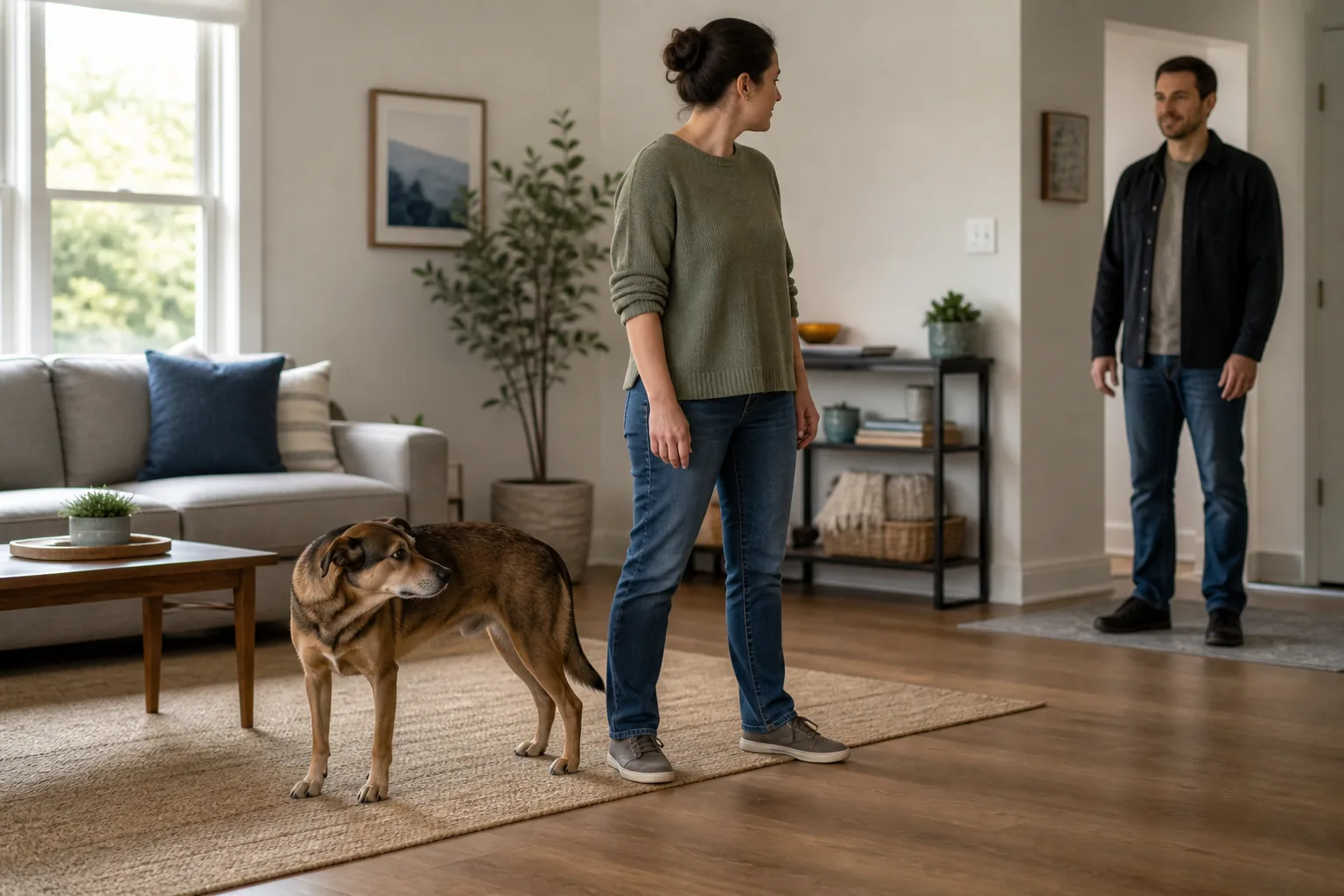
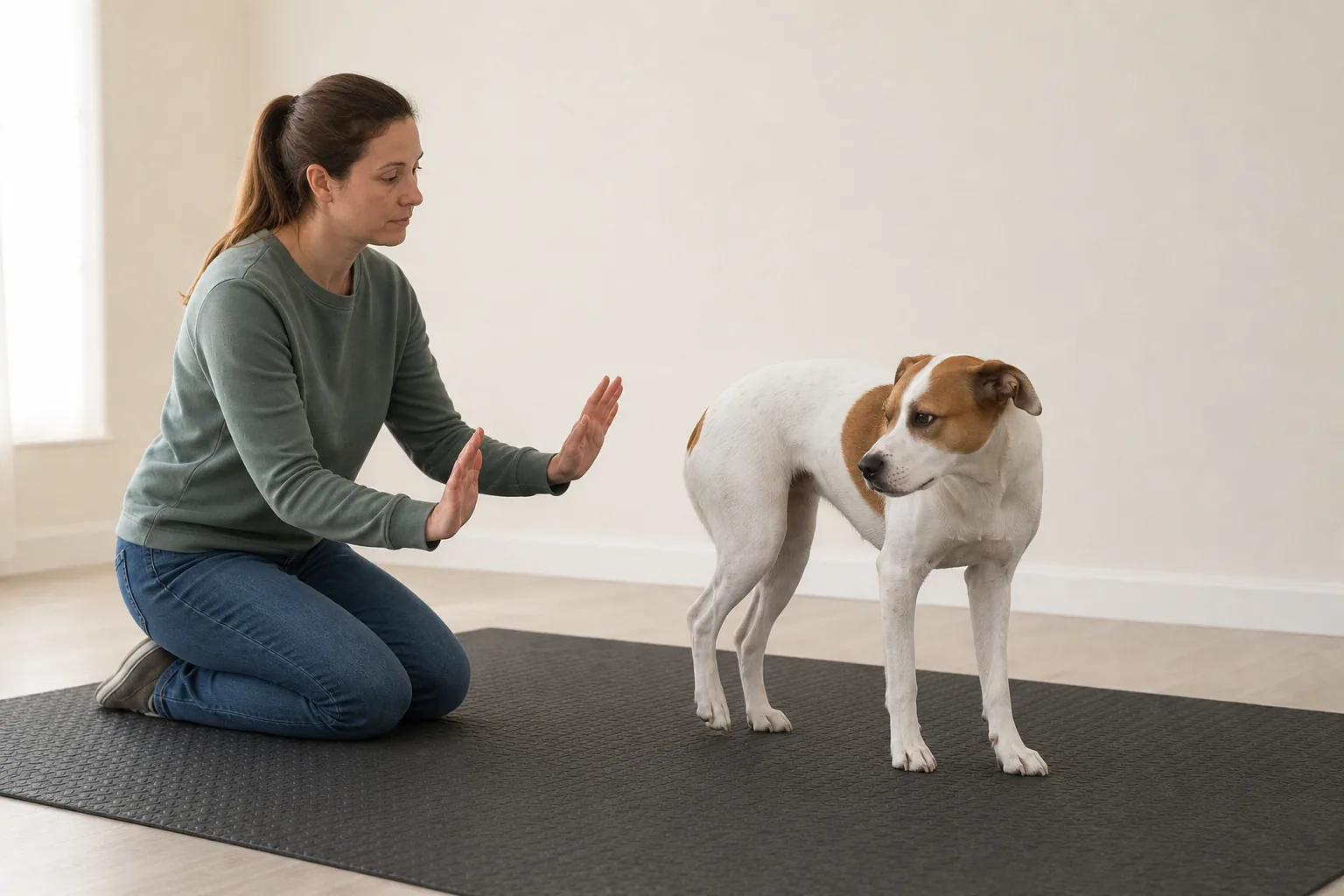
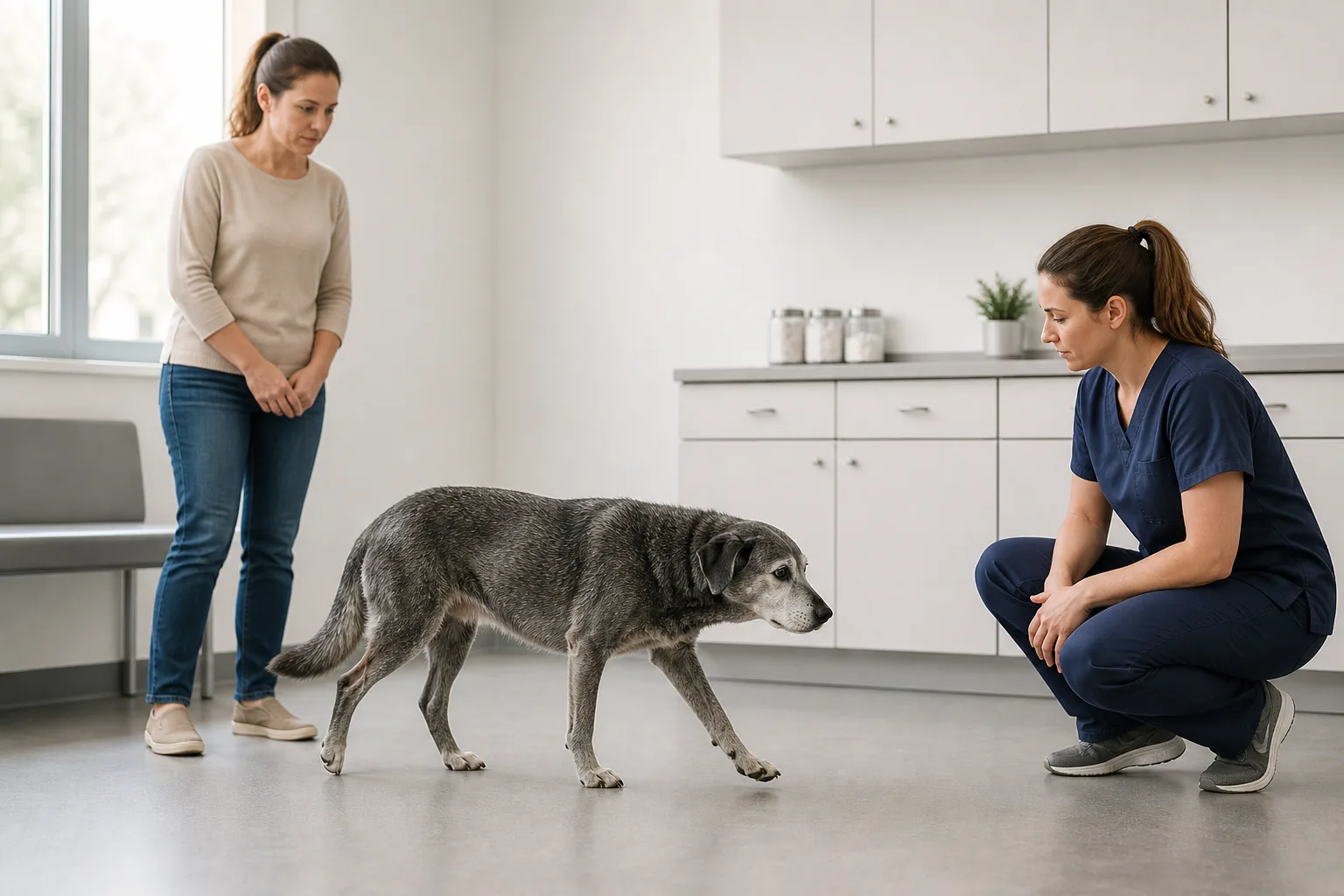
A dog rarely communicates discomfort through one universal pose. Stress may first appear as a closed mouth, a head turn, slower movement, sudden sniffing, a paw lift, or a shift away. The same dog may later freeze, stare, tuck the tail, bark, growl, lunge, or try to escape. Learning to notice early change creates an opportunity to reduce pressure before the dog needs a stronger response.
Body language is not a code in which one signal always has one meaning. A yawn can follow waking. Panting may follow exercise or heat. A wagging tail can occur during excitement, uncertainty, or conflict. Read the whole dog, the setting, the sequence, and the individual’s normal behavior. When health could explain a change, involve a veterinarian rather than assigning an emotional label.
This guide supports observation and safer decisions. It cannot predict whether a dog will bite, diagnose anxiety, or replace an in-person veterinary or behavior assessment.
Establish the dog’s relaxed baseline
Observe the dog during ordinary, low-demand moments: resting at home, exploring a familiar yard, or interacting with a trusted person when the dog can leave. Record what relaxed looks like for that individual:
- usual ear position
- normal eye shape and gaze
- resting mouth and breathing
- natural tail carriage and movement
- weight distribution
- muscle tone and movement speed
- willingness to approach, eat, play, sniff, and rest
- typical response to small household sounds
Breed, anatomy, coat, age, and health change what can be seen. Cropped, folded, very hairy, or erect ears communicate differently. A tightly curled tail may not visibly tuck. Facial wrinkles can look tense even at rest. A dog with arthritis may stand unevenly. Compare the dog with their own baseline instead of an illustration of an idealized dog.
Look at transition. A mouth that closes when a person reaches forward may matter more than whether the closed mouth looks dramatic. A dog who stops taking treats, shifts weight back, and turns the head after the nail clippers appear is providing a sequence.
Read clusters, not isolated signs
One ambiguous signal is a reason to observe. Several changes appearing together are a reason to respond. Useful areas to scan include face, ears, body, feet, tail, breathing, movement, and behavior.
Face and eyes
Possible discomfort signs include a tightened or suddenly closed mouth, repeated lip licking when no food is present, a furrowed brow, rapid scanning, avoidance of eye contact, rounder eyes, dilated pupils, or visible white at the side of the eye. A direct hard stare combined with stillness deserves space.
Visible eye white is sometimes called “whale eye,” but anatomy and gaze direction matter. Do not label it in isolation. Ask what the dog is guarding, avoiding, watching, or trying to leave.
Ears
Ears may move back, flatten, rotate outward, or snap forward toward a concern. The meaningful information is the change from their normal carriage and how it combines with the face and body. Forward ears on a loose dog investigating a sound differ from forward ears with a closed mouth, high stiff tail, and frozen posture.
Body and weight
A worried dog may lower the head or body, shift weight back, lean away, crouch, raise one front paw, make the body smaller, or try to hide behind a person or object. Another dog may become taller, lean forward, raise the hair along the back, or block access. Both forward and backward weight shifts can accompany concern.
Muscle tension and stillness are easy to miss. A dog who “allows” touch while rigid, looking away, and not moving may be coping rather than consenting. Stillness is not automatically calm.
Tail
Look at height, width of movement, speed, stiffness, and the rest of the body. A broad loose movement accompanying a curved, mobile body differs from a high fast stiff wag with forward weight or a low tight wag with retreat. A tucked tail can accompany fear or pain, but tail shape and baseline matter.
Never use wagging alone to decide that approaching or touching is safe.
Breathing, mouth, and whole-body activity
Panting when the dog is not hot and has not exercised, repeated yawning outside a sleep transition, trembling, drooling, pacing, sudden scratching, or repeated shake-offs can occur during stress. They also can have medical or ordinary explanations. Context and clustering determine the next step.
A dog who stops sniffing, playing, or eating may be moving beyond a workable level. A dog who grabs food unusually hard may also be aroused even though food is still accepted.
Notice displacement and avoidance
When uncertain, dogs may perform ordinary behaviors at a contextually unusual moment: sniffing the floor during an approach, scratching during handling, looking away, shaking off, or suddenly investigating the room. These are sometimes called displacement behaviors.
Do not assume the dog is stubborn or distracted. Pause the interaction and see whether distance restores ordinary behavior. The dog may move away, curve rather than approach directly, place an object between themselves and a person, hide, or seek an exit.
Respecting avoidance is a safety decision. Following, cornering, pulling the dog closer, or blocking the exit removes lower-intensity options and can make stronger communication more likely.
Understand an escalation sequence without treating it as a ladder
People often imagine a fixed ladder from lip lick to bite. Real dogs do not use every rung or always progress in the same order. Speed, history, proximity, pain, surprise, and whether earlier signals have worked all affect the response.
A practical progression may include:
- orientation or alerting
- subtle tension, mouth closure, gaze change, or head turn
- weight shift, avoidance, displacement, or retreat
- freezing, hard stare, growl, bark, or showing teeth
- lunge, snap, or bite
Some dogs move quickly. Others freeze without growling. A dog whose growl was punished may offer less audible warning. Never provoke a dog to see which stage comes next.
Treat a growl as information. Stop advancing, create space, and assess the setup. Punishing the sound does not make the underlying fear, pain, guarding, or conflict disappear.
Context changes interpretation
During greetings
A dog may approach because the leash, room, or person limits other choices. Look for a curved loose approach and voluntary re-engagement, not proximity alone. Head turns, lowered posture, retreat, stiffness, closed mouth, and inability to disengage indicate that the greeting should pause.
People should avoid looming, hugging, reaching over the head, staring, or placing their face near the dog. Let the dog choose whether to approach. Children require active adult separation and supervision; they should never be asked to test a dog’s tolerance.
During petting
Offer a brief touch on an area the dog usually enjoys, then stop. If the dog moves closer with a loose body, the interaction may continue. If the dog looks away, moves off, stiffens, lowers, licks lips, or does not re-engage, end the contact.
Absence of escape is not permission. Dogs on furniture, in corners, on leash, being held, or surrounded by people may have limited options.
Around food, toys, beds, or stolen items
Watch for hovering, sudden stillness, faster eating, head lowering over the item, moving it away, side-eye, blocking, growling, or snapping. Do not reach in, pry the mouth open, repeatedly take the item to “prove” ownership, or punish the warning.
Move people and other animals away and obtain qualified help for guarding, especially where children are present or a bite has occurred. Emergency ingestion requires veterinary guidance; safety takes priority over a training exercise.
At the veterinary clinic
Stress can appear in the parking area, waiting room, scale, exam room, or when equipment appears. Panting, retreating, freezing, refusing food, frantic movement, or escalating defense tells the team to reassess.
Tell the clinic before the visit about fear, handling difficulty, or bite history. Ask about quieter scheduling, waiting outside, pre-visit medication prescribed for that dog, and lower-stress handling. Do not change or borrow medication.
During grooming and home care
A dog who tolerates brushing until a particular area, turns when an ear is touched, or pulls a paw away may be signaling pain as well as fear. Stop before restraint becomes a struggle. Veterinary assessment comes before conditioning when discomfort is possible.
Break handling into tiny voluntary steps. The ability to leave, a predictable start signal, and frequent pauses help distinguish cooperation from forced endurance.
On walks
Scan before the dog is barking or lunging. A suddenly closed mouth, fixed stare, higher posture, slower movement, tail change, or refusal to turn may precede a reaction. Increase distance in an arc and use a practiced exit.
Do not tighten the leash and march closer. Distance is not a reward for bad behavior; it is a safety tool that can keep the dog able to learn.
Respond to early signals in four steps
1. Pause pressure
Stop reaching, approaching, restraining, or presenting the difficult object. Ask other people to stop. Keep your voice and movement neutral. Do not demand a sit as proof of compliance.
2. Create a safe exit
Turn the body slightly, move away, open a route, add a barrier, or guide the dog to a familiar quiet space if the dog can follow comfortably. For an unknown dog, remain still or withdraw without running, staring, or reaching.
3. Reduce the trigger
Increase distance, lower sound, end handling, cover a visual trigger, or shorten duration. If food is safe and the dog can eat gently, toss it away from the trigger rather than luring the dog closer.
4. Observe recovery
Look for resumed sniffing, softer muscles, ordinary breathing, normal food-taking, a more mobile body, and the ability to rest. Recovery time is data. A dog who remains vigilant for a long period needs more support and less exposure.
Do not restart just because the dog stops growling. Silence may coexist with continued tension.
Use consent checks without oversimplifying consent
For optional interactions, allow the dog to initiate, pause frequently, and observe whether the dog re-engages. This is useful for petting, brushing, harness practice, and voluntary husbandry.
Some necessary care cannot simply be skipped. Veterinary teams may need medication, modified handling, different equipment, or a planned procedure. “Consent” should not become an excuse to delay urgent care, nor should urgency justify avoidable force in routine practice.
Food can build positive associations, but taking food does not prove comfort. Watch how the dog takes it and what the rest of the body does. Never lure a fearful dog into touching distance and then trap them.
Avoid common reading errors
“The tail is wagging, so the dog is friendly”
A tail conveys arousal and social information, not a simple yes. Read its stiffness and position with the entire body.
“The dog feels guilty”
Lowering, looking away, retreating, or lip licking after a person becomes angry may be a response to that person’s posture and tone. It does not prove the dog understands a past action as a moral offense. Punishment after the event adds stress without teaching an alternative.
“The dog rolled over for a belly rub”
A loose dog who approaches and shifts comfortably may invite contact. A dog who becomes small, still, tucked, and avoids gaze may be trying to reduce conflict. Pause and let the dog choose.
“Taking treats means the dog is fine”
Food acceptance varies. Some stressed dogs eat; others stop. Hard grabbing, inability to orient away, or immediate return to scanning can show the setup remains difficult.
“A quiet dog is calm”
Freezing and shutting down can be quiet. Look for muscle softness, ordinary movement, choice, exploration, and recovery rather than absence of noise.
“A growl is aggression that must be corrected”
A growl communicates a need for distance or change. Treat it as a safety warning and investigate why the dog needed it.
Separate stress from medical problems
Pain, gastrointestinal discomfort, skin or ear disease, breathing difficulty, neurological disease, sensory loss, medication effects, endocrine disorders, and cognitive change can alter posture, tolerance, sleep, vocalization, or interaction.
Contact a veterinarian for a new pattern, sudden irritability, touch sensitivity, limping, persistent panting, trembling without a clear trigger, appetite change, altered sleep, confusion, house soiling, collapse, breathing difficulty, or any other health concern. Breathing distress, collapse, severe injury, repeated unproductive retching, or suspected poisoning requires urgent veterinary direction rather than body-language analysis.
Bring a timeline, ordinary-context videos, medication and supplement list, and notes about eating, drinking, elimination, sleep, and mobility. Do not deliberately reproduce pain or fear for the camera.
Build a practical observation log
Use one row per event:
- date and time
- location
- trigger and distance
- first observable change
- full cluster of signals
- handler response
- whether the dog ate or followed a familiar cue
- peak response
- recovery time
- possible health or environmental factors
The first observable change is especially valuable. If the dog’s mouth closes five seconds before lunging, intervention should happen at or before that change, not after the lunge.
Compare similar events rather than assigning a universal stress score. Improvement might mean choosing distance, recovering faster, remaining able to sniff, or showing fewer escalating signals.
Help the dog rather than testing the dog
Management protects welfare while behavior work develops. Use barriers around visitors, quiet routes, visual blocks, separate feeding, a rest area, and clear household rules. Avoid crowded greetings and repeated handling that the dog cannot decline.
When planned exposure is appropriate, begin at an intensity where the dog remains comfortable and pair the trigger with a positive outcome. Progress at the dog’s pace. Flooding—holding the dog in a feared situation until responding stops—can suppress behavior without creating safety.
Use reward-based methods. Leash jerks, prong or shock collars, yelling, physical correction, and intimidation can add fear and obscure early warning signals.
Know when to involve a professional
Start with a veterinarian when behavior changes, pain is possible, or stress is frequent or intense. Seek qualified behavior assistance when there is:
- a growl, snap, lunge, or bite
- guarding involving people or animals
- severe fear, panic, or inability to recover
- risk involving children or vulnerable adults
- distress during absence, confinement, handling, or veterinary care
- repeated shutdown or compulsive-looking behavior
- uncertainty about what the signals mean
- no improvement with careful management
Share the log and videos. Ask the professional about credentials, coordination with the veterinarian, risk management, and methods. Avoid anyone who guarantees a cure, recommends provoking the behavior, or relies on pain, fear, dominance, or forced exposure.
Early observation creates kinder choices
Reading body language is not about naming every ear flick. It is about noticing meaningful change soon enough to act. Establish the individual’s baseline, scan the whole body, read clusters in context, respect avoidance, and watch recovery.
When uncertain, choose space and safety. A paused greeting, shortened grooming session, quieter clinic plan, wider walking route, or barrier around a valued item can prevent escalation. Listening to subtle communication gives the dog less reason to shout.