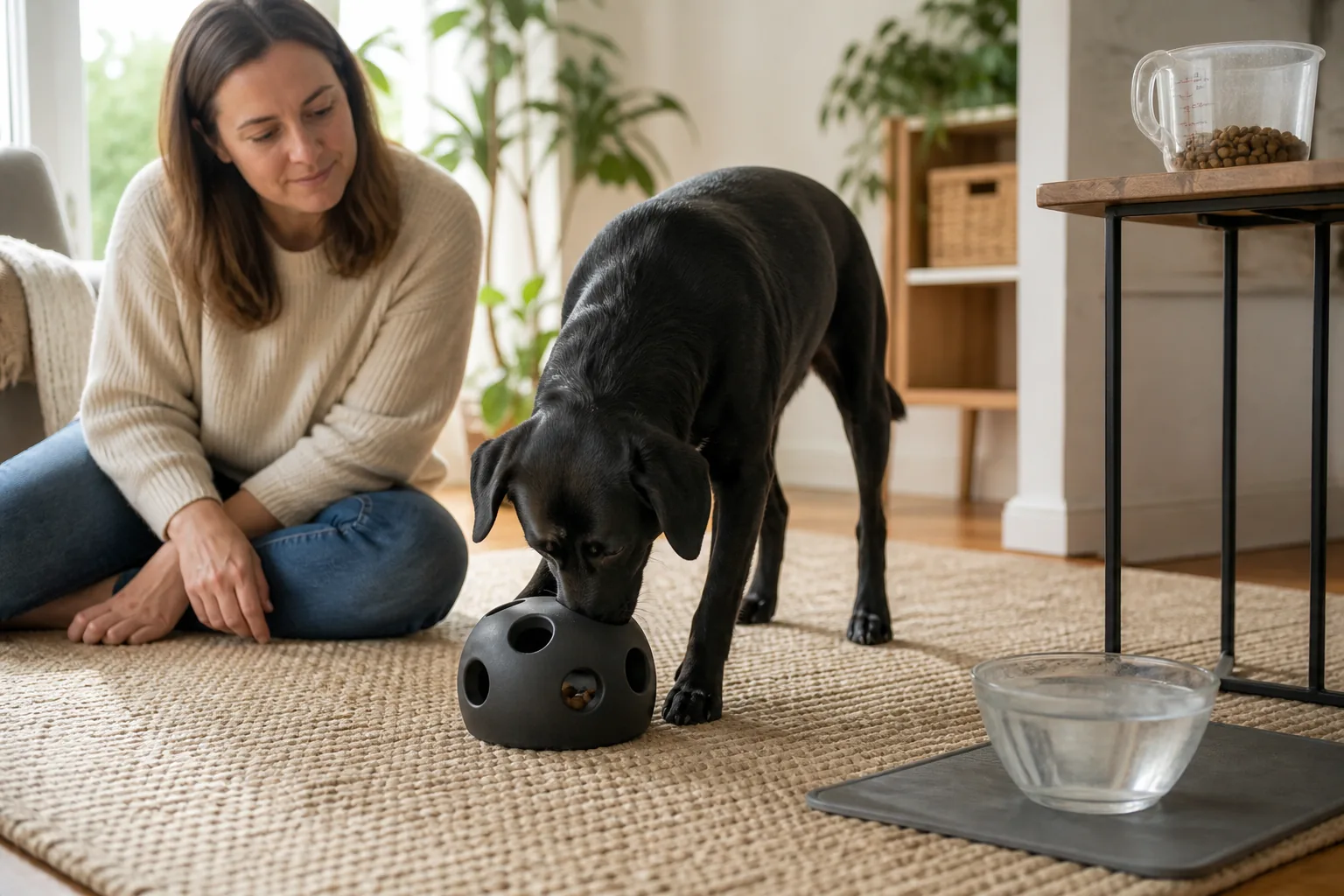
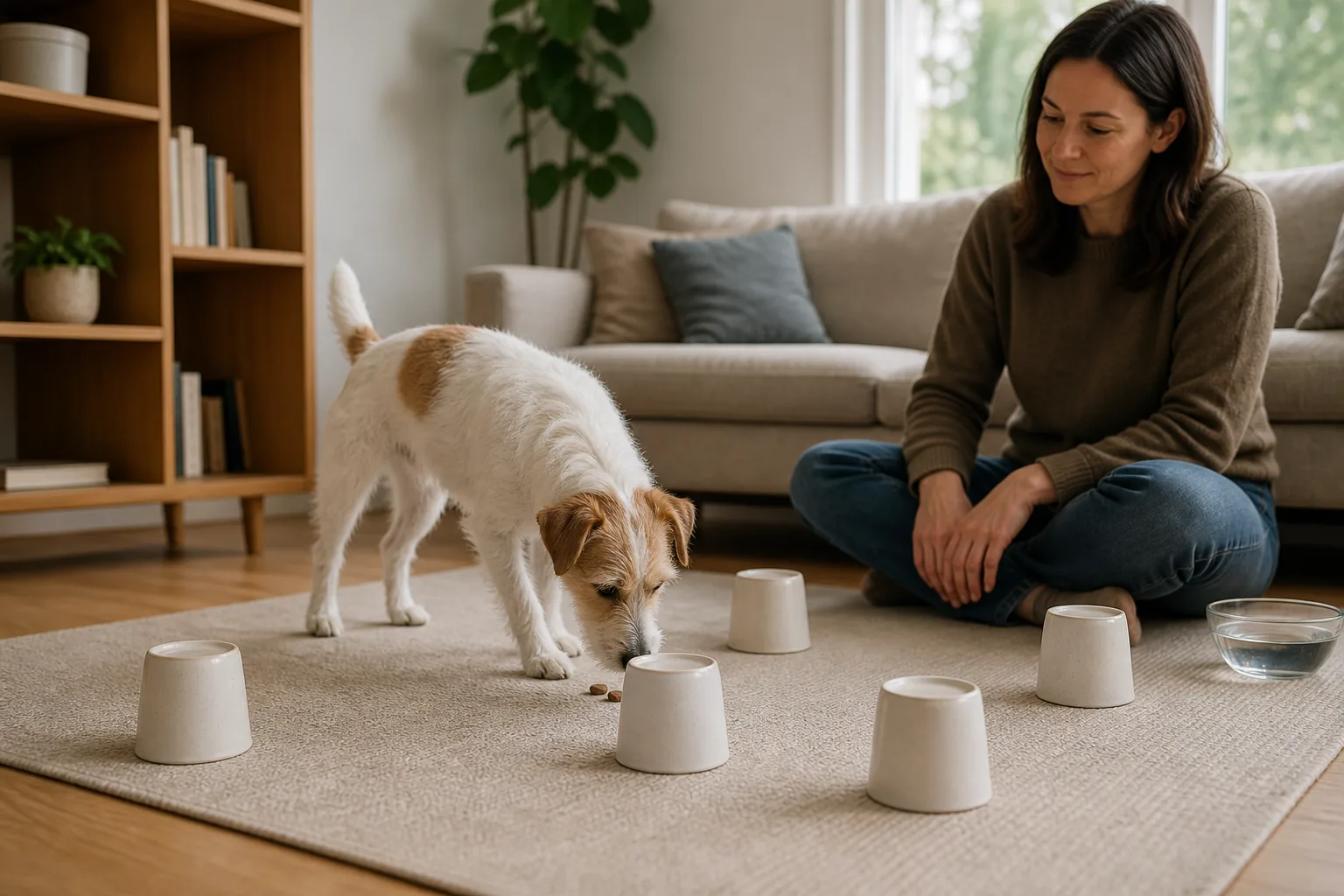
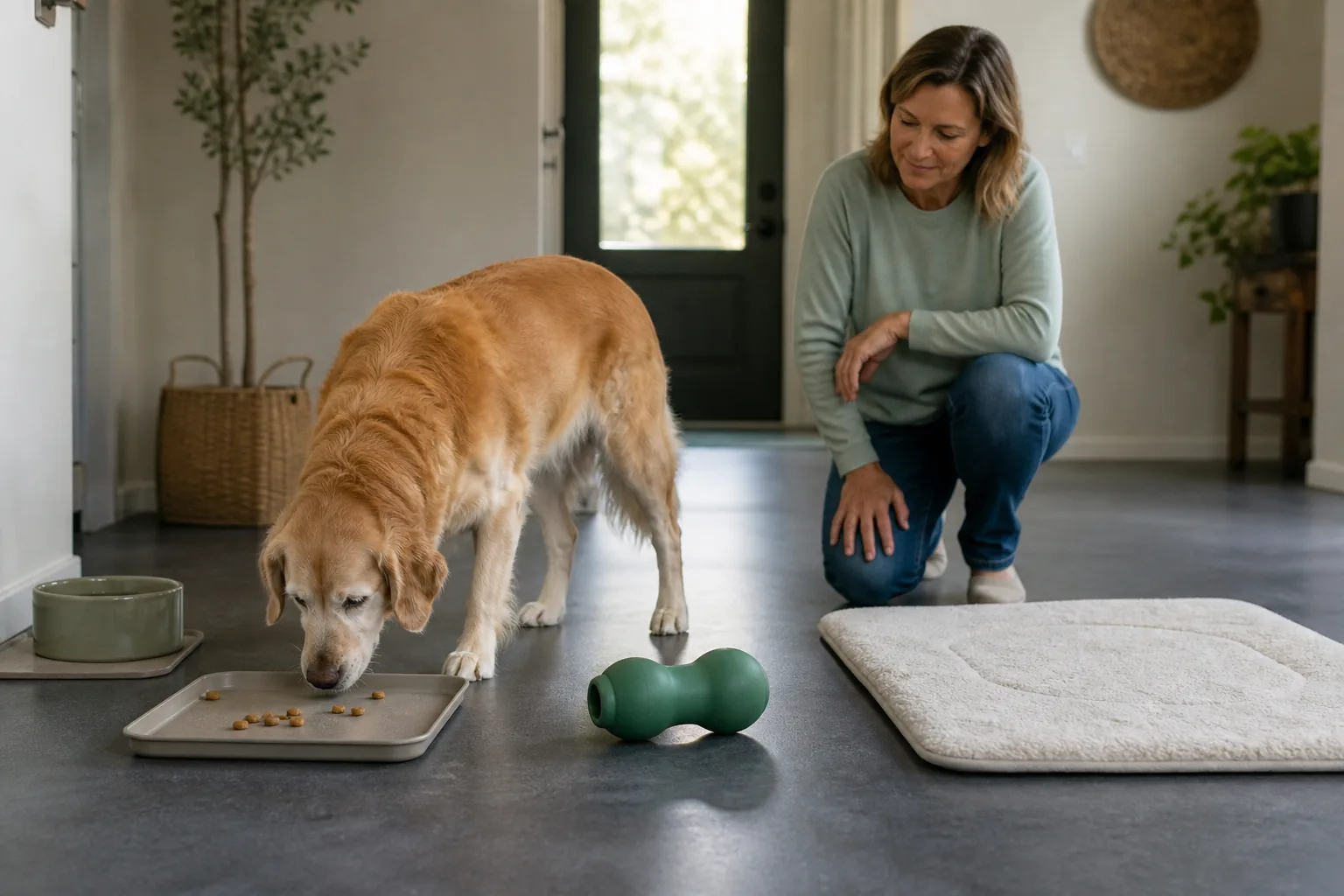
Enrichment is not a product category. It is a planned opportunity for a dog to use behavior, senses, and choices in a safe way that improves the day. A food puzzle can be enrichment for a dog who explores it calmly, frustration for a dog who cannot access the food, and a swallowing hazard for a dog who destroys the material. The object is the same; the outcome is individual.
A useful home plan begins by observing what the dog seeks: sniffing, shredding, chewing, chasing, carrying, digging, solving, watching, training, social play, or uninterrupted rest. Offer an easy version, supervise, and record whether behavior looks engaged and relaxed. Adjust difficulty and rotate activities based on evidence rather than buying the hardest toy.
Enrichment complements physical activity, veterinary care, sleep, social needs, and behavior treatment. It does not cure separation anxiety, aggression, compulsive behavior, pain, or a medical change. It should never be used to keep a distressed dog busy while the underlying trigger continues.
Define the outcome before choosing an activity
Choose a specific goal:
- make a measured meal last longer
- provide ten minutes of safe sniffing indoors
- offer an appropriate outlet for shredding
- build calm independent activity while a person remains nearby
- create low-impact engagement during bad weather
- practice one cooperative skill
- help an adolescent alternate activity and rest
- give a senior a comfortable sensory choice
“Tire the dog out” is not precise. More intense activity can build fitness and arousal rather than produce relaxation. A dog may need sleep, distance from noise, pain treatment, or predictable routine—not another challenge.
After the activity, ask whether the dog is calmer, more agitated, frustrated, sore, guarding, or still seeking the same unmet behavior. The after-effect is part of the assessment.
Observe the dog’s enrichment profile
For one week, record what the dog voluntarily does during free time:
- follows scent trails on walks
- dissects soft toys or cardboard
- carries objects without chewing
- chews hard or soft materials
- watches windows or listens to sounds
- digs bedding or soil
- initiates tug, chase, or retrieve
- seeks human touch or rests at distance
- solves food toys with nose, paws, or mouth
- startles at movement, sound, texture, or unstable surfaces
Also record age, health, mobility, dental condition, diet restrictions, food motivation, guarding history, ingestion of nonfood items, and behavior around other pets. This profile determines which activities are appropriate and how closely they need supervision.
A dog who eats fabric should not use a snuffle mat. A dog with dental disease should not be given hard chewing challenges. A dog who guards food needs separation and professional advice rather than shared puzzles.
Build across several enrichment categories
A balanced week can include sensory, food-acquisition, cognitive, physical, social, and resting opportunities. Not every category must appear every day.
Scent and exploration
Sniffing allows a dog to collect information and search. Indoor scent games, scatter feeding on a clean surface, toy searches, and slow sniff walks are adaptable to many ages.
Food acquisition
Slow feeders, stuffable toys, rolling dispensers, lick mats, and simple box searches change how a measured ration is obtained. They do not add nutritional value, so calories still come from the daily plan.
Cognitive training
One- to three-minute reward-based sessions can teach a hand target, mat, toy name, chin rest, or simple discrimination. The dog receives clear feedback and can stop.
Safe chewing and manipulation
Chewing, carrying, tearing, and pawing can be offered through materials suited to the individual. Safety and ingestion risk determine supervision.
Physical movement
Walking, gentle obstacle navigation, tug with rules, retrieve variations, and controlled movement games can support activity. Flooring, joints, heat, and fitness set limits.
Social choice
Interaction with familiar people or compatible animals can enrich when voluntary and safe. Forced petting and crowded play are not enrichment.
Rest and control
Choice to retreat, predictable quiet, comfortable surfaces, and undisturbed sleep are essential. Constant stimulation can reduce welfare.
Start food puzzles at the easiest level
The AVSAB food-puzzle guide recommends making a new toy easy so food falls out readily. Select the correct size and design for the dog. Place several pieces visibly around and inside it. Demonstrate one movement if needed, then allow exploration.
Watch for relaxed investigation, small problem-solving variations, successful food access, and willingness to return after a pause. Increase difficulty only after easy success. You might reduce opening size, add a small amount of moist food, lightly freeze a portion, or use more compartments—but change one feature.
Difficulty is too high when the dog barks at the toy, bites it forcefully, paws frantically without success, gives up while hungry, guards it, or repeatedly seeks human rescue. Make it easier. Challenge should include frequent payoff.
Do not describe frustration as mental exercise. Learning occurs best when the dog can discover workable actions.
Preserve the daily ration
Put the dog’s measured daily food in one container. Fill puzzles, use training rewards, and scatter from that container. Count any additional food, spread, cheese, meat, or commercial treats within the extra-food calorie allowance.
Rich fillings can add substantial fat and calories. Peanut butter must be checked for xylitol or another unsafe sweetener. Prescription and elimination diets require approved ingredients only. Dogs with pancreatitis history, obesity, kidney disease, food reaction, diabetes, swallowing issues, or other conditions need veterinary guidance.
Moistened or perishable food requires safe handling and prompt refrigeration or disposal. Wash puzzle grooves and dry fully. Retire damaged, porous, or difficult-to-clean equipment.
Create a simple “find it” progression
Begin on a clear nonslip floor. Say “find it” and toss one piece of food close enough for the dog to see. When found, mark softly. Repeat in different directions.
Next, place a piece partly behind a chair leg while the dog watches. Progress to several visible locations, then easy hidden locations in one dog-proofed room. Keep count so no food is left to spoil or attract pests.
For a toy search, allow the dog to smell and play with the toy, ask another person to hold the dog gently only if the dog is comfortable, hide the toy in an obvious place, and release. Reward discovery with play or another valued outcome.
Avoid hiding food near medication, cleaning products, electrical cords, bins, furniture the dog may damage, or spaces where the dog could become stuck. Do not teach searching through handbags, kitchen counters, or children’s rooms.
Scatter feeding safely
Scatter part of the measured kibble across a clean dry floor, nonslip mat, or safe enclosed lawn. Separate pets before starting. The surface should not contain gravel that resembles food, pesticides, toxic plants, sharp debris, fecal contamination, or objects the dog swallows.
Use a contained tray for dogs with mobility limits. Place pieces within comfortable reach rather than requiring twisting or slippery movement.
Scatter games are inappropriate for dogs who guard dispersed food, ingest ground material, become frantic, or cannot be safely separated. Use a bowl-based alternative and seek behavior guidance for guarding.
Offer shredding without creating ingestion risk
Some dogs enjoy tearing paper and cardboard. Use plain clean material with tape, staples, plastic windows, strings, labels, and food residue removed. Place a few pieces of ration loosely in an open box. Supervise actively.
Stop if the dog swallows cardboard, tears off large chunks and gulps, guards the box, or becomes overaroused. Shredding is not safe for every dog. Clean up before another pet or child accesses debris.
Do not use packaging that held chemicals, medication, raw meat, allergens, or toxic food. Avoid glossy coatings and unknown materials.
Teach a start and finish routine. Present the approved box on a mat, give a cue, supervise, then trade for a reward and remove remains. This helps distinguish an enrichment setup from every delivery parcel.
Select chew activities by the dog, not marketing
Chews can fracture teeth, obstruct the gastrointestinal tract, cause choking, add calories, or trigger guarding. Hardness, size, shape, ingredients, digestibility, and chewing style matter.
Ask the veterinarian about dental and medical suitability. Choose an item too large to swallow whole and inspect throughout use. Remove when small, splintered, cracked, softened into a gulpable piece, or otherwise damaged.
Do not leave a novel chew unsupervised. Separate animals. Children do not approach a chewing dog. A dog who freezes, hovers, hard-stares, growls, or rushes to swallow needs a management and behavior plan—not repeated trades by untrained family members.
Chewing time should not substitute for tooth brushing or veterinary dental care. Product claims require evidence; enjoyment does not prove dental benefit.
Use lick mats and stuffed toys thoughtfully
Spread a thin layer of the dog’s own wet food or another approved ingredient. Begin unfrozen so success is easy. A frozen item lasts longer but may be too difficult, cold, or hard for some dogs.
Secure flexible mats only where the dog licks rather than tears. Supervise and remove at the first bite. Choose a stuffable toy that cannot lodge over the jaw or be swallowed. Inspect openings and cracks.
A dog abandoning the food as soon as the person leaves may be showing separation concern. The food toy has not solved the distress. Use a camera and seek appropriate guidance.
Rotate novelty without removing favorites
Novelty can renew interest, but some dogs value predictable familiar objects. Keep one or two safe favorites available and rotate other toys every few days. Reintroduce as though inspecting them anew.
Change the activity, not just the object: carry one day, search the next, brief tug another day. Observe preferences. A toy repeatedly ignored can be retired; the dog does not owe engagement because it was expensive.
Do not present many high-value objects together in a multi-dog home. Rotation should not create resource conflict.
Teach tug as a cooperative game
Use a long suitable toy to keep hands away from teeth. Invite with a cue, move horizontally rather than jerking the neck upward, and allow the dog to grip. Pause and trade for food or a second toy, then restart as reinforcement for release.
Keep sessions short. Stop for accidental hard contact, escalating arousal, guarding, pain, or inability to disengage. Puppies losing teeth and dogs with dental or neck issues need modified or avoided tug based on veterinary advice.
There is no need to prove the human wins. Cooperative play includes turns, pauses, and voluntary re-engagement.
Modify retrieve games
Repeated high-speed ball chasing with abrupt turns can produce intense arousal and physical load. Use short distances on safe footing, rolling rather than high throws, toy searches, two-toy exchanges, or carrying games.
Warm up with walking. Stop before fatigue changes gait. Avoid stairs, slippery floors, heat, and obstacles. Dogs with orthopedic, cardiac, respiratory, or neurologic conditions require veterinary exercise guidance.
If the dog fixates on the ball and cannot stop, reduce repetitive throwing and substitute sniffing or slower searches. Compulsion is not enrichment.
Build low-impact home obstacles
Use flat mats, wide pathways between cones, stepping around boxes, slow backing, and walking over a low pole placed on the floor. Reward deliberate movement. Equipment must not slide or collapse.
Do not create jumps from furniture, unstable balance challenges, tight tunnels, or sharp turns without professional fitness guidance. Small spaces magnify collision risk.
For seniors or mobility-limited dogs, place scent targets at nose height, use seated hand targets, present objects to investigate, or scatter within a shallow tray. Comfort outranks spectacle.
Provide sensory choice
Offer windows only if watching outside is relaxing. A dog who patrols, barks, or lunges at passersby may benefit from frosted film, curtains, or moving the bed away. Visual access is not enriching when it drives chronic arousal.
Introduce sound at low volume and allow retreat. Music, household recordings, or novel toy noises may interest one dog and frighten another. Never trap the dog beside a speaker.
Textures can include grass, a rubber mat, carpet square, cardboard, or a shallow dry towel pile. Ensure stable footing and prevent ingestion. Reward voluntary investigation.
Safe scent samples can be placed outside a sealed perforated container, but avoid essential oils, chemicals, irritants, and substances toxic to dogs. Ordinary outdoor objects and food searches usually provide ample scent.
Social enrichment requires consent
Some dogs enjoy training, massage-like contact, grooming, play, or quiet proximity. Pause contact every few seconds. Continued approach, leaning, or solicitation may invite more; turning away, stiffness, lip licking, leaving, or hiding means stop.
Dog-dog play is appropriate only for compatible individuals with space, supervision, and balanced pauses. Size, health, play style, guarding, and arousal matter. Dog parks are not a universal enrichment requirement.
A dog can have a rich life without greeting unfamiliar people or dogs.
Rest is not boredom by default
Adult dogs spend substantial time resting, and puppies and seniors may need even more. A dog sleeping comfortably after needs are met does not need to be awakened for an activity.
Create an undisturbed bed away from traffic. Alternate engagement with recovery. Signs of too much stimulation can include inability to settle, frantic demand behavior, harder mouthing, barking, pacing, and declining performance.
Sudden lethargy, exercise intolerance, unusual sleep, appetite change, pain, or withdrawal needs veterinary assessment rather than enrichment escalation.
Enrichment during alone time
Only leave items the dog has used safely under supervision. Remove anything that can be shredded, swallowed, trapped, or guarded from another animal. Use a camera.
Enrichment does not make an absence safe for a dog with separation distress. Panting, drooling, pacing, vocalization, escape attempts, elimination, destruction near exits, or abandonment of high-value food can indicate distress. Arrange management and qualified treatment.
Do not extend alone time because a frozen toy theoretically lasts an hour. The dog’s behavior, toileting needs, and trained duration determine the plan.
Make activities accessible for seniors and disabled dogs
Ask the veterinarian about pain, vision, hearing, cognitive change, and exercise limits. Place puzzles on stable nonslip surfaces at a comfortable height. Use larger food openings, strong scent, simple routes, and short sessions.
For vision loss, keep furniture stable and use scent or sound cues the dog finds safe. For hearing loss, use visual markers and predictable approach. For cognitive change, familiar simple activities may be better than novelty.
Monitor fatigue and recovery. Enrichment should preserve dignity and choice, not display difficulty.
Create a weekly rotation
Example for a healthy adult, adjusted to individual needs:
| Day | Food or scent | Skill or play | Recovery | | --- | --- | --- | --- | | Monday | easy scatter | two-minute hand target | quiet bed | | Tuesday | stuffed toy | gentle tug | sniff walk | | Wednesday | toy search | mat practice | rest | | Thursday | slow feeder | low obstacle route | chew under supervision | | Friday | box search | toy-name game | quiet social time | | Saturday | outdoor sniffing | short retrieve variation | rest | | Sunday | familiar favorite | optional review | low-stimulation day |
This is a template, not a quota. Weather, health, sleep, household schedule, and the dog’s response determine changes.
Measure whether enrichment works
Record:
- activity and exact setup
- food amount from daily ration
- time to begin
- duration of voluntary engagement
- successful actions
- frustration or stress signals
- chewing or ingestion behavior
- state 15 minutes afterward
- whether the dog chooses it again
“Searched calmly for eight minutes and then slept” is more useful than “loved puzzle.” “Bit the lid, barked, and abandoned it” says difficulty or design must change.
Common mistakes
Making every meal difficult
Choice matters. Some meals can be offered simply, especially when the dog is tired, ill, stressed, or learning a new device.
Escalating complexity constantly
Mastery is valuable. A familiar easy search can be enriching without a harder level.
Adding calories invisibly
Fillings, chews, and training food all count. Use the measured ration and record extras.
Confusing exhaustion with welfare
A dog can be physically tired and emotionally overaroused. Balance movement, sniffing, thinking, choice, and rest.
Leaving DIY items unsupervised
Cardboard, fabric, plastic, and string can become ingestion hazards. DIY does not mean disposable without risk.
Using enrichment to avoid treatment
Puzzles cannot diagnose or cure pain, anxiety, aggression, compulsive behavior, or cognitive decline.
When to involve professionals
Contact a veterinarian for sudden behavior change, pain, exercise intolerance, weight change, unusual appetite, dental problems, ingestion, vomiting, or lethargy. Ask about safe activity for medical conditions.
Seek a qualified reward-based behavior professional for guarding, panic when alone, compulsive patterns, severe frustration, aggression, or inability to participate safely. A professional should assess function and welfare rather than prescribe more stimulation automatically.
The decision to take away
At-home enrichment works when it matches the individual dog and produces safe, voluntary engagement. Observe preferred behaviors, select an easy activity, preserve the daily calorie plan, supervise, and record the result. Make success frequent and difficulty optional.
Build a varied week from scent, food acquisition, cognitive skills, safe chewing, physical movement, social choice, and undisturbed rest. Keep favorites, rotate some novelty, and adapt for age, health, and mobility.
The goal is not a dog occupied every minute. It is a dog with meaningful choices, appropriate outlets, recovery time, and a household able to tell the difference between engagement, frustration, fear, pain, and rest.