Five minutes is enough time to teach something useful, but only if the session has one small goal. A rushed sequence of sit, down, stay, heel, leave it, recall, and tricks is not efficient training; it is a test the dog was never prepared to take. A productive mini-session creates several easy opportunities for one behavior, rewards clearly, and stops while the dog is still comfortable and interested.
Short games fit ordinary life. You can practice attention before clipping on a leash, reinforce a hand target beside the sofa, build mat relaxation while dinner cooks, or rehearse recall between two rooms. The value comes from repetition across days and settings—not from exhausting the dog in one long lesson.
The American Veterinary Society of Animal Behavior recommends reward-based methods for dog training and behavior modification. The games below follow that approach. They do not use leash corrections, intimidation, shouting, forced positions, shock, prong or choke collars, physical manipulation, or deliberate exposure that overwhelms the dog.
This is general skills training for a dog who can participate safely. Fear, aggression, separation distress, guarding, panic, sudden behavior change, or pain requires an individualized plan from a veterinarian and an appropriately qualified reward-based behavior professional.
Set up the session before the clock starts
Choose a quiet, nonslip area. Put away other pets if they compete for food or interrupt. Have 15 to 30 tiny rewards ready, depending on the dog’s diet and the task. Kibble from the measured meal may work in a low-distraction room; a harder environment may require a more valuable but still safe food. Toys, access to sniffing, and play can also reward behavior when the dog genuinely wants them.
Count food rewards within the daily ration and treat allowance. Training should not cause unnoticed weight gain. Cut soft treats into very small pieces—the reward is information and reinforcement, not a full snack each repetition.
Decide on a marker. A short word such as “yes,” a clicker, or a consistent visual signal tells the dog exactly which moment earned reinforcement. First teach its meaning: produce the marker, then deliver a reward. Repeat several times without asking for behavior. The marker predicts the reward; it does not replace it.
Prepare an exit. A phrase such as “all done” followed by scattering a few pieces from the ration or inviting the dog to rest makes the end clear. Put food away afterward instead of letting the dog keep working at your hands.
What a five-minute structure looks like
Use the clock as a maximum, not a requirement.
- First 30 seconds: settle into the space and offer two or three easy rewards.
- Next 60–90 seconds: practice one simple version of the target behavior.
- Short break: toss one piece to reset, allow sniffing, or pause quietly.
- Next 60–90 seconds: repeat or make one small adjustment.
- Final 30 seconds: finish with an easy success and use the end cue.
Stop sooner if the dog disengages. A puppy may work for only 30 seconds. An experienced adult may enjoy several minutes. Duration is not a measure of commitment.
Read the learner, not only the result
A dog can comply while uncomfortable. Look for loose movement, voluntary re-engagement, normal breathing, ability to take food gently, and willingness to return after a break. Stress may appear as freezing, crouching, tucked tail, repeated lip licking, yawning outside a tired context, panting without heat or exertion, scanning, scratching, frantic grabbing, refusing food, or trying to leave.
When those signs appear, stop or make the exercise easier. Do not label the dog stubborn. Check the environment, floor, reward, physical comfort, and size of the step. Sudden reluctance to sit, lie down, turn, jump, or take food may reflect pain and deserves veterinary attention.
Game 1: Name predicts orientation
Purpose: Teach the dog that hearing their name once is a reason to turn toward you. This supports communication but is not a recall cue.
Stand in a quiet room with the dog nearby and not already staring at you. Say the name once in a normal pleasant voice. The instant the dog turns the head or eyes toward you, mark and deliver a reward near your leg. Then allow the dog to look away and reset.
If there is no response, do not repeat the name louder. Make the next repetition easier: reduce distance, move away from distraction, or make a small neutral sound before the next trial so the dog is more likely to notice. The name should not become background noise.
After several successful indoor repetitions, practice in another quiet room. Increase only one feature at a time—distance or distraction, not both.
Everyday use: Getting orientation before giving another cue, changing direction, or beginning a cooperative task.
Common error: Saying the name to scold, end all fun, or precede something the dog dislikes. That weakens the positive association.
Game 2: Hand target
Purpose: Teach the dog to touch the nose to an offered palm. This can guide movement without pushing or grabbing.
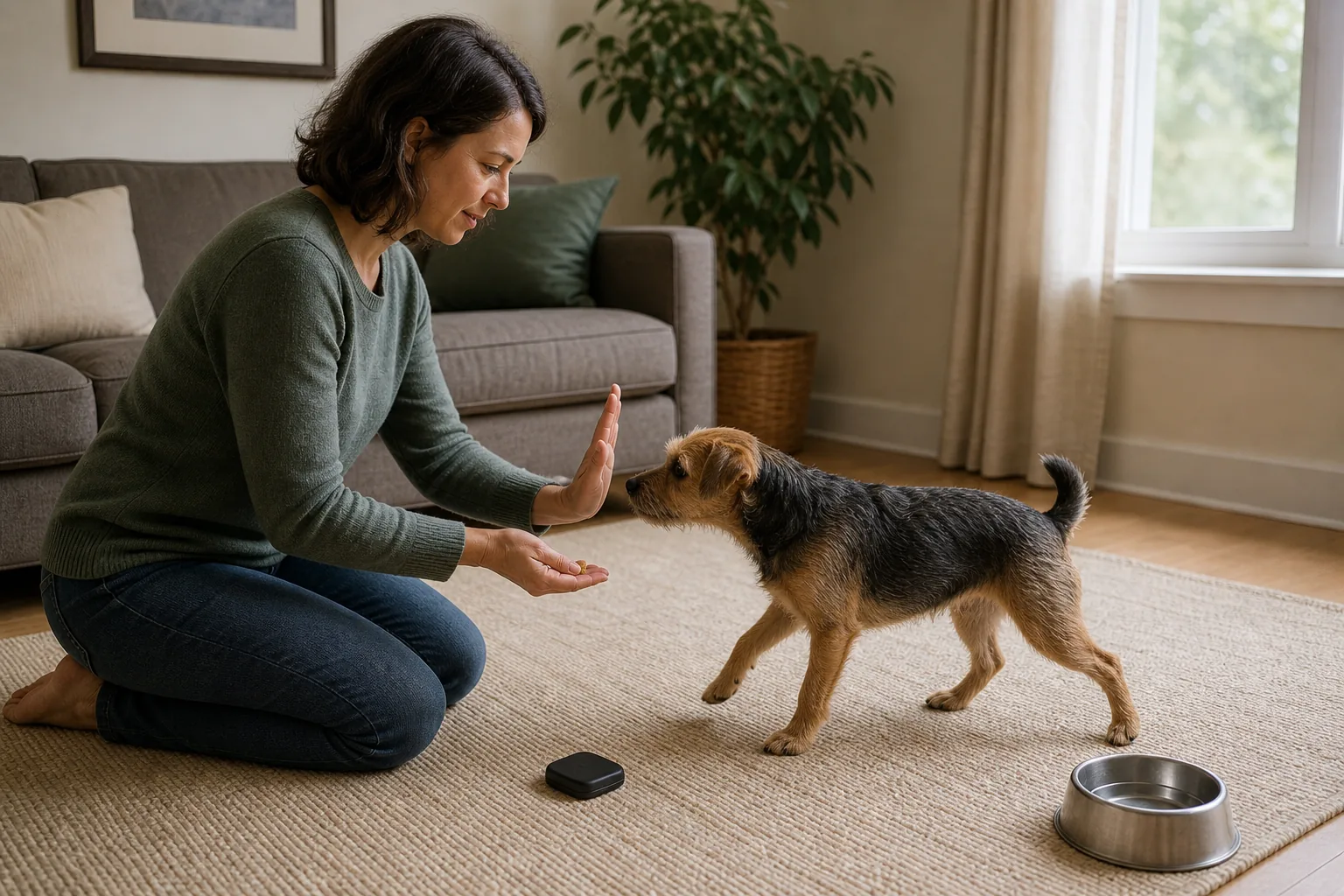
Present an open hand a few inches from the dog’s nose, fingers together and palm facing the dog. Most dogs investigate. When the nose touches, mark and reward from the other hand. Remove the target hand between repetitions.
If the dog does not approach, place the hand closer but do not press it into the face. You can briefly rub a treat scent on the palm, then try again without holding food in that hand. Reward an initial lean or sniff if a full touch is too difficult.
Once the dog confidently touches, move the hand slightly left, right, higher, or one step away. Add a cue such as “touch” just before presenting the hand only after the behavior is predictable.
Everyday use: Moving onto a scale, repositioning near a doorway, turning away from a mild distraction, or beginning cooperative care.
Common error: Moving the hand as the dog approaches, turning the game into a frustrating chase.
Game 3: Find it
Purpose: Teach a simple food search that can redirect attention and encourage sniffing in a safe area.
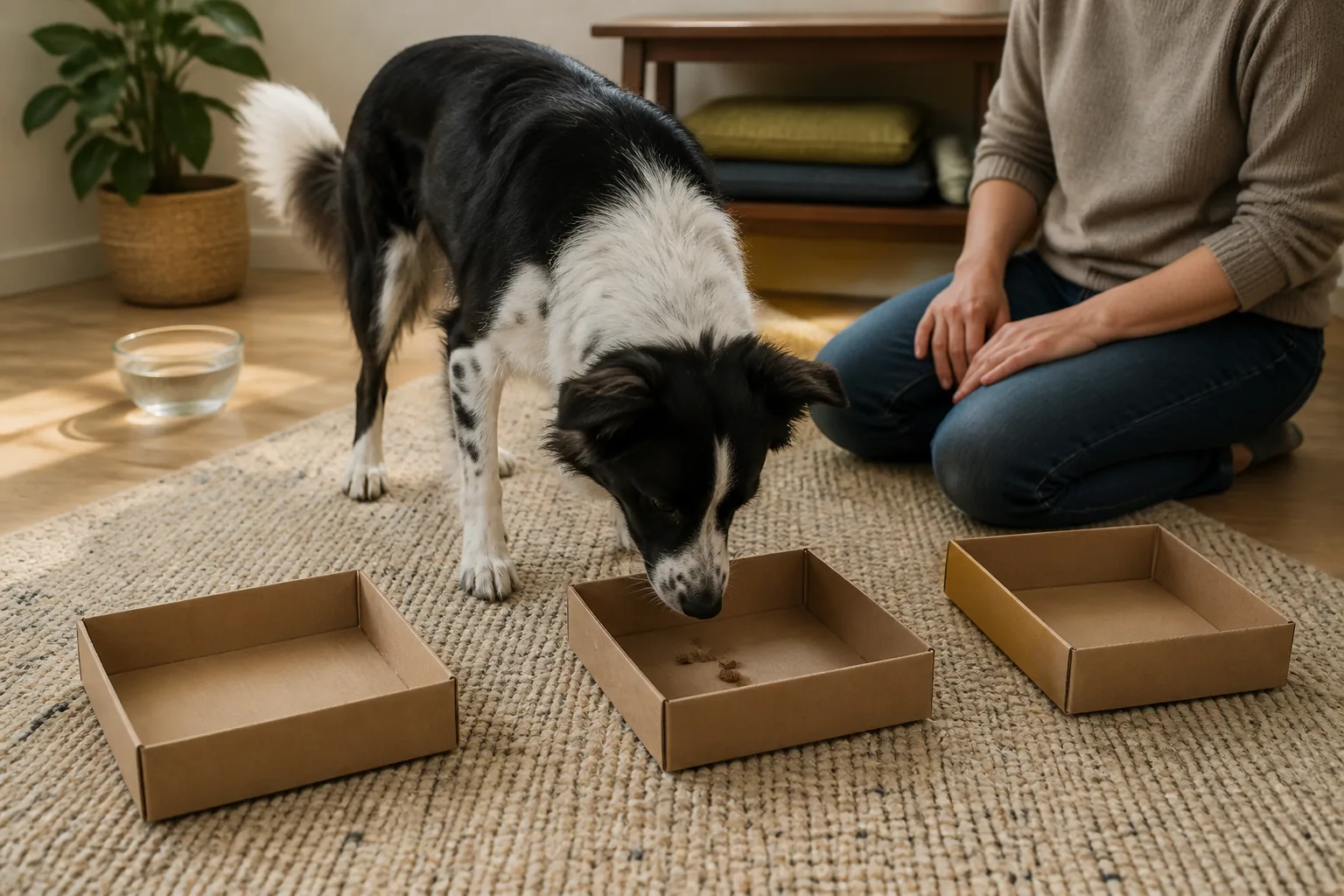
Say “find it,” then toss one piece of food a short distance onto a clear floor where the dog sees it land. When the dog eats it and looks back, repeat in another direction. Keep tosses away from stairs, furniture gaps, other animals, and unsafe surfaces.
After the cue predicts the search, place an easy piece partly behind a chair leg while the dog watches. Increase search difficulty gradually. Do not scatter food in treated grass, near toxic plants, on gravel that can be swallowed, or in public areas contaminated by unknown animals.
Everyday use: Creating distance from a doorway, resetting between repetitions, or offering a calm alternative when the environment is manageable.
Common error: Using “find it” to keep a frightened dog trapped near a trigger. Food search is not permission to ignore fear or safety distance.
Game 4: Go to a mat
Purpose: Build voluntary movement to a portable resting place. The first game teaches location, not a long stay.
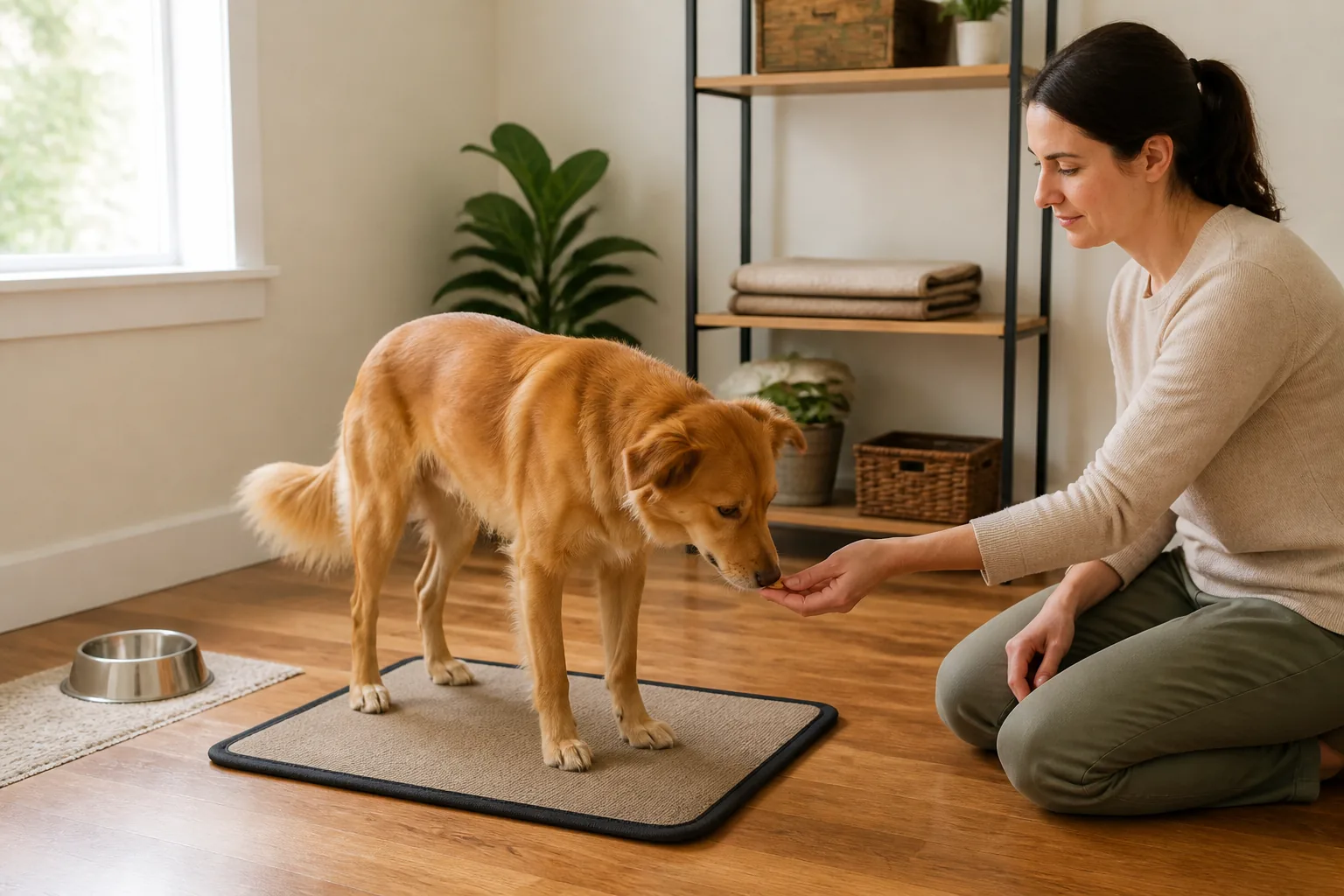
Place a nonslip mat on the floor. Look at it and wait. Mark any voluntary interaction—looking toward it, stepping closer, or placing a paw on it—and deliver the reward on the mat. Toss one reset piece away, then let the dog return. Gradually raise the criterion toward four paws on the mat.
When the dog readily moves onto it, say a cue such as “mat” just before the dog begins the familiar action. Reward on the mat. Release after a second or two. Duration comes later, one easy interval at a time.
Do not pull the dog onto the mat, block departure, or use the mat only before confinement. The dog should be able to leave during training.
Everyday use: A predictable place during meals, visitor setup, café practice at a safe distance, or cooperative household routines.
Common error: Adding duration, distance, and distraction together. Change one dimension while the others remain easy.
Game 5: Capture calm
Purpose: Reinforce naturally occurring relaxed behavior instead of repeatedly asking for excitement followed by control.
Sit quietly with rewards available but hidden. When the dog independently softens the body, rests a hip, lowers the head, or lies down, calmly mark and place a reward between the paws. Pause. Reward another moment of relaxation.
If the marker excites the dog, use a soft word or simply place food gently without fanfare. This is not a formal down-stay. You are noticing behavior the dog offers, not physically positioning the dog.
Keep the environment genuinely calm. A dog who cannot settle because of fear, noise, pain, or unmet exercise and toileting needs does not need stricter obedience.
Everyday use: Reinforcing quiet behavior while people work, eat, or watch television.
Common error: Delivering food only after barking or pawing stops for a split second, which may accidentally create a behavior chain. Begin in an easier context before demanding recovery from high arousal.
Game 6: Collar touch predicts good things
Purpose: Build comfort with a brief, gentle touch near the collar for routine handling. This is not emergency restraint training.
With the dog relaxed, move one hand slightly toward the shoulder, mark, and reward with the other. Over repetitions, progress to a brief touch of the collar, then one finger resting under it, always releasing immediately. Keep the pressure negligible.
If the dog moves away, stiffens, ducks, mouths the hand, or stops taking food, return to an easier stage. Never chase, corner, or grab. Dogs with handling fear or bite history need professional guidance.
Everyday use: Making routine leash attachment and identification checks more predictable.
Common error: Practicing only when the dog’s fun is about to end. Sometimes touch, reward, and release back to the previous activity.
Game 7: Trade
Purpose: Teach that releasing a safe object can produce something valuable and may return the object. This is preventive practice, not a method for confronting active guarding.
Give the dog a low-value toy that is safe to hold. Present a valuable food reward near the nose without reaching for the toy. When the dog releases, mark, deliver the food, and pick up the toy. Often give the toy back. After the release is predictable, add a cue such as “drop.”
Start with an object the dog does not guard. If the dog freezes, hovers, gulps, turns away with the item, growls, or snaps, stop creating confrontations. Separate safely and contact a qualified behavior professional. Never pry open the mouth or punish a warning.
Everyday use: Voluntary release of toys and building a history that human approach does not always mean loss.
Common error: Using only stolen or dangerous items in practice. Emergency retrieval and behavior modification require management beyond this mini-game.
Game 8: One-step follow
Purpose: Reinforce choosing to move with the handler, a foundation that is separate from a complete loose-leash plan.
In a quiet room, stand beside the dog. Take one step backward or sideways. When the dog moves with you, mark and reward beside your leg. Reset and repeat. After success, try two steps before marking.
Keep food delivery at the location you want, rather than reaching forward to a pulling dog. Work without leash tension in a secure indoor area. If using a leash, attach it to suitable equipment and keep it slack; do not pop or correct it.
Everyday use: Moving together through the home and building reinforcement near the handler.
Common error: Expanding immediately into a long walk full of distractions. The dedicated loose-leash article will cover systematic outdoor progression.
Game 9: Doorway pause
Purpose: Teach that waiting briefly makes the door open. This is a household skill, not a dominance exercise.
Use an interior door first. With the dog on the safe side and enough space, touch the handle. If the dog remains back for a moment, mark and reward away from the opening. Open the door a crack. If the dog moves forward, close it gently without trapping or startling. When the dog pauses, mark and open farther.
Release through with a consistent cue. Keep early waits under a second. At exterior doors, use a leash and physical barriers; training is not a substitute for containment.
Everyday use: Safer, calmer transitions through doors and gates.
Common error: Holding the dog in position or repeatedly slamming the door. Reduce the movement of the door until the dog can succeed.
Game 10: Check in on a walk
Purpose: Reinforce voluntary attention outdoors without calling the dog away from every sniff.
Begin in a quiet enclosed area or on a secure leash. Let the dog explore. Whenever the dog voluntarily glances toward you, mark and deliver a reward near your body, then release back to sniffing. The environment becomes part of the reward.
Do not stare, repeat the name, or lure every check-in. You are capturing the dog’s choice. If none occur, the setting is too difficult; increase distance from distractions or return indoors.
Everyday use: Building communication during walks and creating a foundation for later leash skills.
Common error: Rewarding attention by immediately ending exploration. Sometimes send the dog back to the activity so checking in does not predict loss.
Adjust only one difficulty dimension
Training difficulty has several parts:
- duration: how long the behavior continues
- distance: how far the dog is from the handler or target
- distraction: what else competes for attention
- precision: how exact the response must be
- latency: how quickly the response begins
Raise one while lowering or holding the others. A dog who can stay on a mat for ten seconds beside you in the kitchen is not ready for ten seconds across a busy park. New locations often require returning to the easiest version.
Aim for frequent success. If two repetitions fail, reduce the criterion rather than repeating the cue. A “failure” is information about setup, not disobedience.
Use cues carefully
First get the behavior, then attach the word. Repeating an unfamiliar cue while luring does not teach its meaning. Say the cue once, give the dog a reasonable moment, and make the environment easier if the response does not occur.
Do not use one word for several actions. “Down” might mean lie down, get off furniture, stop jumping, or lower the head in different households. Choose distinct cues and teach each outcome.
Release cues matter too. A mat behavior or doorway pause is clearer when the dog knows when the exercise ends. Reward release practice instead of assuming the dog should wait indefinitely.
Keep reinforcement honest
A reward is defined by its effect on the learner. Food the dog refuses, petting the dog avoids, or play that causes conflict is not useful reinforcement in that moment. Test preferences in a calm context.
When a behavior is new, reward every successful repetition. Later, real-life outcomes and varied reinforcement can maintain it, but do not remove rewards abruptly. Praise can become meaningful through history, yet it is not automatically equivalent to food or access the dog values.
Never show a reward and then withhold it after the dog completes the task. The marker should remain a reliable promise.
When games should stop
End the session if the dog avoids the area, freezes, becomes frantic, refuses normally valued food, pants without exertion, repeatedly scratches or yawns, hides, vocalizes from distress, mouths harder, or shows pain. Also stop when the handler feels frustrated. A break protects the learning history.
Sudden behavior change, reluctance to move, sensitivity to touch, loss of appetite, disorientation, or unusual fatigue deserves veterinary assessment. Training cannot resolve a medical cause.
For growling, snapping, bites, severe fear, guarding, panic when alone, or reactivity that threatens safety, manage distance and seek qualified help. Do not reproduce an internet game around the trigger to “see what happens.”
Build a one-week practice plan
Choose only two games. Practice each for one to three minutes once or twice daily, using part of the ration when suitable.
| Day | Game A | Game B | What to record | | --- | --- | --- | --- | | 1 | easiest indoor version | easiest indoor version | reward accepted, relaxed body | | 2 | repeat | repeat | successful repetitions | | 3 | one small change | no change | effect of the change | | 4 | practice in another quiet room | repeat easy version | location difference | | 5 | easy refresher | one small change | latency and comfort | | 6 | use once in real life | easy practice | whether cue transferred | | 7 | review or rest | review or rest | next smallest step |
Write observations, not judgments: “Touched palm eight of ten times at six inches” is actionable; “knows touch but ignores me” is not.
The decision to take away
Useful training does not require a long block of free time. It requires a clear behavior, an easy environment, precise marking, a reward the dog values, and a stopping point before stress or fatigue.
Pick one game that solves a real household need. Practice the easiest version for a minute or two. Reinforce generously, reset cleanly, and change only one difficulty dimension. Across the week, the dog learns that orientation, movement, calmness, and cooperation produce safe predictable outcomes.
Five minutes is a ceiling, not a challenge. A successful 45-second session that leaves the dog eager to return is better training than a five-minute struggle.