
A number on a scale cannot show how much of a dog’s body is fat, muscle, fluid, growing tissue, or another change. Two healthy dogs of the same breed can weigh differently because of frame, sex, age, and individual build. A more useful check combines body weight with a standardized body condition score, a separate muscle condition score, physical examination, diet history, and change over time.
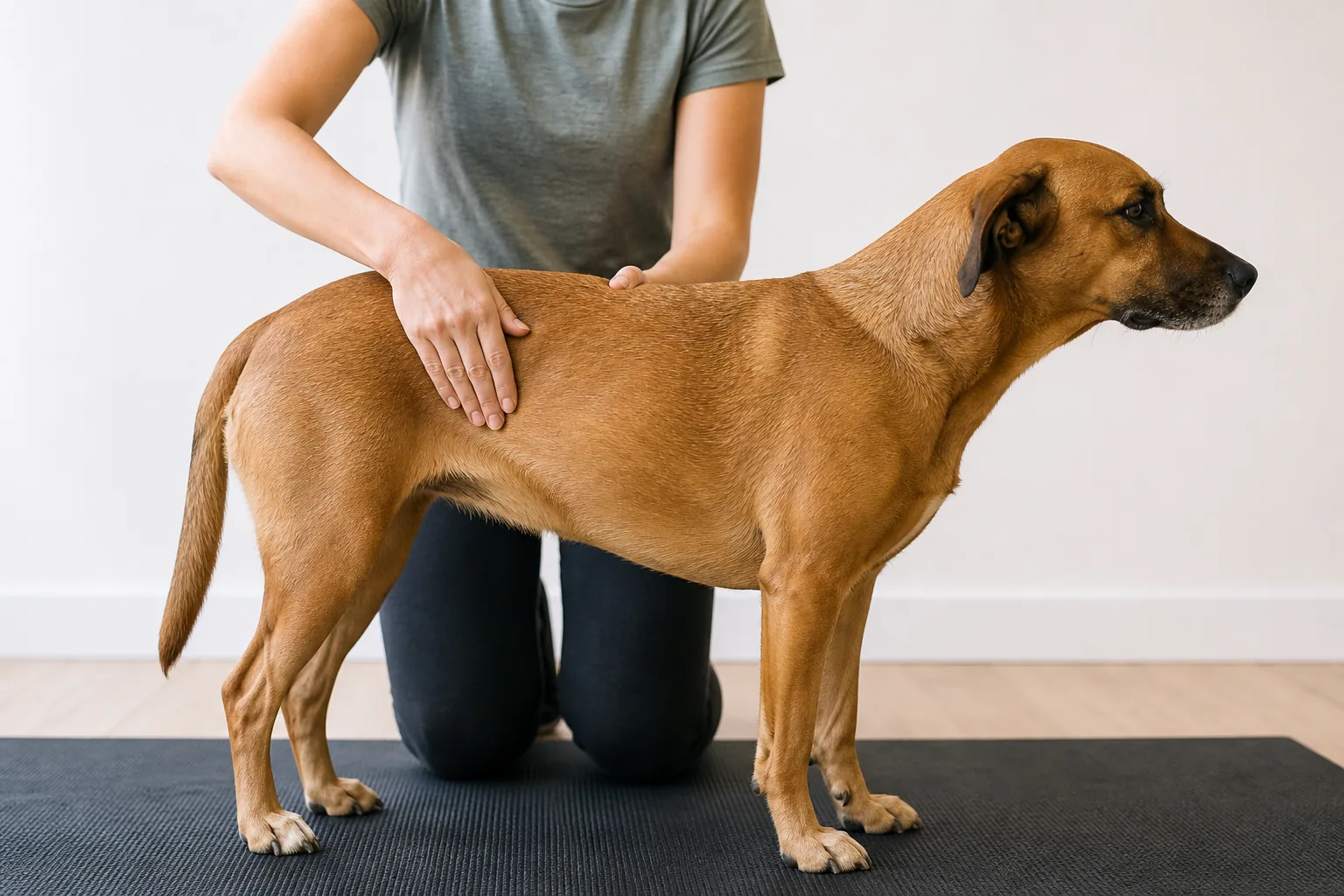
At home, you can learn to feel the ribs, look for a waist from above, view the abdominal tuck from the side, and notice muscle over the spine, shoulder blades, skull, and hips. Those observations help you communicate early changes. They do not diagnose disease or establish a weight-loss target without veterinary assessment.
Sudden weight change, muscle loss, a swollen abdomen, breathing difficulty, weakness, appetite or thirst change, vomiting, diarrhea, pain, or altered elimination requires veterinary attention. Do not respond to an unexplained change by simply feeding much more or less.
Use three measurements, not one
Body weight
Weight is objective and easy to trend when measured consistently. It is valuable, but it does not reveal composition. Growth, pregnancy, fluid accumulation, a large mass, fat gain, or muscle gain can all increase the number. Fat loss and muscle loss can both decrease it.
Body condition score
Body condition scoring estimates fat stores by combining touch and visual shape. Common veterinary systems use either five or nine points. Always record the denominator: “4/9” and “4/5” mean very different things.
On the nine-point system, a score around four to five is generally considered ideal for dogs, but the veterinary team should set the individual target. Lower scores indicate progressively less fat cover; higher scores indicate progressively more.
Muscle condition score
Muscle condition is assessed separately. A dog can carry excess fat while losing muscle, particularly with aging, reduced mobility, or disease. Body condition alone can hide that loss. Muscle scoring commonly describes normal, mild, moderate, or severe loss after examining specific areas.
Together, these measures answer different questions: What does the dog weigh? How much fat cover is present? Is muscle being maintained?
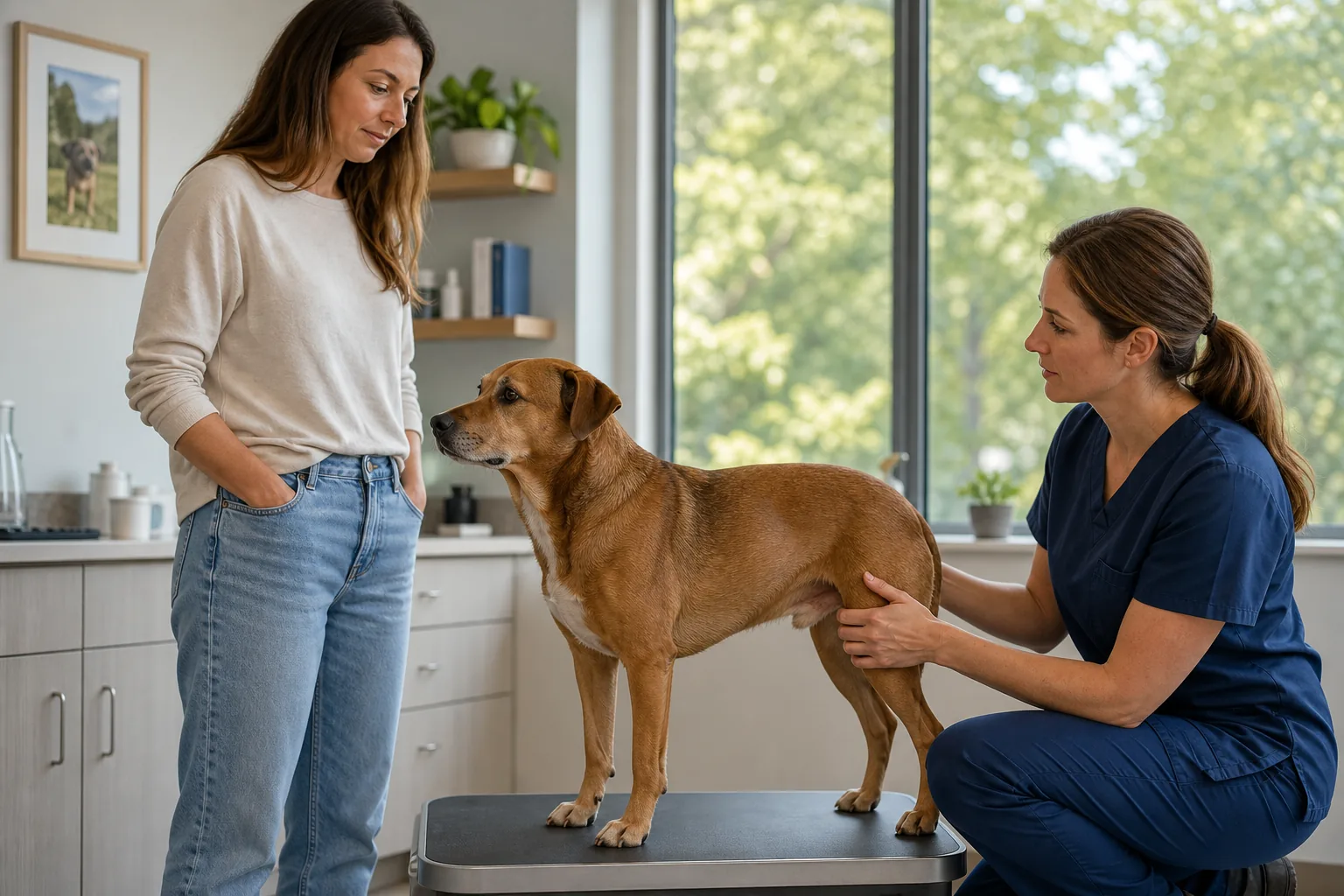
Ask the veterinary team to calibrate your hands
Charts are helpful, but touch is easier to learn with a demonstration. At the next visit, ask the veterinary professional to:
- state the current weight
- assign and explain the BCS scale used
- assess muscle condition separately
- show where to feel ribs, waist, tuck, spine, shoulders, skull, and hips
- identify an individualized target range
- explain how often to recheck
- document findings in the medical record
Practice while the professional watches. Thick coat, loose skin, unusual conformation, pregnancy, growth, edema, abdominal disease, and muscle loss can make home interpretation harder.
Do not copy a target weight from another dog or an online breed table. A target should reflect the individual’s frame, health, life stage, and body composition.
Prepare for a calm home check
Choose a nonslip surface and a time when the dog is relaxed. Have good light and, if useful, another adult observe from the side and above. Keep the session brief.
Begin with ordinary petting. Stop if the dog shows pain, flinches, guards an area, moves away repeatedly, freezes, growls, or attempts to bite. Pain changes posture and requires assessment. Do not press harder to “feel through” resistance.
Use flat fingertips and gentle pressure. The aim is to assess tissue, not squeeze the abdomen or manipulate joints. Children should not perform the check unsupervised.
For long-coated dogs, touch is more reliable than photographs alone. Wetting or shaving the coat is unnecessary.
Step 1: Feel the ribs
Run flat fingertips lightly over both sides of the rib cage. In an ideally conditioned dog, ribs are usually easy to feel with a slight fat covering rather than sharply protruding or buried under a thick layer.
Ask:
- Can each rib be distinguished with light pressure?
- Is there a thin, even covering?
- Must you press firmly to locate ribs?
- Are ribs visibly prominent from a distance in a short-coated dog?
- Are the two sides similar?
Ribs that are difficult to feel under substantial tissue suggest higher body fat. Very prominent ribs with little cover suggest low body condition, although build and disease matter. One tender or asymmetric area is not a scoring issue; it is a reason to contact a veterinarian.
Do not use the “back of the hand versus knuckles” analogy as a diagnosis. Hands differ, and it ignores the dog’s other landmarks.
Step 2: Look from above for a waist
Stand behind the dog while the dog stands naturally. The body should narrow behind the rib cage before widening toward the hips in a dog near ideal condition. This is often described as an hourglass, but it may be subtle depending on conformation and coat.
An extremely narrow waist with prominent bones can accompany low body condition. A straight or outward-curving outline with no discernible waist can accompany excess fat. Do not suck in or reposition the abdomen, and do not judge a curled sleeping dog.
A round abdomen is not automatically obesity. Pregnancy, fluid, organ enlargement, gas, endocrine disease, parasites, and other conditions can change shape. New or disproportionate abdominal enlargement requires veterinary evaluation.
Step 3: View the abdominal tuck
From the side, look at the line from the rib cage toward the hind legs. Many ideally conditioned dogs have an abdomen that rises behind the ribs. Less tuck can accompany higher fat stores; a severe tuck with prominent bones can accompany low condition.
Breed and individual shape affect the outline. Deep-chested dogs naturally look different from stockier dogs. Use tuck as one part of a combined score, never the only criterion.
A tense dog may pull the abdomen up. A painful dog may stand differently. Reassess in a relaxed posture and involve the veterinarian when shape or stance changes.
Step 4: Feel additional fat landmarks
Following the chart and veterinary demonstration, gently assess the spine, base of tail, hips, and other designated areas. Higher-condition dogs may have fat deposits over the lower back and tail base. Lower-condition dogs may have prominent bones with little tissue cover.
Do not confuse muscle with fat. Firm tissue beside the spine in an athletic dog differs from a soft fat pad, but home interpretation is imperfect. That uncertainty is exactly why body and muscle scores should be calibrated professionally.
Avoid pressing directly on painful hips or an arthritic spine. Comfort takes priority over completing the score.
Step 5: Assess muscle separately
Body condition asks about fat; muscle condition asks about muscle mass. Examine and gently feel areas recommended by the veterinary team, commonly including the temples, shoulder blades, spine, and pelvic bones.
Look for:
- newly sharp shoulder blades
- a more prominent spine despite unchanged or increased body weight
- hollowing at the temples
- reduced muscle over hips or thighs
- left-right asymmetry
- declining ability to rise, climb, jump, or walk
Age alone should not dismiss muscle loss. Older dogs need close muscle and mobility monitoring because disease, pain, disuse, and nutritional factors may contribute. An overweight dog can still have substantial muscle loss underneath fat.
Do not start protein supplements or strenuous resistance exercise without veterinary guidance. Kidney, liver, orthopedic, neurological, and other conditions change what is appropriate.
Weigh consistently and look for trends
Use the same reliable scale when practical, at a similar time relative to meals and elimination. For small dogs, a suitable pet or infant scale may work if the dog can stand safely. For larger dogs, schedule brief veterinary or clinic weight checks.
Never hold a struggling heavy dog on a household scale. The fall risk and measurement error outweigh convenience. Do not subtract two unstable human-scale readings and treat the result as precise.
Record:
- date
- weight and unit
- scale/location
- BCS with denominator
- muscle condition
- diet and measured daily amount
- treats, chews, table food, supplements, and food used for medication
- activity and mobility change
- appetite, thirst, stool, vomiting, and other health observations
One reading can be noisy. A consistent trend, especially with BCS or muscle change, is more informative. Still, a sudden marked shift or illness signs should not wait for more data.
Photograph shape responsibly
Monthly overhead and side photographs can support a trend when taken on the same nonslip spot, from the same angle, with the dog standing naturally. Include the date and current weight in the record.
Photographs cannot replace hands-on scoring. Coat, posture, lens distortion, lighting, and camera distance can conceal or exaggerate shape. Do not force an uncomfortable stance or share identifying images publicly when a private health record is sufficient.
Interpret the nine-point scale as a continuum
A standard chart provides progressively changing descriptions rather than a binary pass/fail. At the lowest end, ribs, spine, and pelvic bones may be readily visible with severe loss of fat and muscle. Around the ideal middle, ribs are readily felt with slight cover, a waist is visible from above, and an abdominal tuck is present. At the highest end, ribs may be very difficult to feel, the waist and tuck may disappear, and substantial deposits may occur over the back and tail base.
Do not assign a point from one landmark. Use all chart criteria and the same scale over time. A home score that differs from the clinic score is an opportunity for recalibration, not a contest.
Words such as “obese” describe a medical body-condition category, not a moral failure. Neutral language makes accurate monitoring and sustainable care easier.
Respond safely to a low body condition
A thin dog does not simply need unlimited food. Low body condition or unintended loss can relate to inadequate intake, diet imbalance, parasites, dental pain, gastrointestinal disease, endocrine disease, cancer, organ disease, competition for food, difficulty accessing a bowl, or other causes.
Arrange veterinary assessment, particularly when change is unintended. Bring a complete diet history. The veterinarian may recommend examination, testing, a different diet, a controlled calorie increase, treatment, and a recheck schedule.
Rapid refeeding can be dangerous in a severely malnourished animal. Do not improvise a high-calorie plan, supplements, or large fatty meals. A rescued dog’s visible thinness does not establish how quickly or what they should eat.
Protect meals from competition and observe swallowing and chewing. Difficulty eating is a clinical sign, not pickiness to overcome.
Respond safely to a high body condition
Do not crash-diet the dog or halve food based only on appearance. The veterinary team should confirm the score, identify the current total calorie intake, consider disease and medications, select an appropriate complete diet, protect nutrient and protein intake, and set a safe rate of change.
Count every calorie source, including:
- measured meals
- training rewards
- dental chews
- long-lasting chews with edible material
- table food
- supplements and flavored medication vehicles
- food provided by other household members
- scavenged or shared pet food
Use a gram scale where practical because scoops and cups vary. The detailed process for calculating and adjusting portions belongs in a feeding plan; body-condition monitoring tells you whether that plan is moving the individual toward the veterinary target.
Exercise must match health, heat, mobility, and fitness. An overweight or arthritic dog may need gradual low-impact activity rather than intense running. Stop for breathing distress, collapse, marked weakness, heat signs, or pain and obtain veterinary direction.
Separate body-condition assessment from portion calculation
Body condition is feedback, not a feeding formula. It helps answer whether stored fat is below, near, or above the individual target. A portion plan uses that feedback along with food calorie density, life stage, activity, reproductive status, health, current intake, and veterinary goals.
Do not convert one BCS point into an automatic cup reduction without professional guidance. Foods contain very different calories per cup or gram. Growing puppies, pregnant or nursing dogs, working dogs, seniors, and dogs with disease require specialized decisions.
After a plan begins, repeat weight, BCS, and MCS at the interval set by the veterinarian. Adjust from measured evidence rather than frustration with a single week.
Watch for weight change that can hide disease
Contact a veterinarian for:
- unplanned weight loss or gain
- continued change despite a measured plan
- increased thirst or urination
- increased or reduced appetite
- vomiting, diarrhea, or altered stool
- coughing, breathing change, or reduced stamina
- a swollen or painful abdomen
- muscle loss or weakness
- difficulty rising, walking, or climbing
- new lumps, swelling, or asymmetry
- medication-associated appetite or weight change
Some conditions increase appetite while weight falls. Others cause weight gain through fluid or reduced activity. The scale cannot tell these apart.
Medication should never be stopped or changed solely because weight changed. Contact the prescribing veterinarian.
Account for puppies, athletes, and senior dogs
Growing puppies
Growth requires regular veterinary assessment using age- and size-appropriate nutrition. Faster or heavier is not automatically healthier. Large and giant breeds have particular growth considerations. Do not use an adult weight-loss strategy for a puppy.
Athletic and working dogs
Lean, well-muscled dogs may show more definition than sedentary pets. Muscle assessment, performance demands, season, and recovery matter. A generic breed target does not replace a veterinary and nutrition plan.
Senior dogs
Weight stability can conceal muscle loss and fat gain. Track muscle condition and mobility separately. Difficulty reaching food, dental pain, cognitive change, chronic disease, and medication can alter intake. Unplanned loss in an older dog warrants timely assessment rather than being accepted as normal aging.
Dogs with thick coats or unusual shapes
Hands-on assessment is essential. Coat trimming is unnecessary for scoring. Ask the veterinary team to show which landmarks are reliable for that dog.
Make household monitoring consistent
Agree on one feeding and recording system. Assign who measures meals, who gives medication food, and how treats are logged. Keep the daily allowance separate so family members can see what remains.
Use neutral goals such as “ribs easier to feel with slight cover” or “maintain normal muscle over shoulders,” not appearance-based criticism. Celebrate process: measured feeding, safe movement, successful rechecks, and stable muscle.
Do not withhold affection when food changes. Replace edible extras with play, sniffing, training using measured ration, brushing, or another activity the dog enjoys.
A repeatable monthly home check
For a medically stable adult following a veterinary plan:
- Review recent appetite, thirst, elimination, mobility, and medication changes.
- Weigh on the same scale if safe and available.
- Feel ribs on both sides.
- View waist from above.
- View abdominal tuck from the side.
- Check spine, tail base, and other chart landmarks gently.
- Assess muscle areas separately.
- Record BCS with its denominator and MCS.
- Take consistent photographs if useful.
- Compare the trend with the veterinary target and recheck date.
The veterinarian may recommend more frequent monitoring during growth, illness, or active weight management. Home checks do not replace scheduled examinations.
A healthy target belongs to the individual
The most reliable answer combines scale weight, hands-on fat assessment, muscle condition, medical context, and trend. Feel for ribs with slight cover, view waist and tuck, then assess muscle separately instead of assuming a heavier dog has more muscle or a lighter dog is healthier.
Ask the veterinary team to calibrate your score and set the target. Respond to unexpected change with investigation, not a crash diet or feeding surge. Consistent neutral observation can reveal a problem early and show whether a safe plan is truly working.