
A “healthy” dog treat is not defined by a green package, a short ingredient list, a high meat percentage, or a word such as natural. A useful treat does a specific job, fits within the dog’s calorie and health plan, can be delivered safely, and does not crowd out the complete diet. Sometimes the best reward is a crumb-sized commercial treat. Sometimes it is measured kibble, a toy, permission to sniff, or access to something the dog values.
Treats become difficult to evaluate because they sit between nutrition, training, enrichment, dental care, and household affection. A product marketed as a reward may contain more calories than expected. A long-lasting chew may be swallowed quickly. A dental treat may carry a specific evidence-based claim or only a shape that looks like a toothbrush. A “single ingredient” item may still be too fatty, hard, large, or incompatible with a therapeutic diet.
This guide provides a selection and budgeting process for generally healthy dogs. It cannot approve a treat for a dog with pancreatitis, diabetes, kidney disease, food allergy, dental disease, swallowing difficulty, obesity, or another medical concern. Ask the veterinarian what is permitted within that dog’s plan.
Define the job before choosing the product
Start by naming what the treat needs to accomplish. Common jobs include:
- frequent reinforcement during a training session
- one high-value reward during a difficult situation
- food for medication
- a calm licking or foraging activity
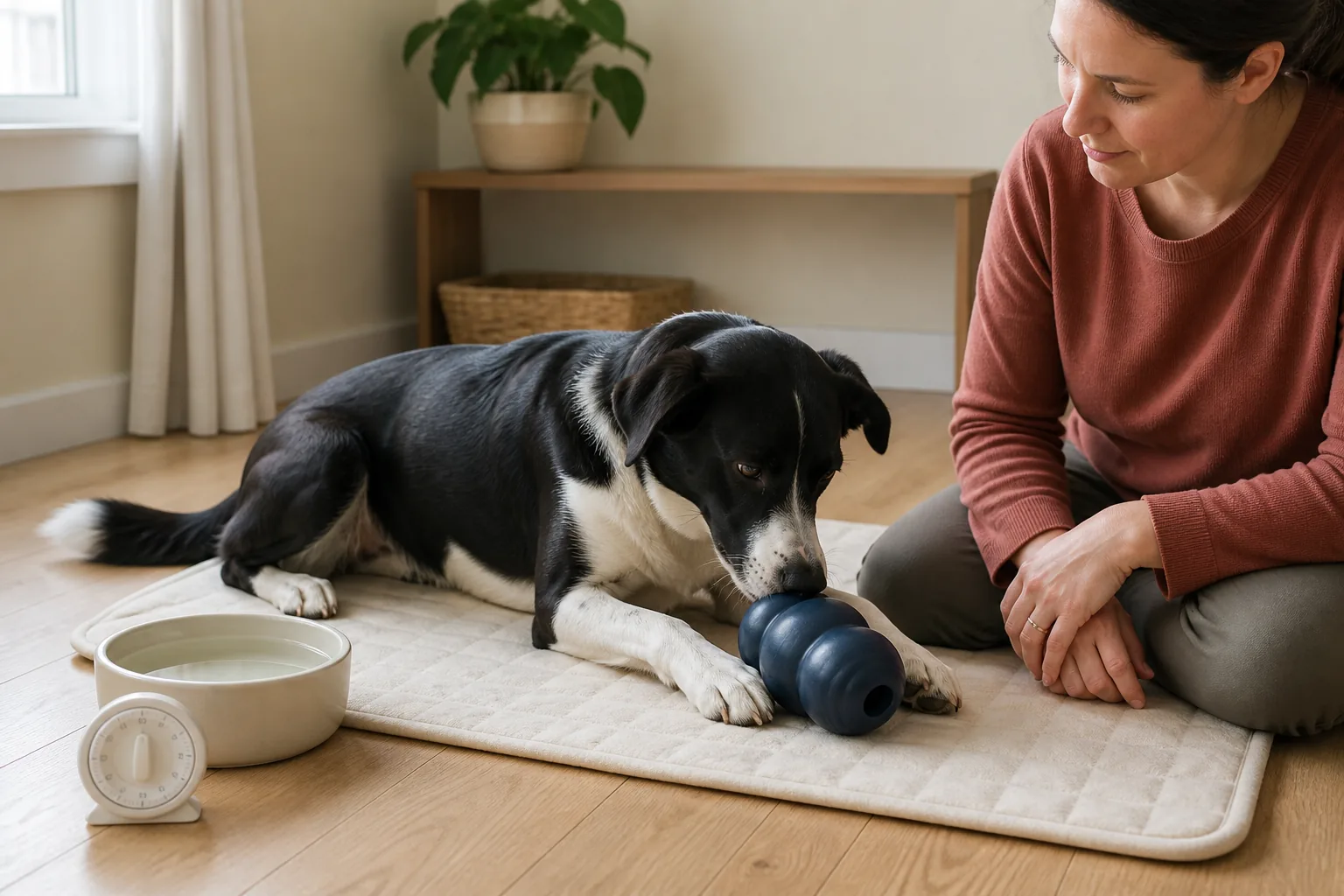
- a longer chewing activity under supervision
- a product intended to help control plaque or tartar
- an occasional shared ritual
One item rarely performs every job well. A large crunchy biscuit is slow to deliver during rapid training repetitions. A soft, rich treat may be valuable around distractions but inappropriate for dozens of rewards. A chew may occupy time but provide more calories and risk than its packaging suggests.
Once the job is clear, choose the smallest and simplest option that performs it safely. Do not buy a high-calorie chew to solve boredom if a sniffing walk, cardboard search game, or food portion in a puzzle would meet the need.
Read the calorie statement before the ingredient story
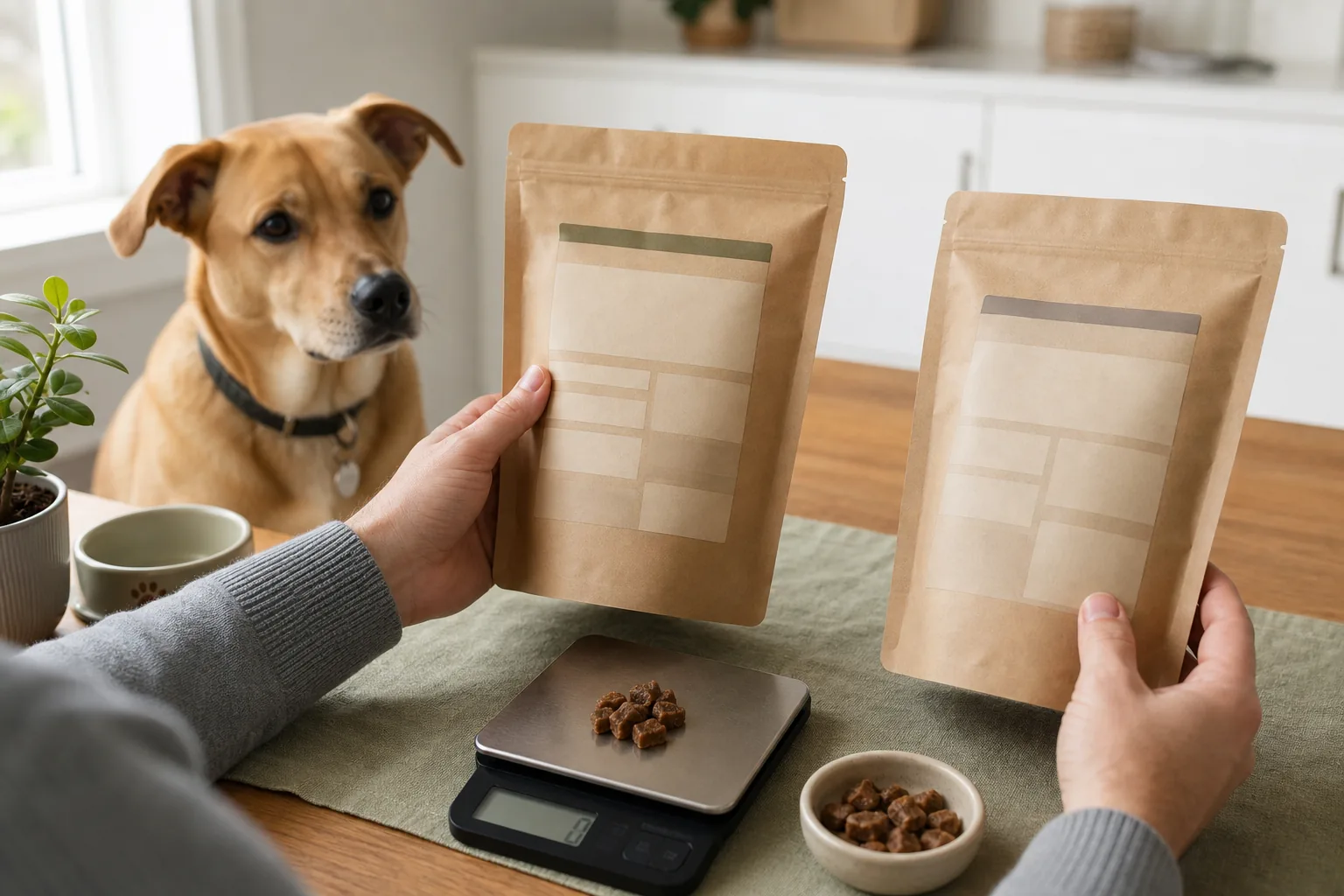
Treat calories are easy to miss because the serving unit may be a piece, biscuit, stick, ounce, or kilogram. AAFCO explains that calorie content may be stated as kilocalories per kilogram and per familiar unit. If only kcal/kg is available and the treat’s weight is known, estimate calories per piece:
- Divide kcal/kg by 1,000 to get kcal per gram.
- Multiply by the grams in one treat.
A product at 3,600 kcal/kg contains about 3.6 kcal per gram. A 10-gram chew would supply about 36 kcal. A training piece weighing one gram would supply about 3.6 kcal. The arithmetic is straightforward; the important step is comparing the result with the individual dog’s daily calorie target.
Do not compare packages using “low fat,” “light,” or piece count alone. A large light biscuit can contain more calories than a tiny regular treat. A bag promising 100 pieces does not say how large each piece is or how quickly a training session will use them.
When calories per piece are absent, contact the manufacturer. If the company cannot provide calorie information and precise budgeting matters, choose a product that can be measured.
Keep extras within a deliberate allowance
AAHA advises that treats make up no more than ten percent of a pet’s total daily calories. Its nutrition guidelines also identify a risk when more than ten percent comes from foods that are not complete and balanced, because extras can dilute essential nutrition and add excess energy.
This is a ceiling for many healthy pets, not a daily goal. Some dogs should receive less. Dogs on therapeutic diets may need only approved treats or portions of the prescribed food. Very small dogs may have an allowance that disappears after one ordinary biscuit.
If a dog’s veterinary calorie target is 600 kcal per day, ten percent is 60 kcal. That 60 includes every noncomplete extra: training food, dental chews, table food, lick mats, pill pockets, and edible chews. It is not 60 kcal for each category.
Create one daily treat budget. Subtract fixed items first, such as a dental product or medication food. Divide the remainder among training and enrichment. If the total will not fit, change the reward—not the arithmetic.
Use size strategically during training
A training treat needs to be valuable enough for the environment, easy to swallow, and small enough to permit many repetitions without filling the dog. Dogs generally register the delivery of a reward, not its visual generosity. A soft reward can often be cut into very small pieces.
Prepare pieces before training. Tearing them while the dog waits slows timing and encourages accidental overfeeding. For a new skill in a quiet room, measured kibble may be sufficient. For recall practice around difficult distractions, a more valuable reward may be appropriate, delivered in tiny pieces or as several rapid small pieces.
Match rate to learning. Early practice may require frequent reinforcement. As the behavior becomes reliable, rewards can become less predictable without disappearing completely. Do not reduce food simply because an online rule says to “phase out treats”; maintain behavior with a mix of food, play, access, praise, and real-life rewards that matter to the dog.
Avoid luring indefinitely. Use food to establish movement, then shift the visible lure out of the picture while continuing to reinforce successful responses. This keeps the dog from needing to see a treat before acting.
Consider non-food rewards
Food is efficient, but it is not the only reinforcer. Depending on the dog and context, useful rewards include:
- permission to sniff a tree or investigate a scent
- opening the door to the yard
- chasing an appropriate toy
- a short tug game
- greeting a familiar person
- moving forward on a walk
- calm praise or touch, if the dog genuinely enjoys it
- access to a resting place or distance from pressure
Observe what the dog seeks in that moment. A ball may outrank cheese for one dog and have no value for another. Environmental rewards help preserve the calorie budget, but they should not be forced. Petting is not a reward when the dog moves away from it.
Check ingredients for the individual dog
An ingredient list is not a complete quality score, but it matters when a dog has a confirmed allergy, is participating in a veterinary elimination trial, or must avoid a particular nutrient or ingredient. During an elimination trial, even a flavored medication, chew, or shared crumb can invalidate the process. Use only items approved by the veterinarian.
Check for hazardous ingredients, especially xylitol in products adapted from human food. Avoid treats containing grapes or raisins, chocolate or caffeine, onion, garlic, alcohol, or macadamia nuts. Mixed products deserve more scrutiny than a clearly labeled commercial dog treat.
“Single ingredient” does not mean universally safe. A dried organ product may be rich and calorie-dense. A very hard animal part may damage teeth. A large strip can become a swallowing hazard. Evaluate composition, size, texture, and quantity separately.
Match texture and size to how the dog eats
Watch the dog consume the item. Does it chew methodically, gulp whole pieces, tear off large chunks, or guard the treat when approached? Select a size that cannot be swallowed whole at the start, but recognize that the item becomes smaller during use.
Supervise chews. Remove them when they become small enough to swallow or when pieces break off. Do not reach suddenly into the mouth of a dog who may guard; use a trained trade with another appropriate reward and seek behavior help if guarding creates risk.
Hardness matters for teeth. A product that is nearly impossible to indent or flex may create fracture risk for an aggressive chewer. Existing dental disease, missing teeth, age, jaw structure, and chewing style change the decision. Ask the veterinarian to examine the mouth and recommend suitable textures.
Puppies and seniors may need softer items, but “soft” does not eliminate choking or calorie concerns. Dogs who swallow without chewing may be poor candidates for edible chews of any texture.
Evaluate dental treats by the actual claim
A toothbrush shape is a design, not evidence. The Veterinary Oral Health Council authorizes its seal for products that meet criteria for helping control plaque, tartar, or both. Its accepted-products list identifies the specific claim for each product.
If dental benefit is the purpose, look for a recognized evidence signal such as a current VOHC seal and verify that the exact product and size appear on the accepted list. “Helps freshen breath” is not the same claim as reducing plaque or tartar. Bad breath may also reflect dental disease that needs examination rather than another chew.
Even an accepted dental treat contributes calories and must match the dog’s size and health. It does not replace professional dental assessment or home brushing when brushing is appropriate. A product tested for tartar control should not be advertised by the owner as preventing every dental disease.
Treat supplements as supplements, not snacks
Products marketed for joints, calming, skin, digestion, or immunity may look like ordinary soft treats. They can contain active ingredients and dosing instructions. Giving several because the dog likes the flavor can exceed the labeled amount. Combining products may duplicate ingredients.
List every supplement for the veterinarian, including “natural” chews. Ask what outcome is expected, how long a trial should last, what evidence supports the ingredient for this dog, and what adverse effects or interactions to watch for. If the item has no defined goal or monitoring plan, its calories and cost may be easier to justify as something else.
Be cautious with long-lasting and rawhide-style chews
Chew safety depends on the product and dog. Potential problems include choking, obstruction, broken teeth, gastrointestinal upset, contamination, and consumption of more material than intended. “Digestible” does not mean risk-free or that every piece will pass safely.
Choose products from manufacturers that provide clear sizing, calorie, ingredient, lot, and contact information. Follow size and supervision instructions. Do not let multiple dogs compete over valuable chews. Discard damaged, contaminated, or inappropriately small pieces.
Rawhide is a product category with variation in thickness, processing, and use. Some products have earned a VOHC claim, but that claim concerns plaque or tartar efficacy—not a guarantee against choking, obstruction, or individual intolerance. Discuss suitability with the veterinarian.
Understand what an “all natural” jerky claim cannot prove
The FDA has investigated illness reports associated with jerky pet treats. The agency notes that jerky treats are not required for a complete diet and advises monitoring dogs who receive them. Reported signs have included reduced appetite or activity, vomiting, diarrhea, increased drinking, and increased urination, although an adverse report alone does not prove that one product caused every illness.
This history does not justify declaring every jerky treat dangerous. It does show why traceability and observation matter. Keep the package and lot number. Stop feeding a suspect product and contact a veterinarian when illness follows. Report the product through the manufacturer and relevant regulator when advised.
Country-of-origin language, a rustic package, or “one ingredient” is not a substitute for quality controls. Ask who manufactures the product, where, and how finished lots are tested.
Store treats like food, not toys
The FDA recommends keeping pet food and treats in their original containers or preserving the product name, manufacturer, UPC, lot number, and best-by date. Those details are essential if a complaint or recall occurs.
Store treats in a cool, dry, secure place. A dog who consumes an entire bag may face a much larger calorie, fat, salt, obstruction, or ingredient exposure than intended. Wash and dry reusable containers between products instead of continuously topping them up. Keep moist or refrigerated products according to label instructions.
Use clean hands and utensils. Treats can carry harmful bacteria just as other foods can. This is especially important in households with young children, older adults, pregnant people, or anyone with reduced immunity.
Build a label comparison card
For each candidate treat, record:
- intended job
- calories per piece or gram
- piece weight and whether it can be divided
- complete-and-balanced or treat/supplement status
- full ingredient list
- relevant allergen or therapeutic-diet conflicts
- texture and size
- supervision instructions
- manufacturer and contact route
- lot and best-by location
- evidence for any dental or functional claim
- daily maximum that fits the dog’s calorie plan
- stop signs to monitor
Then run a real-use test. Count how many pieces a normal five-minute session consumes. A treat that looks low-calorie per piece can still dominate the allowance when 30 pieces are used.
Make a daily reward plan
At the start of the day, measure the full allowance into one container. Everyone rewards from it. If the dog has a fixed dental treat, place a token in the container representing those calories so they are not forgotten. When the container is empty, use measured main food or non-food rewards as appropriate.
For multi-dog homes, keep separate containers. Dogs may have very different calorie needs and dietary restrictions. Do not divide a treat bag equally by eye.
Review the plan when weight, activity, health, medication, or main food changes. A switch to a more calorie-dense main diet may leave less room for extras even when the bowl volume looks smaller.
When to stop a treat and call the veterinarian
Stop using the product and seek advice if the dog develops repeated vomiting or diarrhea, marked appetite or activity change, increased thirst or urination, facial swelling, hives, breathing difficulty, pain, blood in vomit or stool, difficulty swallowing, choking, a broken tooth, or suspected obstruction. Emergencies such as breathing difficulty, collapse, severe weakness, repeated unproductive retching, or a lodged object require immediate care.
Save the product and packaging unless handling it is unsafe. Record how much was offered, how much may have been eaten, and when signs began. Do not assume a new symptom is a harmless “detox” response.
The decision to take away
A healthy treat is a tool with a defined job and a controlled cost. Read calories, ingredients, texture, size, evidence, and manufacturer information. Fit every edible extra into one daily allowance and protect complete nutrition. During training, make pieces smaller before making the calorie budget larger. For enrichment, consider whether access, sniffing, play, or measured main food can do the job.
Treat claims should be as specific as the evidence. A VOHC tartar claim is not a promise to prevent all dental disease. A single ingredient is not proof against choking or excess fat. A supplement-shaped treat is still a supplement. And a product the dog loves is not automatically one the dog should eat without limit.
The best treat is not the most impressive item in the aisle. It is the smallest safe, suitable reward that helps this dog succeed without quietly rewriting the nutrition plan.