A dog who empties a bowl in seconds may look enthusiastic rather than unwell. Sometimes that is exactly what is happening: the dog has learned that food arrives briefly, has practiced gulping for years, or becomes hurried around another animal. But speed can also travel with regurgitation, choking risk, competition, an unusually strong appetite, or a medical change. The useful question is not simply, “Which slow bowl should I buy?” It is, “What pattern am I trying to change, and is a household feeding adjustment appropriate?”
Start by observing the meal you already have. Preserve the dog’s measured daily ration, change one feature at a time, and choose equipment that fits the dog’s muzzle, food texture, and behavior. A successful method makes eating calmer and longer without causing panic, damaged teeth, swallowed toy pieces, calorie creep, or conflict between dogs.
This guide is for routine fast eating in a dog who otherwise seems well. It cannot diagnose excessive hunger, vomiting, regurgitation, swallowing disease, dental pain, parasites, diabetes, medication effects, or gastric dilatation-volvulus. New or worsening signs deserve veterinary assessment rather than a more complicated puzzle.
Define the problem before changing the bowl
“Too fast” has no universal stopwatch cutoff. A small portion of easy-to-lap canned food will disappear faster than dry food scattered across a mat. A large dog may finish a correctly measured meal quickly without showing distress. Record the complete pattern instead of assigning meaning to one number.
For several ordinary meals, note:
- the food, texture, and exact measured amount
- the start and finish time
- whether the dog chews, pauses, coughs, gags, or backs away
- whether food or fluid returns immediately and appears undigested
- whether there is later vomiting, loose stool, gas, restlessness, or discomfort
- whether another pet or person approaches the feeding area
- whether the dog guards the bowl or frantically searches afterward
- changes in thirst, urination, weight, stool, energy, or appetite
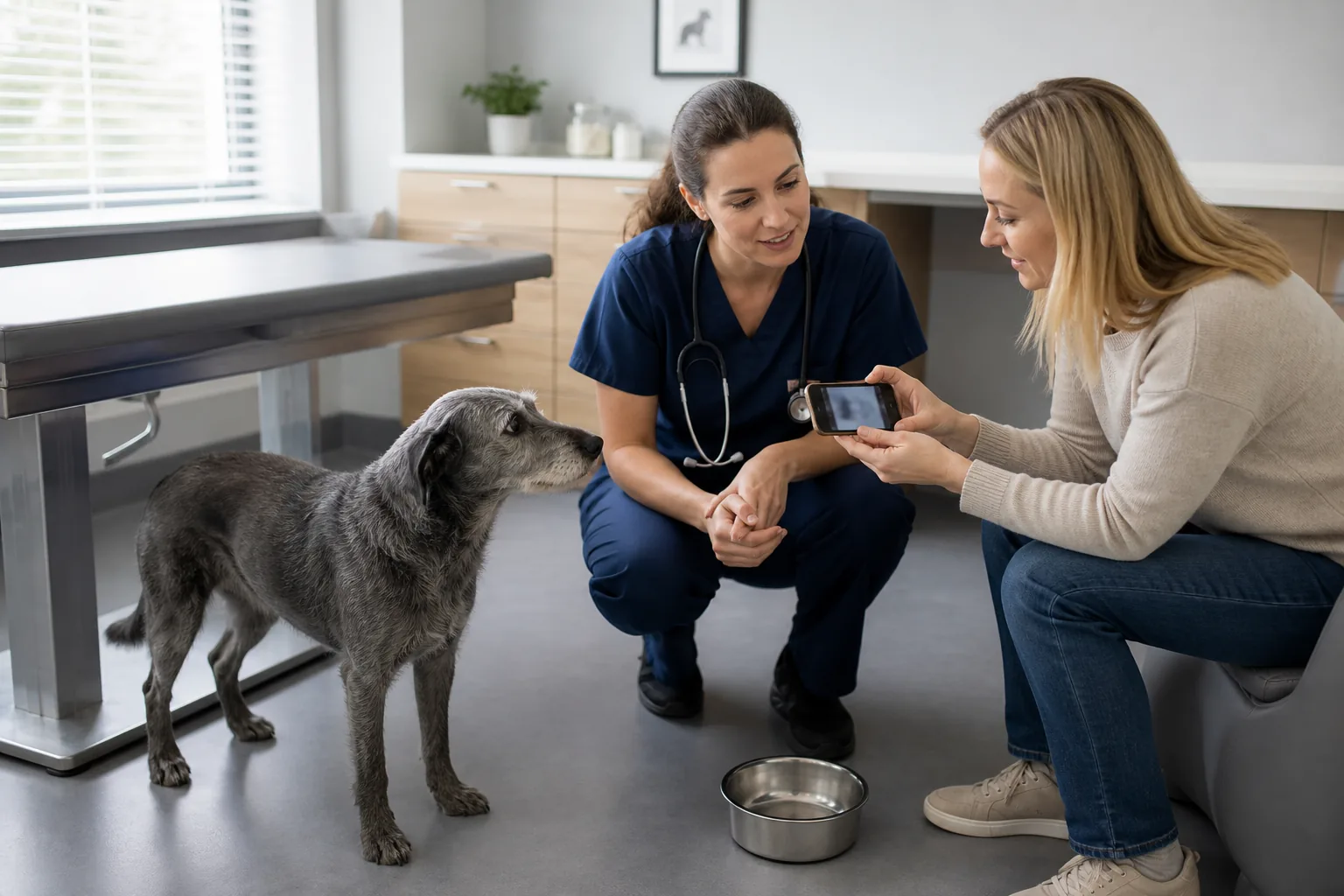
A phone timer is more useful than a guess, and a short video can help a veterinarian see the mechanics. Film without crowding or provoking the dog. Do not reach into the bowl, repeatedly remove it, or “test” guarding. Those actions can add pressure and may create a bite risk.
Distinguish vomiting from regurgitation when describing an event. Vomiting usually involves nausea and abdominal effort; regurgitation is often more passive and may occur soon after swallowing. Owners cannot always separate them reliably, but timing, appearance, and a video give the veterinary team better evidence than the single word “sick.” Repeated episodes are not a normal price of eating enthusiastically.
Decide whether this is a routine case
It is reasonable to trial a simple slowing method when the dog has a stable appetite, normal energy, stable weight, ordinary stool, no repeated cough or gag, no abdominal swelling, and no recurring vomiting or regurgitation. The goal is then to reshape meal delivery, not treat disease.
Arrange veterinary advice when speed is new, the appetite has become unusually intense, the dog loses weight despite eating, thirst or urination increases, stool changes persist, the dog raids nonfood items, or meals repeatedly cause coughing, gagging, vomiting, or regurgitation. Puppies, very small dogs, seniors, pregnant or nursing dogs, and dogs with diabetes, swallowing problems, gastrointestinal disease, previous abdominal surgery, or prescription diets may need an individualized schedule.
Medication can change hunger, thirst, nausea, or coordination. Do not alter a prescribed medicine or diet to solve fast eating. Tell the prescriber what changed and when.
Treat possible bloat as an emergency
Gastric dilatation-volvulus, commonly called GDV or bloat, is not something a slow feeder can manage at home. The Merck Veterinary Manual describes it as a life-threatening emergency in which the stomach dilates and may twist. Warning signs can include a swollen or painful abdomen, repeated unsuccessful attempts to vomit, excessive drooling, restlessness, rapid breathing, weakness, pale gums, or collapse. Seek emergency veterinary care immediately if these signs appear. Do not wait to see whether a dog settles, offer a large meal or drink, or attempt a home remedy.
Large, deep-chested dogs and dogs with a close relative affected by GDV may have greater risk, but any concerning acute pattern deserves action. Ask the veterinarian about the dog’s individual feeding routine and preventive options; do not assume that buying a maze bowl eliminates risk.
Protect the ration before making meals longer
Slowing a meal should not silently increase calories. Measure the complete daily food allowance first. If kibble is used for a puzzle, training, a scatter activity, and the bowl, all of it comes from that allowance. Put the day’s ration in one labeled container each morning and feed only from that container. This makes it difficult for several family members to duplicate meals.
Count calorie-containing toppers, treats, and fillings. Peanut butter, cheese, commercial pastes, biscuits, and extra canned food can turn “enrichment” into a substantial second meal. Water can change texture without adding calories when it is safe and suitable for the food, but moistened food should not be left at room temperature for extended periods. Follow the product’s storage instructions and clean food-contact equipment after use.
Do not solve speed by deliberately overfilling a device. The dog still needs an appropriate total amount based on food calories, body condition, life stage, activity, health, and veterinary guidance. Portion calculation belongs to the separate Kickaball feeding guide; this page focuses on delivery mechanics.
Remove social pressure first
In a multi-dog home, competition can make eating faster. Feed dogs in separate rooms, behind secure barriers, or in crates only if each dog is already comfortable eating there. Give each animal enough distance that nobody stares, circles, steals, or waits at the other side of a gate. Pick up equipment after every dog has finished before reopening the space.
Separation is also safer when foods differ. It prevents a puppy from eating an adult diet, a healthy dog from taking prescription food, or a larger dog from emptying a smaller dog’s bowl. It provides an honest record of who ate.
Do not stand over a dog and repeatedly touch the food in an attempt to teach tolerance. A dog who stiffens, freezes, hovers, hard-stares, growls, snaps, or rushes harder around food needs a low-conflict plan. Create distance and consult a qualified reward-based behavior professional or veterinarian. Speed caused by perceived theft will not be repaired by more threats of theft.
Choose the least complicated method that works
Begin with a method the dog can solve easily. The objective is a smooth, observable meal—not maximum difficulty. Time the original meal, trial one change for several days, and compare speed and behavior.
A wide flat surface
For dry food, spreading the measured ration across a clean rimmed baking sheet can prevent one large mouthful. The surface should be nonslip and placed where it cannot slide or clang. A muffin tin divides food into small wells and can work for kibble or suitable moist food.
These low-cost options are easy to inspect and wash. They also reveal whether the dog slows when food is physically separated. Stop if the dog bites metal, flips the tray, becomes frantic, or scrapes the muzzle.
A purpose-made slow-feeder bowl
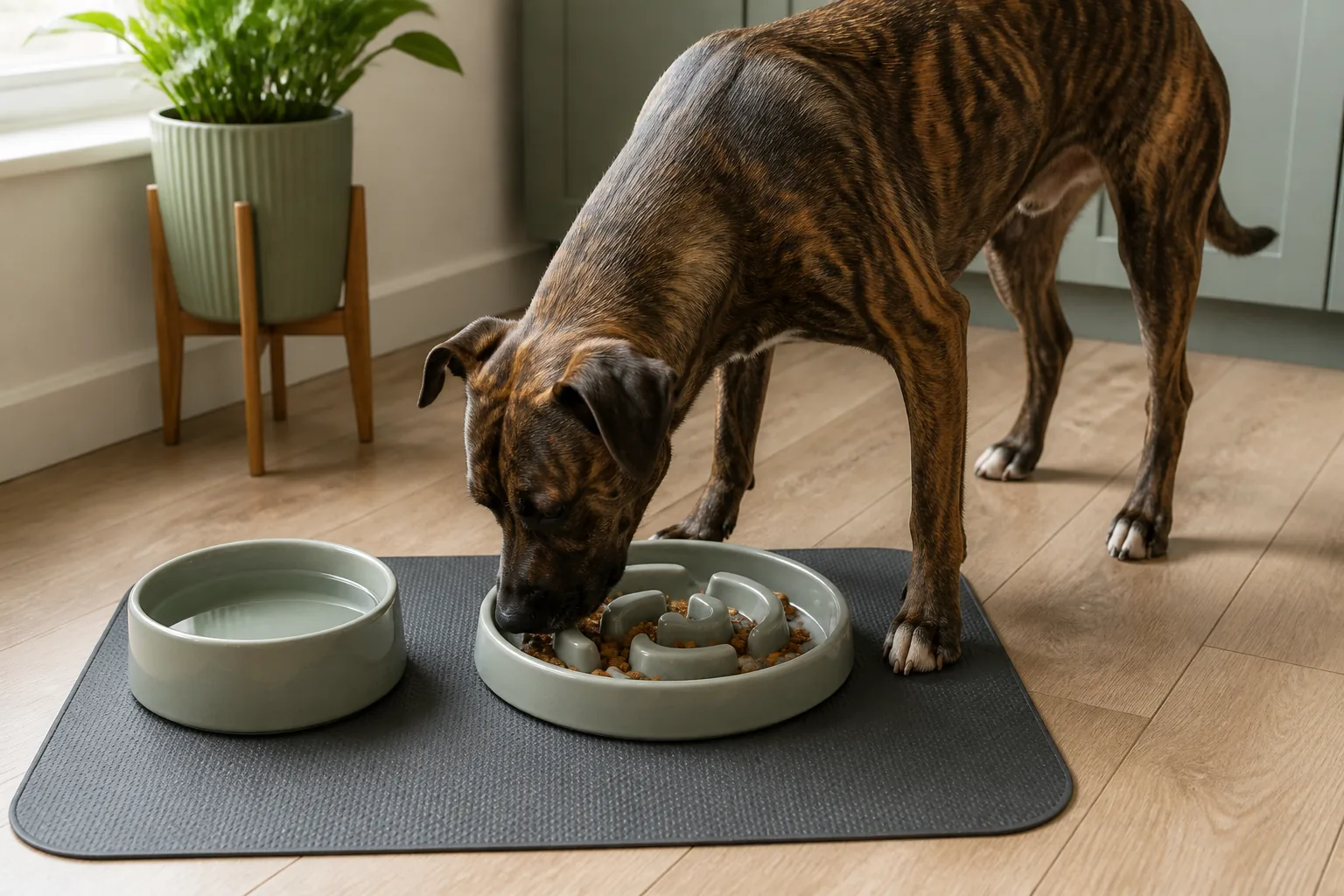
Choose a food-safe bowl with broad, smooth channels. The dog must be able to reach food without wedging the jaw or rubbing the eyes and nose. Flat-faced dogs may need a shallow design; a deep maze designed for a long muzzle may be inaccessible. The base should remain stable under normal use.
Inspect seams, ridges, suction pads, and rubber feet. Retire a bowl that cracks, splinters, develops sharp edges, or loses pieces. Difficulty should come from smaller accessible sections, not from forcing the dog to bite hard plastic.
Run a supervised first meal. If the dog calmly licks or picks up pieces and finishes the ration, the design may be appropriate. If the dog paws violently, chews barriers, carries the bowl, quits while still hungry, or shows escalating frustration, choose an easier design.
A lick mat for suitable soft food
A thin layer of the dog’s own canned food on a food-safe lick mat can extend a meal. Use an amount from the ration, not an unmeasured high-calorie coating. The mat must stay intact and should be supervised; it is not suitable for a dog who tears and swallows flexible material. Wash grooves thoroughly and replace damaged mats.
Freezing may increase duration, but very hard food can be frustrating or unsuitable for dogs with dental sensitivity. Start unfrozen or lightly chilled and ask the veterinarian before changing texture for a dog with swallowing, dental, or gastrointestinal concerns.
A food-dispensing toy
An interactive feeder can release small portions as it moves and can combine eating with foraging. Select the correct size and strength. No opening should trap the lower jaw, and no detachable part should be small enough to swallow. Supervise until the dog has demonstrated a safe style of use.
Introduce the device at its easiest setting with some food visible and easy to obtain. A dog should learn how it pays before difficulty increases. A toy that rolls beneath furniture, startles the dog, or requires forceful chewing is not automatically enriching.
Scatter feeding or a sniffing search
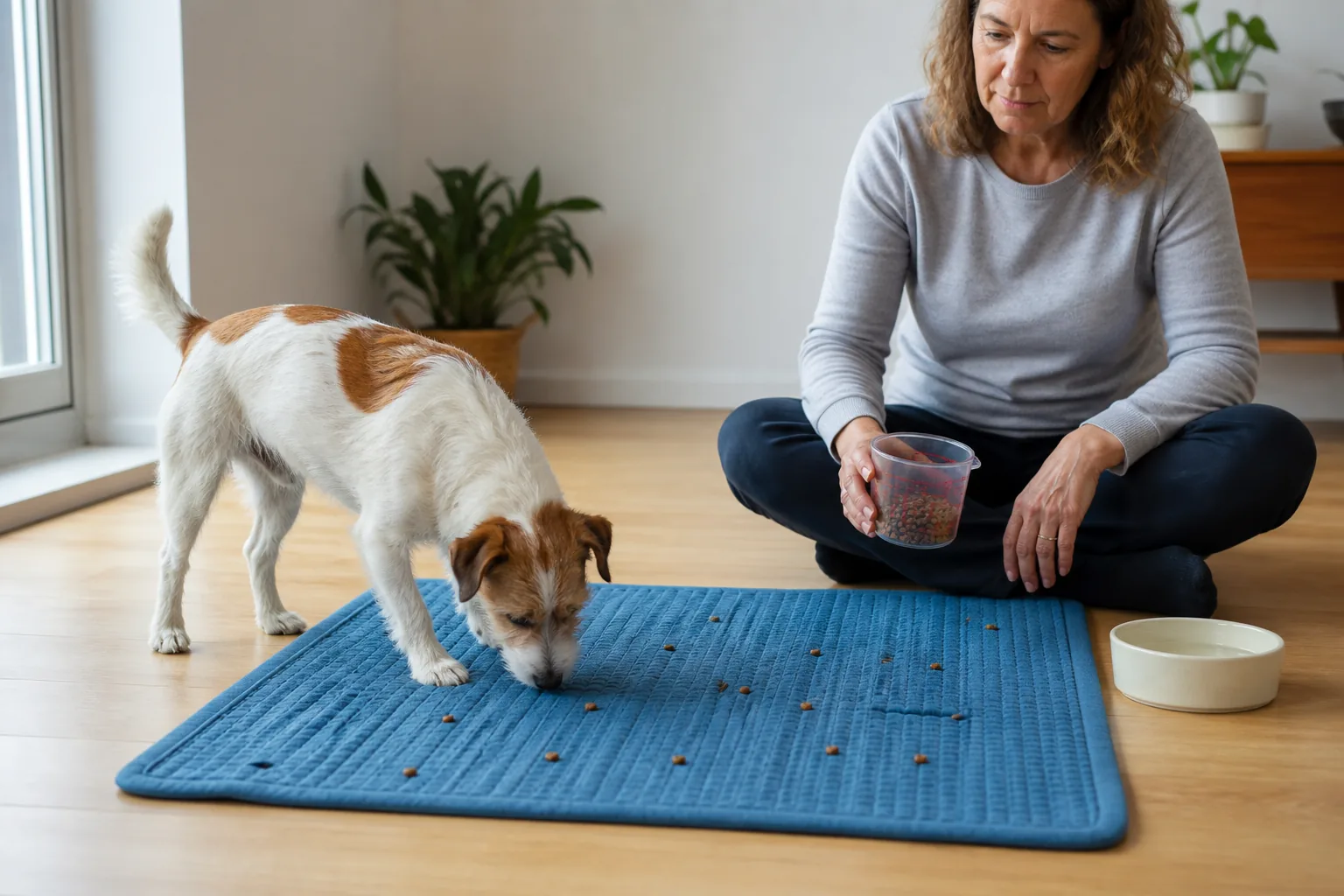
Scattering kibble over a clean, dry, enclosed surface can turn one pile into many finds. A snuffle mat can serve a similar purpose if the dog searches rather than eats fabric. Count every piece as part of the meal and supervise cleanup.
Avoid treated lawns, pesticides, toxic plants, gravel that resembles kibble, dirty public ground, and spaces shared with unfamiliar animals. Do not scatter food where multiple dogs will compete. For a dog who eats foreign objects, searches obsessively, or guards found food, use a contained alternative.
Training with the meal
Part of the measured ration can reinforce a few familiar, low-pressure behaviors. Deliver one or several pieces at a time, keep the session short, and finish the remaining ration through an appropriate feeder. This works best when the food is safe to handle and the dog can eat individual pieces comfortably.
Training should not make access to basic nutrition exhausting. A puppy, sick dog, anxious dog, or dog learning a new skill may need a simpler meal. Do not demand a long performance or withhold the ration because responses are imperfect.
Several scheduled portions
Dividing the same daily ration into more meals reduces the amount available to gulp at once. This can help some dogs, but meal frequency interacts with age, household schedule, medication, diabetes management, gastrointestinal conditions, and GDV planning. Confirm the schedule with a veterinarian when health conditions are present.
A timed feeder can deliver portions consistently, but it must resist tipping and chewing. Observe whether anticipation increases distress. Never rely on an unsupervised device until you know the dog cannot break, swallow, or become trapped by its parts.
Methods to avoid
Do not place rocks, golf balls, loose hardware, or another improvised object in a bowl. Advice like this appears online, but a movable object can damage teeth, become a choking or swallowing hazard, or collect contamination. Purpose-made intact equipment or a flat divided surface is easier to assess.
Do not hand-feed by pushing fingers into the mouth, grab the bowl mid-meal, use punishment, or frighten the dog away from food. These methods add conflict and can worsen rushing or guarding.
Do not add water solely to make a dog feel full and then encourage rapid drinking. Fresh water should normally remain available, and changes to water intake for a medical reason belong to veterinary instructions. A dog who suddenly drinks much more needs assessment, not a device that hides the measurement.
Do not use a puzzle as an unsupervised chew toy unless the manufacturer identifies it for that use and the individual dog has proven safe. “Durable” is not the same as indestructible.
Do not make the challenge harder every day simply because the dog has learned it. Once a device produces a calm, safe meal, consistency may be more valuable than novelty.
Measure whether the change is helping
Use a short trial log for five to seven meals:
| Measure | Before | With method | | --- | --- | --- | | Food and amount | Record exact ration | Keep identical | | Meal duration | Time in minutes/seconds | Time again | | Eating mechanics | Gulping, coughing, pauses | Describe changes | | Emotional state | Loose, rushed, guarded, frantic | Describe changes | | After-meal signs | None, regurgitation, vomiting, discomfort | Record timing | | Equipment | Standard bowl | Product and setting |
The result does not need to meet an invented minimum duration. A helpful method produces smaller mouthfuls or more pauses, keeps the dog relaxed, delivers the full intended ration, and is practical to clean. It should not create a new safety problem.
If a meal becomes dramatically longer because the dog cannot access the food, that is failure rather than success. If frustration rises, reduce difficulty. If speed remains unchanged, try a different delivery category instead of stacking obstacles.
Clean equipment as feeding equipment
Food puzzles are dishes, not decorative toys. Disassemble them according to their instructions, remove food from seams, wash with an appropriate method, rinse, and dry fully. Porous, scratched, or damaged surfaces are harder to keep clean. Have enough equipment that a wet item can dry rather than being refilled immediately.
Handle kibble and treats with clean, dry hands. Preserve the original food bag and lot information even if daily portions go into another container. Wash scoops and storage bins between products rather than continually topping up old residue. Refrigerate opened canned food as directed and discard food left out beyond safe product guidance.
Build a calm repeatable routine
Prepare the measured food before calling the dog. Ask other pets and children to leave the feeding area. Place the device on a stable surface, release the dog without teasing or prolonged waiting, and give space. Observe quietly from a safe distance.
After the meal, note the time and any signs, pick up the device, and clean it. Predictability reduces the pressure created by people hovering, moving the bowl, or improvising a new contest each day.
If the dog finishes calmly, resist adding extra food just because the meal looks small or the dog continues to solicit. Appetite and calorie need are related but not identical. Review body condition and the feeding plan separately.
When to stop experimenting and call
Contact a veterinarian promptly for recurring vomiting or regurgitation, coughing during meals, trouble swallowing, marked abdominal discomfort, persistent diarrhea, blood, appetite change, weight loss, unusual hunger, increased thirst or urination, lethargy, weakness, or ingestion of feeder material. A dog who cannot keep water down or who deteriorates needs urgent guidance.
Seek emergency care for a distended or painful abdomen, repeated unproductive retching, heavy drooling, restlessness with rapid worsening, pale gums, weakness, breathing difficulty, or collapse. These signs can accompany GDV or another emergency. A feeding log is useful, but collecting perfect evidence must never delay care.
The practical decision
Helping a dog eat more slowly is a small behavior-and-equipment project, not a contest to create the hardest puzzle. First confirm that the pattern is stable enough for a household trial. Measure the ration, remove competition, and begin with a wide surface, suitable slow bowl, lick mat, dispenser, search, training portion, or divided schedule. Introduce one change under supervision and record what happens.
Keep the option that produces a calmer, safer meal without calorie drift, damaged equipment, frustration, or new symptoms. Clean it as carefully as any food bowl. If hunger, swallowing, digestive signs, weight, thirst, or behavior has changed, investigate the dog rather than endlessly redesigning the dish.
The best result is not a particular number of minutes. It is an individual dog consuming the correct ration with manageable mouthfuls, ordinary breathing, relaxed behavior, and no concerning after-meal pattern.