The honest answer to “How much should I feed my dog?” is not a universal number of cups. A cup is a volume, foods do not contain the same calories per cup, and dogs of the same weight do not always use energy at the same rate. Age, neuter status, activity, environment, health, body composition, and life stage all change the context. That is why a useful feeding plan starts with a defensible estimate and then treats your dog’s weight, body condition, appetite, stool, and energy as feedback.
This guide gives you a repeatable way to make that estimate. It is intended for generally healthy dogs eating a commercial diet. A growing puppy, a pregnant or nursing dog, a working athlete, a dog who is underweight, or a dog with diabetes, kidney disease, digestive disease, pancreatitis, food allergy, or another medical condition needs an individualized plan from a veterinarian. Sudden weight change, persistent vomiting or diarrhea, marked appetite change, difficulty eating, or muscle loss is not a portion-calculator problem.
The short version: use a starting point and a feedback loop
A practical portion process has six steps:
- Confirm that the main food is appropriate for your dog’s species and life stage.
- Find the calorie statement, usually expressed as kilocalories per cup, can, tray, or kilogram.
- Use the package feeding direction or a veterinary recommendation as a starting estimate—not a promise.
- Measure the full daily amount consistently, including toppers, chews, table food, and training treats.
- Track body weight and body condition on a regular schedule.
- Adjust deliberately, and involve your veterinarian when the dog or the trend falls outside a routine situation.
The important shift is from “What does a dog this size eat?” to “What starting amount does this particular food suggest, and what does this particular dog’s condition tell us after eating it consistently?”
Step 1: make sure you are portioning the right kind of food
Before calculating cups, read the nutritional adequacy statement. For a healthy dog’s main diet, you generally want a food identified as complete and balanced for the dog’s relevant life stage. In the United States, the statement may say the food is formulated to meet an AAFCO nutrient profile or that animal feeding tests using AAFCO procedures substantiate nutritional adequacy. The FDA explains that “complete and balanced” is intended to indicate that the product can serve as the sole diet for the stated life stage. Treats, snacks, toppers, and many supplements are not designed to do that.
Life stage matters. A food intended for adult maintenance is not automatically the right choice for growth or reproduction. Large-breed puppies also require careful nutritional management; a package that merely looks “natural” or lists a favored ingredient first does not answer whether the diet is suitable. If you cannot locate or interpret the adequacy statement, contact the manufacturer or take a clear photograph of the full label to your veterinary appointment.
Do not use this article to adjust a therapeutic veterinary diet. Those diets may be prescribed for a particular disease and may have feeding instructions that depend on examination findings, laboratory results, medication, or a target weight. Follow the prescribing veterinarian’s plan.
Step 2: find calories per usable unit
The calorie statement turns an imprecise scoop into something you can compare. AAFCO’s consumer guidance explains that calorie content is commonly stated as kilocalories per kilogram and per a familiar unit, such as a cup, can, or biscuit. “Calorie” on everyday food packaging usually means a kilocalorie in this context.
Look for language such as:
- 360 kcal per cup
- 420 kcal per can
- 1,150 kcal per tray
- 3,800 kcal per kilogram
The first three are immediately useful for portioning. The per-kilogram number becomes useful when you weigh food in grams. To estimate calories per gram, divide kcal/kg by 1,000. A food listed at 3,800 kcal/kg provides about 3.8 kcal per gram. If a measured meal weighs 90 grams, that meal contains roughly 342 kcal. This is arithmetic, not a personalized calorie prescription; the daily calorie target still needs to come from an appropriate starting recommendation.
Why does this matter? Imagine two dry foods. Food A supplies 320 kcal per cup and Food B supplies 450 kcal per cup. One level cup of each looks like the same portion, but Food B supplies about 41 percent more calories. If you switch foods and keep the same number of cups without checking the label, daily intake may change substantially.
Wet food needs the same attention. “One can” is not a standardized amount. Can sizes and calorie density vary. If you combine wet and dry food, calculate the calories contributed by each instead of filling a bowl with the usual dry portion and adding wet food on top.
Step 3: choose a reasonable starting estimate
The package feeding chart is a sensible place to begin for many healthy dogs, but AAFCO explicitly describes feeding directions as guidelines that may need modification for an individual animal. Read which weight and life stage the chart addresses, whether the amount is per day or per meal, and whether the range assumes the food is the only source of calories.
If the label gives a daily range, avoid assuming the upper number is a default. Consider where your dog fits:
- A small, lightly active, neutered adult living mostly indoors may begin toward a lower part of a broad range.
- A very active healthy adult may need more, but activity should be real and sustained—not inferred from breed reputation alone.
- A puppy’s needs change through growth, and the number of daily meals also changes with age.
- An older dog may use fewer calories if activity falls, but age alone does not justify cutting food when weight or muscle is already declining.
- A dog at an unhealthy weight needs a target and monitoring plan, not an abrupt percentage cut copied from the internet.
Veterinary teams may calculate an estimated resting energy requirement and apply a life-stage or activity factor. Those equations are useful clinical starting tools, but they still produce estimates. Two dogs can respond differently to the same calculated intake. If your veterinarian gives you a daily calorie target, use the label to convert that target into grams, cups, cans, or a combination.
For example, if the professional target is 720 kcal per day and the dry food provides 360 kcal per cup, the food-only equivalent is two cups per day. If 72 kcal are reserved for treats and the remainder comes from the food, the food portion becomes 648 kcal, or 1.8 cups. Weighing the portion may be easier and more repeatable than trying to judge eight-tenths of a cup by eye.
Step 4: measure what actually enters the dog
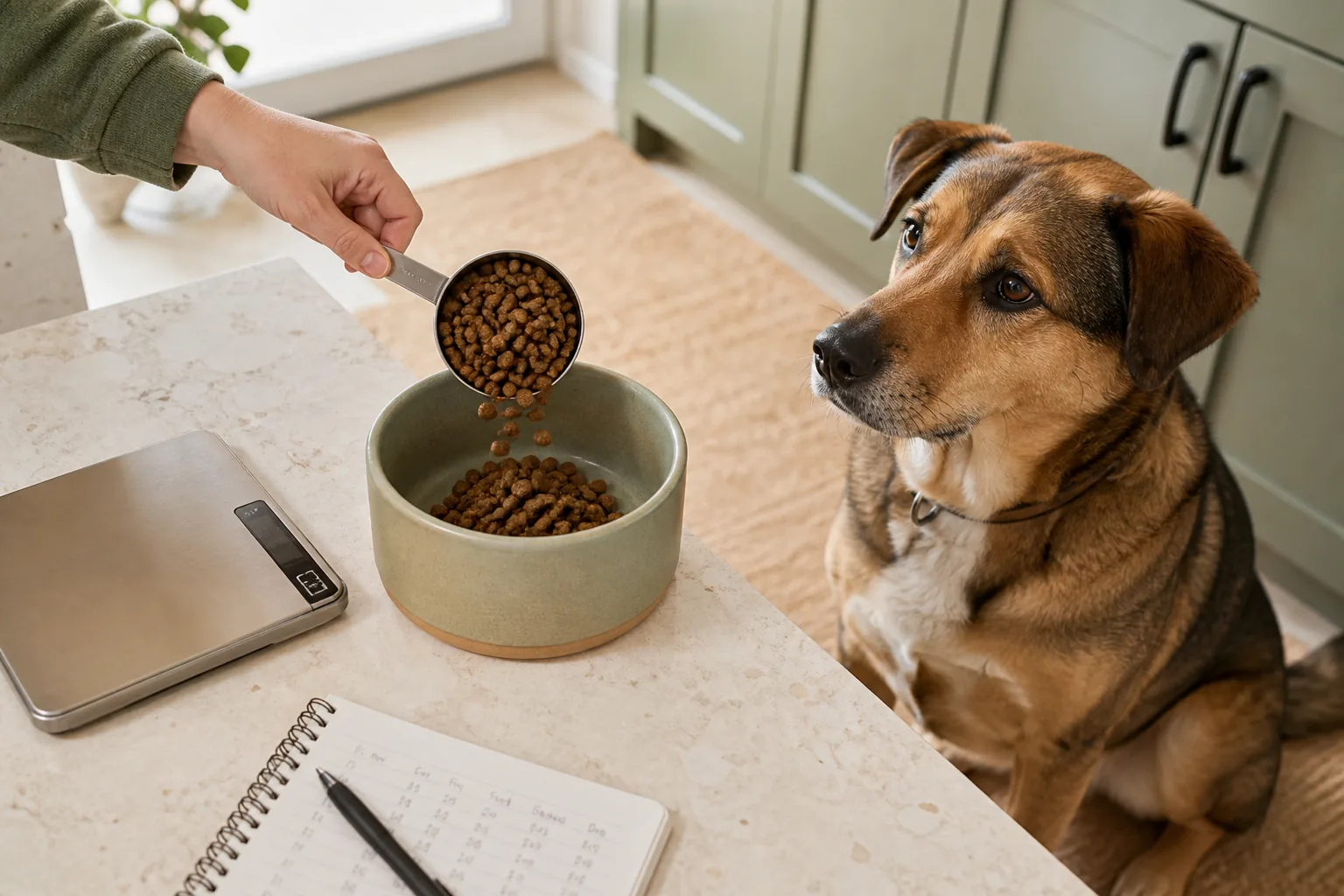
Portion plans fail quietly when the written amount and the eaten amount differ. A coffee mug, drinking cup, or unlevel scoop is not a reliable measuring cup. Even a marked pet-food scoop can be overfilled. A digital kitchen scale that reads in grams gives the most repeatable measurement for dry food.
Run a simple household audit for three ordinary days. Record everything the dog consumes:
- breakfast and dinner
- food used to hide medication
- training rewards
- dental chews and long-lasting chews
- lick-mat ingredients
- table scraps
- food offered by other family members
- edible parts of enrichment toys
Do not count only “treats from the bag.” A spoonful of peanut butter, cheese used for pills, and pieces of chicken during training all contribute calories. The AAHA nutrition guidelines flag a pattern in which more than ten percent of calories come from foods that are not complete and balanced, because those extras can displace essential nutrition as well as add energy. Ten percent is a practical ceiling for many healthy dogs, not a target that every dog must fill. A dog on a veterinary diet may need different rules, including no unapproved extras.
Make the plan easy to follow. Put the entire day’s treat allowance in one container each morning. Every person rewards from that container. Use part of the measured main meal as training rewards when practical. If a chew is too calorie-dense to fit, choose a shorter session, a lower-calorie alternative, play, access to sniffing, or another non-food reward.
Step 5: assess body condition, not just scale weight
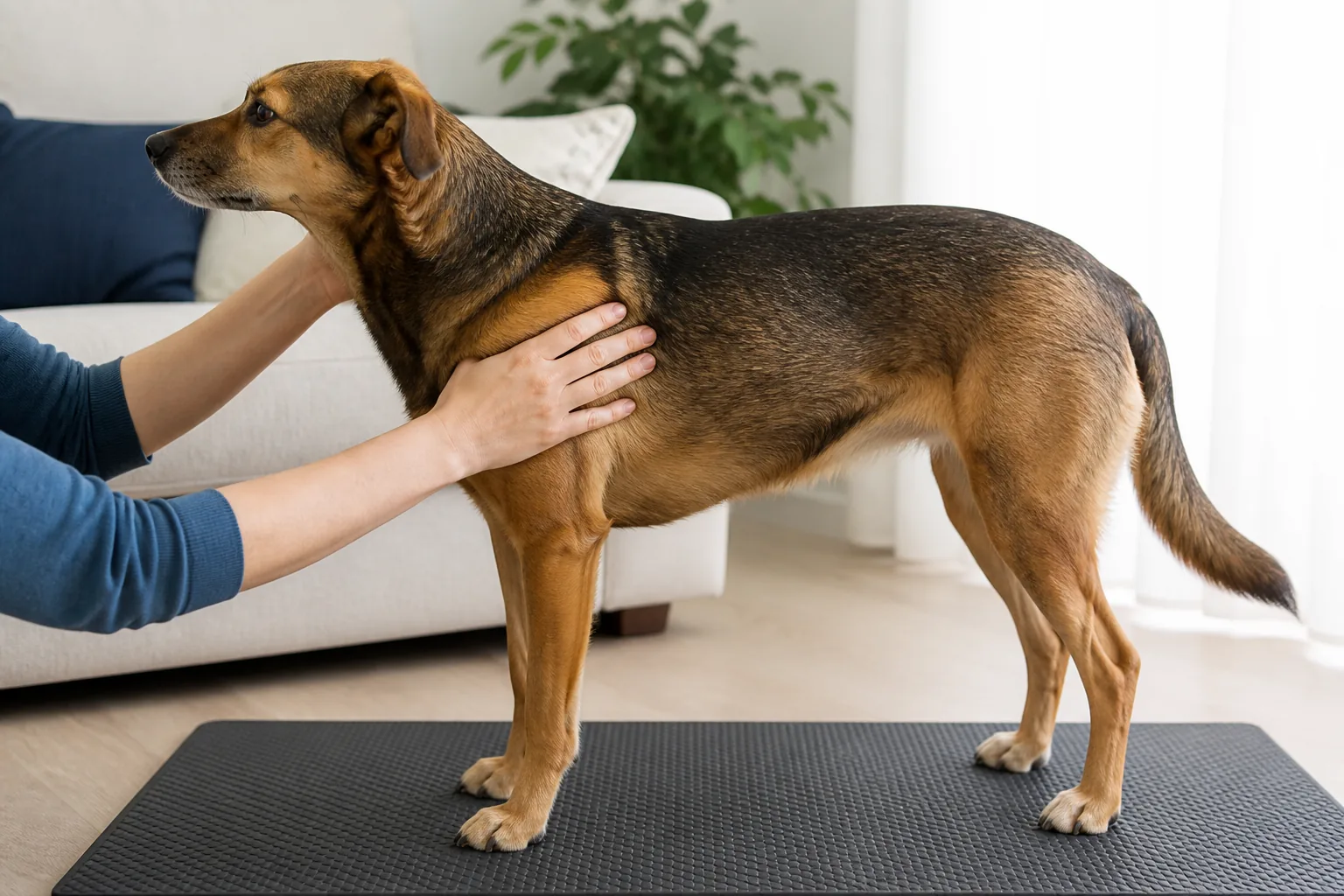
Weight is valuable, but it does not tell you by itself how much of the dog is fat or muscle. A body condition score combines what you see with what you feel. WSAVA provides dog body-condition charts, and veterinary teams commonly use a five- or nine-point scale. On the nine-point system, the middle score is generally the target for many dogs, but your veterinarian should confirm what is appropriate for the individual.
For a basic home observation:
- Run flat fingers lightly over the ribs. You should be able to feel them without pressing through a thick layer of fat, but they should not necessarily be sharply visible.
- Look from above. Many dogs at an appropriate condition have a waist behind the ribs.
- Look from the side. Many have an abdominal tuck rather than a belly line that continues straight back.
- Feel along the spine, shoulders, hips, and thighs. Muscle loss is not the same as healthy fat loss.
Coat, conformation, age, and breed can make visual judgment difficult. A dense coat can hide the waist, while a naturally lean build may show more outline. Take photographs from the same angles and lighting once a month, and ask the veterinary team to show you how they score your dog rather than relying on an online silhouette alone.
AAHA identifies a body condition below 4/9 or above 5/9, any muscle loss, and unexplained weight change as reasons for an extended nutritional assessment. That does not mean every dog outside the middle is in immediate danger. It means that simply changing the scoop may miss disease, pain, dental problems, feeding difficulty, or a diet mismatch.
Step 6: monitor long enough to see a real trend
For a healthy adult whose diet and routine are otherwise stable, record the starting amount, weekly or periodic weight, monthly body-condition observations, and relevant changes in treats or exercise. Use the same scale when possible. Small differences between two scales or a full versus empty bladder can look like change when they are only measurement noise.
Do not respond to one hungry look or one unusually active day by rewriting the whole plan. Appetite is behavior as well as physiology. Some dogs readily ask for more food even when intake is adequate. Others are distracted or cautious eaters. Look for a pattern across weight, condition, muscle, stool, energy, coat, and appetite.
If a healthy adult is gradually gaining fat while everything else is stable, discuss a modest adjustment with the veterinary team and then reassess. If the dog is losing weight, losing muscle, developing persistent loose stool, vomiting, drinking or urinating more, becoming lethargic, or changing appetite, do not keep increasing or decreasing food indefinitely. Those signs can have causes a portion change will not solve.
Weight-loss plans deserve particular care. Cutting a complete food too far can reduce intake of essential nutrients along with calories, and rapid loss can be unsafe. A veterinarian may recommend a diet formulated for weight management so the dog can receive appropriate nutrients within a lower calorie allowance. The plan should include a target, expected rate of change, recheck schedule, treat budget, and instructions for what to do if weight changes too quickly or not at all.
Common portion mistakes and how to correct them
Mistake: feeding for current weight when a target weight is needed
A chart keyed to current weight can maintain the status quo in an overweight dog. But choosing an “ideal weight” without assessment can also underfeed. Ask your veterinarian which weight should anchor the plan and why.
Mistake: treating cups as comparable between foods
Always compare calories per cup, can, or gram. When changing foods, recalculate rather than transferring the old cup measurement.
Mistake: ignoring mixed feeding
If half the calories come from wet food, the dry portion must account for that. Write one daily calorie budget and allocate each component within it.
Mistake: measuring after the bowl is filled
Pre-measure the daily ration. This prevents accidental refills and makes it easier to see whether appetite truly changed.
Mistake: making several changes at once
Changing food, portion, treats, and activity simultaneously makes the result hard to interpret and can upset digestion. Unless a veterinarian advises urgency, change one controlled variable and document it.
Mistake: assuming a feeding chart diagnoses a problem
A chart cannot explain weight loss, ravenous appetite, vomiting, chronic stool changes, dental pain, or muscle wasting. Those require veterinary context.
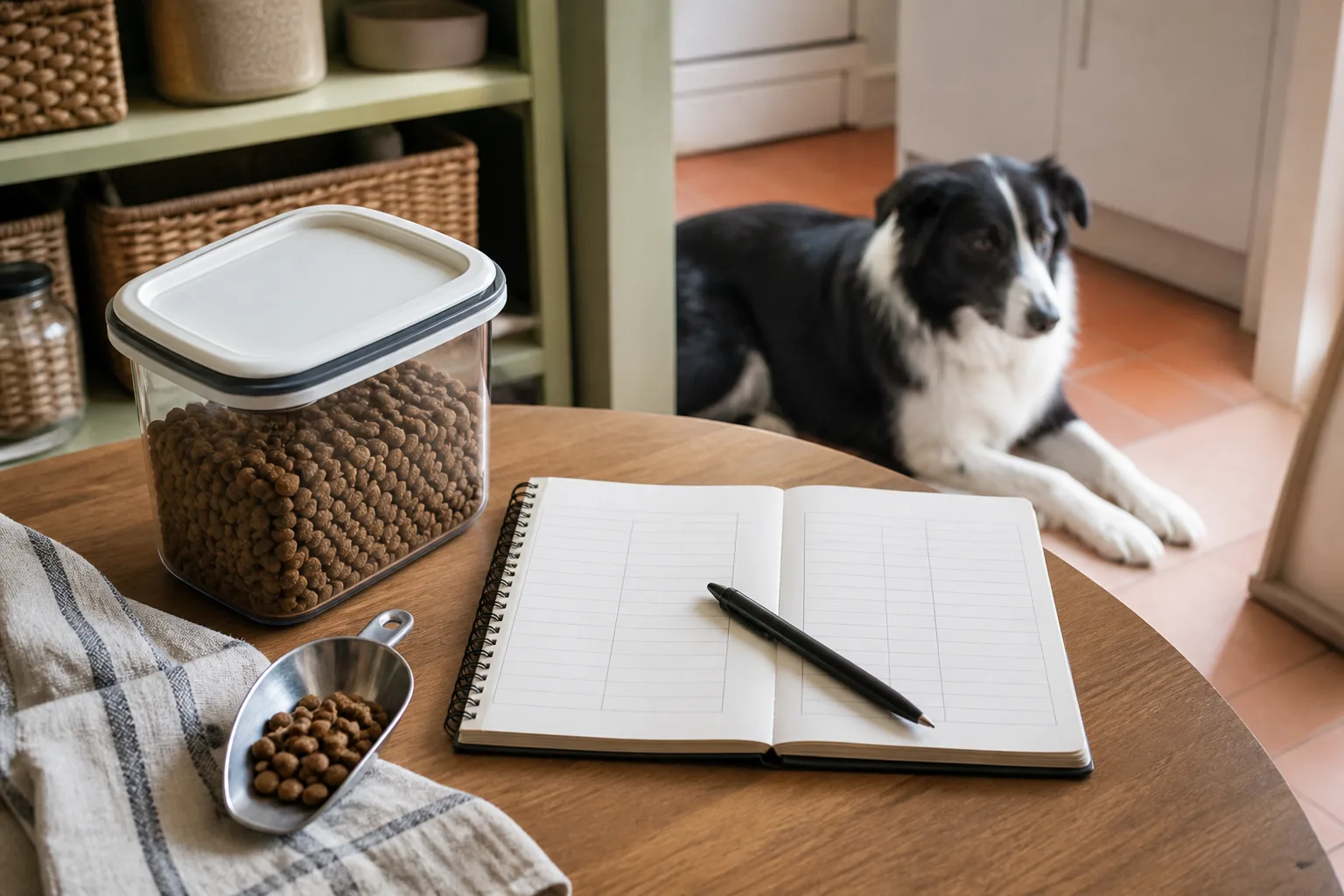
A one-page feeding record you can actually maintain
Use a note on the refrigerator or phone with these fields:
- food name, recipe, and lot number
- kcal per cup, can, tray, or gram
- measured main-food amount per day
- treats and extras per day
- meal times and number of meals
- current weight and date
- body-condition score and who assigned it
- medications or supplements given with food
- stool, appetite, vomiting, thirst, and energy changes
- planned recheck date
Keeping the lot number matters if a product problem or recall arises. The FDA recommends retaining food in its original bag inside any storage container, or at least saving the product name, UPC, lot number, manufacturer, and best-by date. Wash and dry storage containers between bags, and keep food cool and dry.
When to ask for veterinary help before adjusting portions
Contact a veterinarian promptly if your dog has a sudden or persistent appetite change, repeated vomiting or diarrhea, difficulty swallowing, a swollen or painful abdomen, weakness, collapse, marked lethargy, rapid unexplained weight change, increased thirst or urination, or visible muscle loss. Puppies, very small dogs, seniors with disease, and dogs using insulin or other meal-linked medication may have less room for trial and error.
Also ask for help when the math will not stay stable. If a carefully measured amount produces ongoing gain or loss, the useful question is not “Which online multiplier should I try next?” It is “Is the target, food, measurement, activity estimate, or health assumption wrong?” A diet history and examination can answer that more safely.
The decision to take away
The right portion is not the number printed in the largest type on a feeding chart. It is a measured starting amount of an appropriate food, adjusted with evidence from the individual dog. Confirm the diet’s purpose, read its calories, account for every extra, measure consistently, and track body condition as well as weight. When the dog’s condition or symptoms do not fit a routine adjustment, pause the experiment and involve the veterinary team.
That approach is less satisfying than a universal cup chart, but it is far more useful. It turns feeding from guesswork into a documented process—and it keeps a calculator from pretending to know what only the dog and a proper assessment can show.