Dogs jump during greetings because it works. Jumping reaches faces and hands, starts touch, produces speech, and creates movement. Even pushing, laughing, saying the dog’s name, or holding paws can become attention. A small puppy may be rewarded for the same behavior that becomes unsafe when the dog reaches adult size.
Reducing jumping requires two coordinated changes. First, prevent the dog from repeatedly reaching people during high-arousal arrivals. Second, teach a behavior that reliably opens access to greetings: four paws on the floor, a brief sit, a hand target, or movement to a mat. People must know exactly when to approach, touch, pause, and retreat.
This is reward-based manners training for social jumping. Jumping can also occur with fear, conflict, pain, guarding, overarousal, or aggressive behavior. A dog who becomes stiff, growls, snaps, bites, hides, lunges, or cannot recover needs distance, veterinary assessment, and qualified behavior support—not a greeting drill.
Observe the complete pattern
Record several events without deliberately provoking them:
- who arrives or approaches
- location and distance
- whether a bell, knock, vehicle, or key sound occurs first
- the dog’s speed, body posture, vocalization, and ability to eat
- whether jumping targets the front, back, arms, face, or held objects
- what each person does immediately afterward
- whether jumping increases after petting begins
- how long recovery takes
“Jumps” is not enough detail. A loose wiggly dog bouncing toward a familiar adult presents a different problem from a dog who rushes, freezes, hard-stares, guards the doorway, or mouths painfully.
Check whether the behavior changed suddenly. Pain, sensory change, medication, cognitive change, or illness can alter arousal and impulse control. Veterinary review comes before escalating training for a new pattern.
Choose the greeting behavior
Select one simple rule for the context.
Four paws on the floor
This is flexible and natural. The person approaches and interacts while all paws remain down. It suits dogs who find sitting difficult or become more excited when repeatedly cued.
Sit for approach
The dog sits while the greeter moves closer. Once greeting begins, standing is acceptable if the paws remain down. This gives a clear starting position but should not be forced in dogs with pain or on slippery surfaces.
Hand target
The dog touches the handler’s palm and moves away from the person, then returns under control. This is useful for repositioning but requires a separately trained target.
Go to a mat
For door arrivals, the dog moves away from the entrance and waits on a mat until released. This is often safer for energetic dogs, delivery interactions, small entryways, and visitors who prefer distance.
Do not ask for a long stay, perfect eye contact, and calm petting all at once. The first criterion may be one second with paws down.
Manage real arrivals before practicing
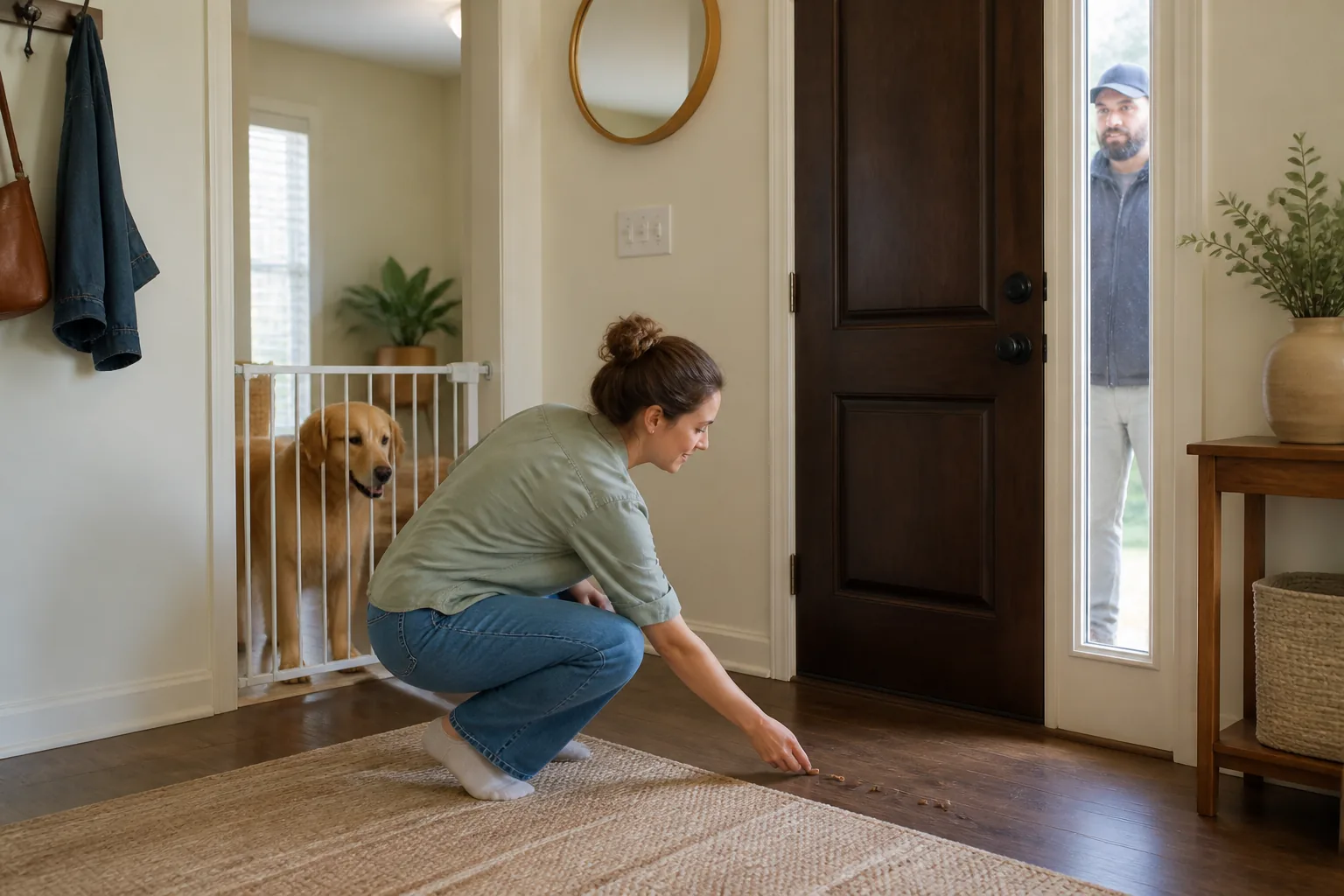
Training fails when the door opens before anyone is ready. Set up barriers:
- a closed interior door
- a securely mounted gate
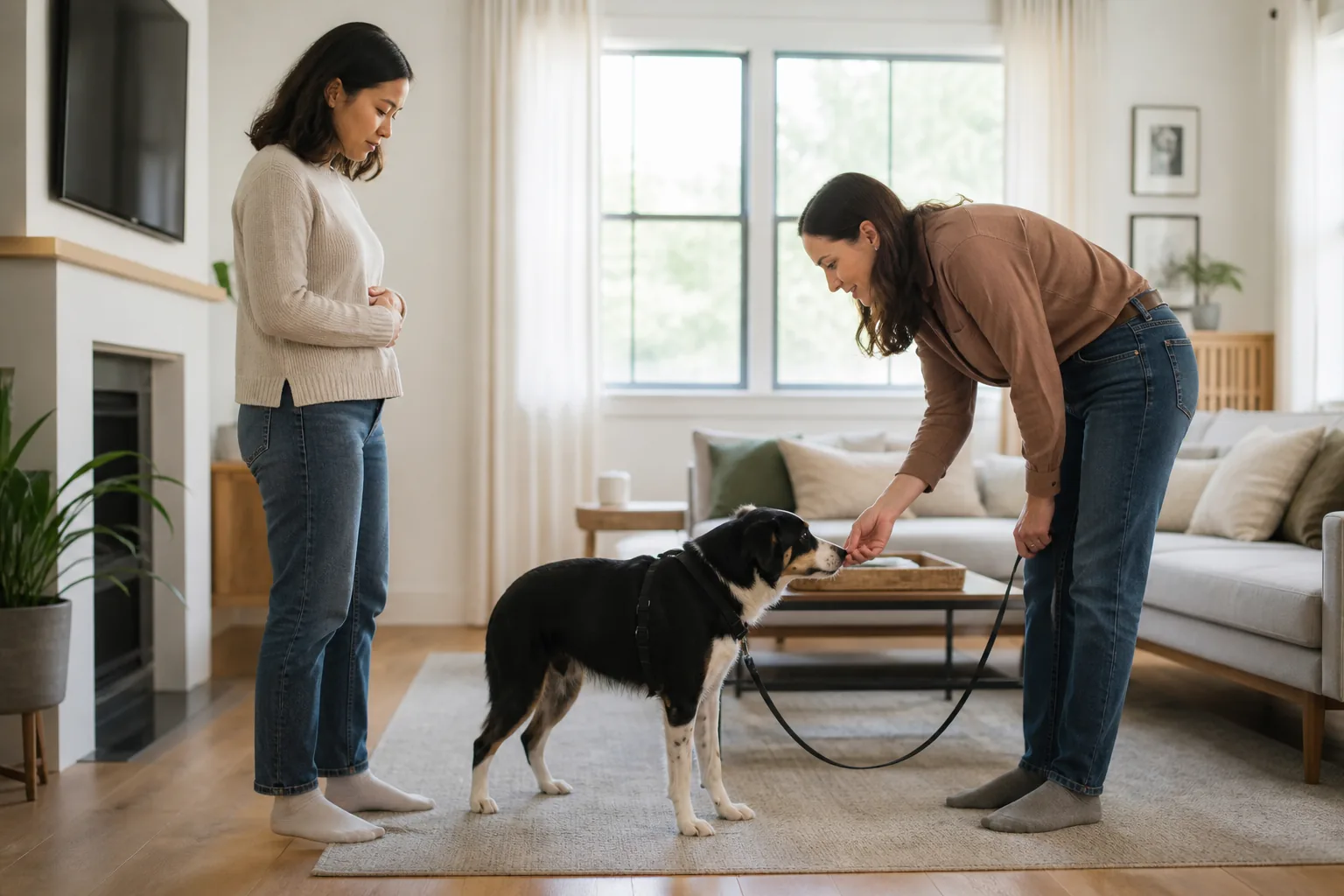
- a leash attached to a well-fitted harness and held by an adult
- a prepared room with water, bed, and safe enrichment
- a mat positioned well away from the entry
Contain the dog before opening the exterior door. Management protects visitors and prevents the jumping behavior from paying. It is not punishment and should use a space the dog can tolerate comfortably.
Tell guests in advance: “Please wait outside until I say we are ready. If the dog jumps, step away and become quiet. Approach again when paws are down.” A written note near the bell can help.
For couriers, contractors, emergency workers, or guests unable to follow the plan, keep the dog separated. The dog does not need to greet everyone.
Teach the alternative away from greetings
Practice sit, four-paws reinforcement, hand target, or mat in a quiet room. Use a marker such as “yes” to identify the correct moment and deliver tiny rewards immediately.
For four paws, stand calmly. Mark whenever the dog approaches without jumping and feed low near the floor or at knee level. Move away, reset, and repeat. Do not hold food high over the dog’s head, which can encourage upward movement.
For a mat, reward looking, stepping, and then standing or lying on it. Add the cue only after movement is predictable. Build a one-second stay and a release cue before introducing the door.
For sit, reward the completed position. If the dog jumps for the lure, lower the food and slow the hand. Do not press the dog’s hips down.
Sessions should last one to three minutes. Stop while the dog is successful.
Make human approach the reward
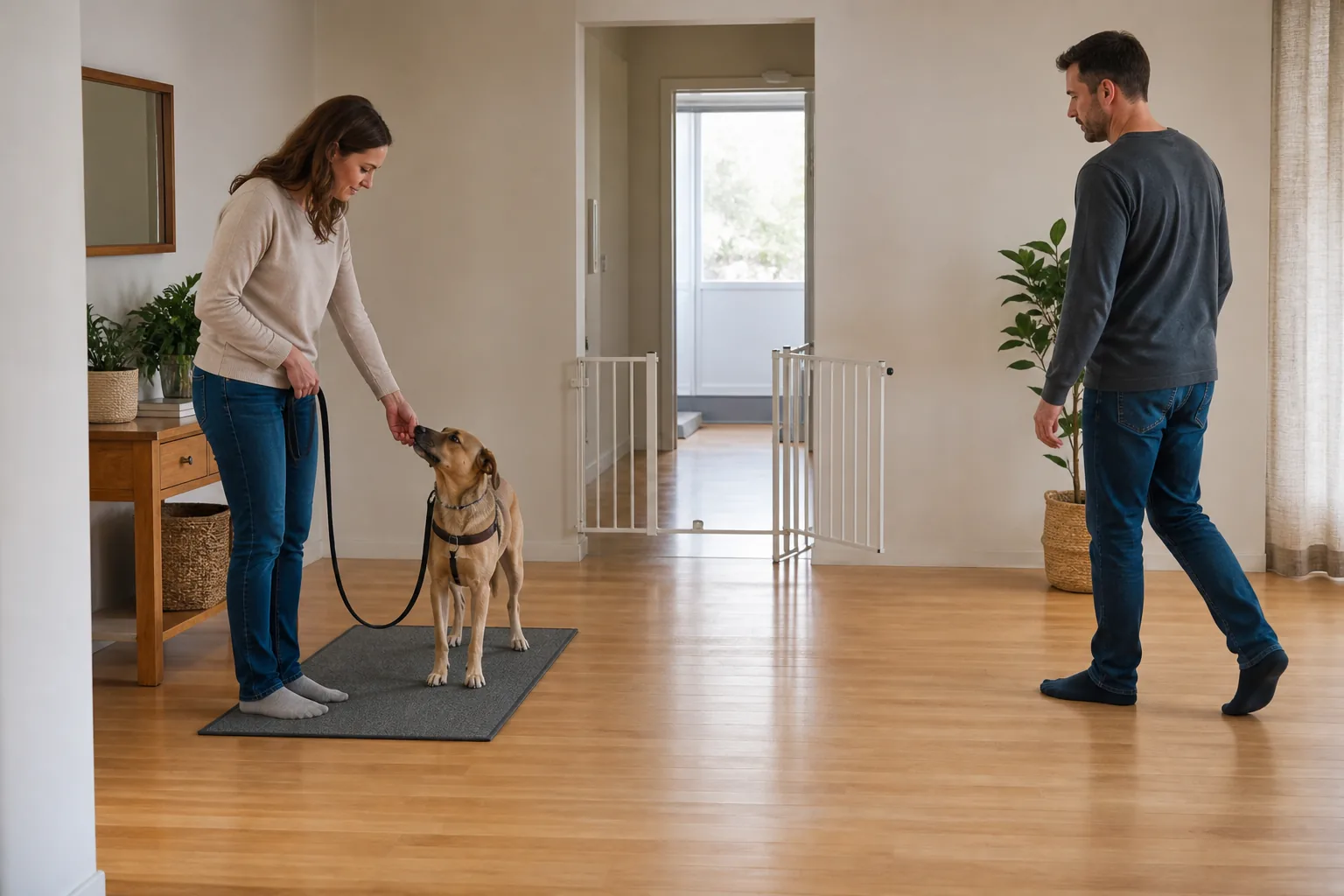
Use a familiar helper and enough space. The dog wears secure humane equipment or remains behind a barrier.
- Helper stands far enough away for the dog to think.
- Handler marks and rewards four paws down or the selected behavior.
- Helper takes one step closer.
- If paws remain down, mark, reward, and allow another step.
- If the dog jumps or surges, helper calmly steps away.
- Reset at an easier distance.
The helper’s movement is a life reward. Paws down makes the person approach; jumping makes approach pause. There is no shouting, kneeing, leash correction, or physical blocking with hands.
The leash prevents contact but should remain as slack as safety allows. Do not hold the dog suspended or let the dog repeatedly hit the end.
Practice the actual greeting in layers
Break greeting into components:
- person visible
- person takes one step
- person reaches conversational distance
- person turns slightly sideways
- person briefly offers a hand low and still
- one second of chest or shoulder contact if the dog invites it
- person stops touching
- greeting resumes only with paws down
Some dogs jump only when a hand moves or petting begins. Reward through those layers rather than assuming the approach solved the problem.
Ask the helper to pause after one second. If the dog remains grounded, mark and resume. If the dog jumps, the helper removes hands and steps away. Withdrawal must be calm, not a dramatic game.
The dog may stand during greeting; the goal is safe paws, not an indefinite sit.
Why simply turning away may fail
Turning away can remove attention, but it is not a complete plan. The dog may jump on the person’s back, grab clothing, become more frustrated, or move to someone else. A child or older adult may be knocked down while attempting it.
Use barriers and a handler so the dog cannot continue contact. Reinforce the desired behavior before jumping starts. Teach a mat or four-paws rule. Attention withdrawal is one consequence within a structured setup, not the only instruction.
If turning creates more mouthing or frantic behavior, increase distance and lower arousal. Do not remain as a target.
Train household homecomings
Daily arrivals create many repetitions. Before entering, the returning person texts or signals so the dog can be behind a gate or on a harness. Enter quietly, put belongings down, and wait at a distance.
When the dog offers paws down, mark and approach. If jumping begins, step back behind the barrier. Try again after a short reset. Keep the greeting brief and low-key.
Do not wait until the dog is exhausted after several minutes of jumping. The learning moment is the first second of approach.
Practice “fake arrivals” when no one has been away: open and close the door, step out for ten seconds, return, reinforce. The event becomes less rare and overwhelming.
Train the doorbell separately
The bell may trigger a chain before the visitor appears. Record the sound at a low volume or have a helper tap softly. Immediately feed several small rewards away from the door. Repeat until the dog hears the sound and orients to the handler or mat.
Gradually increase realistic volume. Then add handler movement to the door, touching the handle, opening it a crack, seeing the helper, and inviting the helper inside. Practice one layer at a time.
If the dog barks or rushes intensely at a low version, reduce volume or distance. A dog reacting from fear or territorial concern requires a different behavior plan; do not lure closer to a stranger.
Use a mat for visitors
Teach mat behavior before a visitor rehearsal. Place it far enough from the door that the dog is not physically crowding the opening. Send the dog to the mat, reward, take one step toward the door, return, reward, and release.
Build to touching the handle, opening the door, speaking to a helper, and having the helper enter and sit. Reward frequently on the mat. Release to greet only if the dog is relaxed and the visitor agrees.
Some visits should never include greeting. Delivery workers and brief callers can come and go while the dog remains safely behind a barrier with reinforcement.
Avoid using a crate as an emergency solution if the dog has not been positively crate-trained or becomes more distressed with visitors while confined.
Greetings on walks
Do not let the dog drag the handler to people. Ask potential greeters to wait. Maintain enough distance for slack leash and four paws down. Reward the position, then say a release cue and approach together.
If tension or jumping begins, move away in an arc and reset. The person should not reach over the dog or excite the dog with rapid speech and patting.
Many people do not want to greet. Practice passing at distance and reward checking in. A social dog does not have a right to touch strangers.
Avoid on-leash greetings with unknown dogs as part of human greeting practice. Competing arousal makes learning harder and can create tangled-leash conflict.
Children and vulnerable adults need management first
A dog can injure without aggressive intent. Use physical separation around babies, small children, older adults, people using mobility aids, anyone carrying an infant, and visitors with balance or medical concerns.
Children should not train by turning their backs while the dog jumps. An adult manages the leash or barrier. The child may toss a treat away from the body under supervision when the dog is calm, or have no contact.
No face-level greetings, hugging, chasing, or holding paws. If either dog or person is uncomfortable, separation is successful management.
Mouthy greetings require more distance
Some dogs jump and grab sleeves, hands, hair, or the leash. Do not wrestle, push into the mouth, or use hands as toys. Prepare a barrier and lower arousal before contact.
A safe toy may provide an incompatible mouth activity for a dog with a known gentle retrieve, but do not offer it where guarding or conflict could occur. Reinforce approaching with the toy and paws down.
Hard mouthing, bruising, torn clothing, inability to disengage, or escalation around movement requires qualified help. Protect people rather than repeating the greeting to collect proof.
Fearful jumping is different
A dog may jump while simultaneously showing tucked posture, ears back, lip licking, avoidance, barking, or frantic licking. This can be conflicted approach, not simple enthusiasm. Requiring close sit-and-pet repetitions may worsen it.
Increase distance, let the visitor ignore the dog, and allow voluntary movement. Toss treats away from the person rather than luring the dog close. The dog never has to greet.
Growling, snapping, freezing, hard staring, or repeated retreat needs veterinary and behavior assessment. Do not punish warnings.
Manage arousal before the event
Meet toileting, sleep, and appropriate activity needs. A short sniff walk or food search before a planned visitor may help. Exhausting the dog through intense fetch or rough play can increase arousal instead.
Prepare rewards, harness, leash, gate, mat, and visitor instructions before the bell. The handler cannot train precise timing while searching for equipment.
For predictable gatherings, schedule rest in a separate quiet area. Constant social exposure is not required.
Reinforce what people usually miss
Jumping gets noticed; standing quietly often does not. Carry part of the dog’s measured ration and reward:
- approaching with paws down
- looking at a person without rushing
- choosing the mat
- returning to the handler
- stepping away after greeting
- settling while people talk
AVSAB guidance emphasizes catching desired behavior and reinforcing immediately. Waiting until the dog jumps and then asking for sit produces a chain: jump, sit, treat. Mark the grounded approach before the jump.
Coordinate every greeter
Write a simple protocol:
- do not touch or speak while dog is jumping
- handler creates distance safely
- approach resumes for paws down or the selected behavior
- pet chest/shoulder for one second
- pause and continue only if paws remain down and dog seeks contact
Family inconsistency slows learning. If one person invites jumping, use a distinct cue and context only if the dog can discriminate—but the safer household rule is no jumping on people.
Do not blame the dog for a guest ignoring instructions. Use the barrier.
Troubleshoot common patterns
Dog sits, then launches when touched
Petting is too difficult. Reward one second of paws-down contact, stop, and repeat. Ask the greeter to move slowly and touch the chest rather than reaching over the head.
Dog jumps higher when ignored
Attention withdrawal increased frustration. Add a gate, more distance, a mat, and rapid reinforcement for the earliest grounded moment. Keep people physically safe.
Dog is calm for family but jumps on guests
The behavior has not generalized. Recruit familiar helpers, then less familiar helpers, always in controlled rehearsals. New people require easier criteria.
Dog jumps when people sit
Practice approach to a seated helper as a separate picture. Reward paws down before the dog reaches the lap. Use a leash or barrier and give the dog a mat beside—not on—the furniture.
Dog jumps from behind
Turning away is unsafe for this dog. Step through a gate or close a door so contact ends. Train with physical management and professional help if mouthing accompanies it.
Dog jumps only outdoors
Increase distance from people, reduce environmental distraction, and use higher-value reinforcement. Indoor skill does not automatically transfer.
Fade food thoughtfully
Reward every successful greeting step while the skill is new. Later, the greeting itself becomes reinforcement: paws down makes the person approach and continue contact.
Vary food in familiar easy situations, but continue to pay difficult arrivals, children at safe distance, novel places, and strong recovery. Do not remove reinforcement abruptly.
Count food within the daily ration. Tiny pieces and life rewards prevent calorie drift.
A four-week practice plan
Week 1: behavior away from doors
Choose four paws, sit, target, or mat. Practice one-minute sessions with household members.
Week 2: approach and retreat
Use one familiar helper. Person takes one step for grounded behavior and retreats for jumping. Add one-second contact.
Week 3: doorway components
Practice bell at low intensity, handle movement, cracked door, and helper entry separately. Use barriers.
Week 4: generalization
Add another helper, seated greeting, or quiet outdoor greeting—not all together. Continue management for unplanned visitors.
The calendar is not a deadline. Repeat stages until behavior and body language remain comfortable.
Measure progress
Record:
- greeter and setting
- starting distance
- selected alternative behavior
- number of approaches before first jump
- whether petting triggered jumping
- recovery time
- reward used
- stress or fear signals
“Four paws for three one-second chest touches with familiar helper at home” is meaningful. “Did better with visitors” does not identify the next step.
When to get professional help
Seek help when jumping knocks people down, includes hard mouthing, occurs with growling or snapping, reflects fear, cannot be safely managed, or worsens despite consistent reward-based practice. Veterinary assessment is appropriate for sudden behavior change, pain, sensory decline, or extreme arousal.
Choose a professional who uses barriers, distance, reinforcement, gradual rehearsal, and clear criteria. Avoid kneeing the chest, stepping on paws, leash corrections, shock/prong/choke collars, shouting, or dominance claims. These methods add pain or fear without teaching a safe greeting.
The decision to take away
Greeting jumps change when people stop accidentally paying them and make a safe alternative consistently successful. Choose one visible behavior, teach it in a quiet room, then use a barrier and helper to rehearse approach, brief contact, pause, and retreat.
Manage real visitors until the training is ready. Protect children and vulnerable adults with physical separation. Treat fearful, mouthy, or aggressive patterns as more than manners.
The finished greeting does not have to be a perfect sit. It can be a relaxed dog with four paws on the floor who can approach, receive brief contact, and move away while every person remains safe.