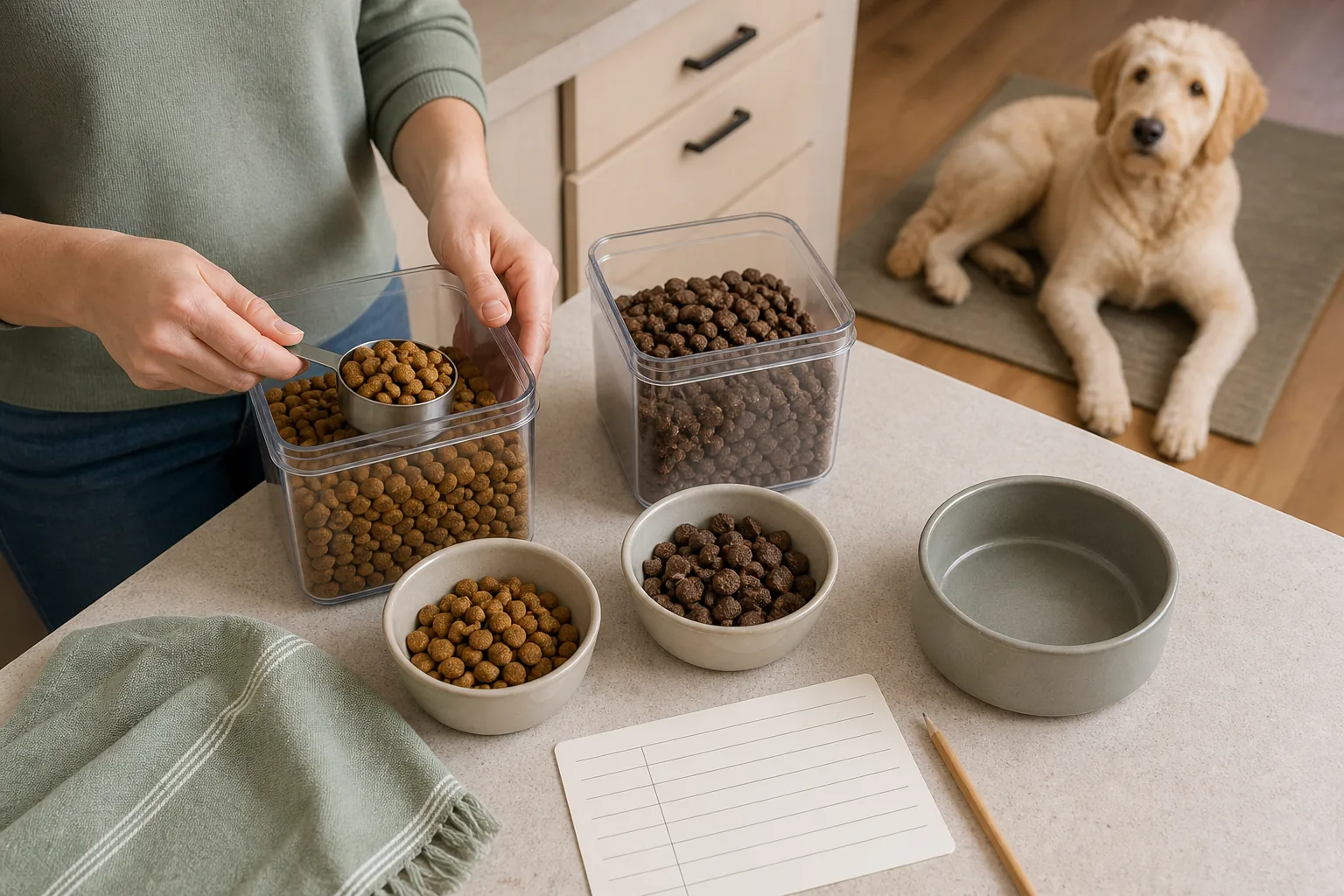


Changing dog food is often described as a seven-day mixing chart. That chart can be a useful starting pattern, but it is not a biological guarantee. Dogs differ in health, diet history, age, appetite, medication, and gastrointestinal sensitivity. Foods differ in calorie density, moisture, fat, fiber, protein sources, texture, and feeding amount. A transition that is uneventful for one dog may need to move more slowly for another.
The safest routine switch is controlled and observable. Confirm that the new food is appropriate, calculate the new daily amount instead of copying the old number of cups, change the ratio in stages, and keep other variables stable. At each stage, watch the dog—not only the calendar.
This guide addresses planned transitions in dogs who are otherwise well. It is not a treatment protocol for vomiting, diarrhea, pancreatitis, food allergy, kidney disease, diabetes, or another illness. A veterinarian-prescribed diet may require a specific transition or an immediate change. If the dog is currently sick, contact the veterinary team before experimenting.
First identify why the food is changing
The reason determines how much flexibility you have.
Routine practical change
The current food may be unavailable, unaffordable, discontinued, reformulated, or no longer practical. The dog is healthy and stable. This is the situation most suited to a gradual household transition.
Life-stage change
A puppy is moving to adult maintenance, or another life-stage need has changed. Timing should be based on development, expected adult size, body condition, and veterinary advice—not a birthday alone.
Weight or calorie-plan change
The veterinarian may recommend a different calorie density or a diet formulated for weight management. The new portion and recheck schedule are part of the switch.
Suspected intolerance or food reaction
Repeated digestive or skin signs need assessment. Randomly rotating retail foods can obscure patterns and introduce new variables. A veterinary elimination trial is a controlled diagnostic process; it requires an exact diet and excludes unapproved treats, flavored medications, chews, and scavenged food.
Therapeutic change
A diet may be prescribed for urinary, kidney, gastrointestinal, liver, pancreatic, allergic, or another medical condition. Follow the prescriber’s instructions. In some cases a slow mix is appropriate; in others the previous food should not remain in the plan.
Product concern or recall
If the food has an off odor, swollen or leaking packaging, foreign material, confirmed recall, or suspected link to illness, do not keep feeding it merely to achieve a gradual transition. Stop using the suspect product, preserve the package and lot details, contact a veterinarian, and follow regulator or manufacturer instructions.
Confirm the new food before opening it
Read the nutritional adequacy statement and intended life stage. Confirm that the exact recipe—not only the brand—is appropriate. Check calorie content per cup, can, tray, or kilogram. Compare the new feeding directions with the old food.
Do not assume that one cup should replace one cup. If the old food contains 330 kcal per cup and the new food contains 440, equal volumes increase calories by one-third. During a mixed transition, calculate the calorie contribution of each food so the combined daily intake stays near the intended target.
For a healthy dog with a 660-kcal daily target:
- Old food at 330 kcal/cup would provide 660 kcal in two cups.
- New food at 440 kcal/cup would provide 660 kcal in one and a half cups.
- A half-old, half-new calorie stage is one cup old food plus three-quarters cup new food—not one cup of each.
This example demonstrates conversion only; it does not prescribe 660 kcal for any dog. Use the dog’s established veterinary or label-based starting target.
Check package integrity and best-by information. Save the product name, UPC, lot number, manufacturer, and receipt. The FDA recommends retaining food in its original bag, even when the bag sits inside a storage bin, because the lot details are important if a problem arises.
Create a stable baseline
Before the first mixed meal, record two or three ordinary days when possible:
- exact old food and measured amount
- treats, chews, toppers, supplements, and table food
- meal times
- appetite and eating speed
- stool frequency and consistency
- vomiting, regurgitation, gas, or abdominal discomfort
- water intake changes
- medication
- body weight and body condition
Without a baseline, a pre-existing soft stool may be blamed on the new food, or a real change may be missed. Use neutral descriptions. “One formed stool at 8 a.m. and one soft stool at 6 p.m.” is more useful than “stomach seems weird.”
Keep treats and routine steady during the transition. Introducing a new chew, rich topper, supplement, and food at the same time makes the result impossible to interpret.
Use stages, not a race against the calendar
A common starting pattern for a healthy dog is to move through four ratios:
- Mostly old food with a small amount of new.
- Roughly equal calorie contributions from old and new.
- A small amount of old with mostly new.
- New food only.
The ratio should be based on the intended calories or weighed amounts, not identical scoops. Hold each stage long enough to observe ordinary meals and bowel movements. A dog with a history of sensitivity may need smaller ratio changes and longer holds. A dog following a veterinary instruction may use a different schedule.
Do not advance merely because a printed day arrived. Advance when the dog is eating, comfortable, and producing stool close to its baseline. If a mild change occurs once and the dog is otherwise bright and comfortable, hold the current ratio and observe rather than immediately adding remedies. If the change persists, worsens, or comes with other signs, call the veterinarian.
Do not repeatedly move forward and backward without a record. Document the ratio, amounts, signs, and timing so a professional can see the pattern.
Measure each component accurately
Use a digital kitchen scale for dry food when practical. If using cups, use a standardized level measuring cup. Weighing is especially helpful when calorie densities differ or the dog’s portion is small.
For mixed wet and dry feeding, calculate each component separately. A quarter of the bowl by visual volume is not necessarily a quarter of the calories. Record cans by size and fraction, not simply “half a can,” because can sizes vary.
Prepare one day at a time unless both product labels support pre-mixing and storage. Do not pour the new bag into a bin containing crumbs and fat from the old bag. Clean and fully dry the container first, and keep the new food in its original packaging when possible.
Avoid free-pouring top-ups. Pre-measure the full day’s ration into a container so every family member knows what remains.
Understand which changes may be mild—and which are not routine
A stool may change somewhat when ingredients, fiber, fat, moisture, or feeding amount changes. A dog may also notice a different texture or smell. But “transition” should not become a label for every symptom.
Pause and contact the veterinary team for guidance if you see:
- repeated vomiting
- persistent or worsening diarrhea
- blood in stool or vomit
- marked appetite reduction or refusal
- abdominal pain, swelling, or repeated unproductive retching
- lethargy, weakness, collapse, or fever
- signs of dehydration
- rapid weight change
- increased thirst or urination
- facial swelling, hives, breathing difficulty, or another possible allergic emergency
- symptoms in a puppy, frail senior, or medically vulnerable dog
Emergency signs such as collapse, breathing difficulty, a distended painful abdomen, repeated unproductive retching, severe weakness, or significant bleeding require immediate care.
Merck’s Veterinary Manual emphasizes that vomiting and diarrhea have many potential causes, including infection, parasites, inflammation, obstruction, organ disease, and dietary triggers. A food switch can coincide with illness without causing it. Persistent signs need cause-specific assessment rather than endless diet rotation.
Do not improvise fasting or medication
Do not withhold food for a fixed period, give human antidiarrheal drugs, add supplements, or start a homemade bland diet without veterinary advice. Puppies, very small dogs, diabetic dogs, and animals taking meal-linked medication may be harmed by missed meals or inconsistent intake.
A veterinarian may recommend a particular temporary diet, meal size, medication, diagnostic test, or hydration plan based on the dog’s examination and history. Follow that plan instead of combining multiple online remedies.
Plain pumpkin, probiotics, rice, chicken, or fiber are not universal corrections. They change the diet and can confuse an elimination trial. Some commercial supplements vary in organisms or dose. Ask what problem the addition is intended to solve and how success will be evaluated.
Manage appetite without creating a topping dependency
Some dogs hesitate when a familiar food changes. First verify that the food is fresh and the dog is otherwise well. Offer measured meals on a predictable schedule and remove uneaten food according to safe handling guidance.
Avoid escalating through cheese, meat, broth, and rich toppers after every refusal. This can add calories, introduce hazardous seasoning, disrupt a therapeutic plan, and teach the dog that waiting produces a different menu.
If a topper is approved, define the exact type and amount and include it in the calorie budget. Warm water may change aroma for some dry foods without adding ingredients, but discard moistened leftovers rather than leaving them out.
Persistent refusal is information. Dental pain, nausea, stress, medication effects, and illness can reduce intake. Contact the veterinarian, especially when appetite change is sudden or accompanied by other signs.
Handle a necessary abrupt change differently
Sometimes the old food cannot be used: a recall, contamination concern, severe adverse reaction, or medical instruction may require stopping it. An abrupt change can affect stool, but continuing a suspect or contraindicated product may carry greater risk.
In that situation:
- Follow the veterinarian’s or recall notice’s instructions.
- Preserve the old package, lot number, receipt, and a sample if advised.
- Record the last time and amount fed.
- Use the recommended replacement and portion.
- Monitor appetite, vomiting, stool, energy, thirst, and urination.
- Report illness or a product defect through the appropriate manufacturer and regulatory route.
The FDA advises stopping a food and calling a veterinarian when a pet becomes sick after eating it. It also encourages complaints to both the agency and manufacturer where applicable. Do not feed a recalled product to another animal or donate it.
Transitioning during a veterinary elimination trial
An elimination diet is designed to test a question. The prescribed diet must be the only source of relevant food exposure for the specified period. That often excludes ordinary treats, flavored chews, table food, supplements, toothpaste, and flavored medication unless approved.
Ask the veterinarian:
- whether the transition period counts toward the trial
- exactly which food and flavor to use
- which treats or rewards are allowed
- how to handle medication
- what signs and photographs to record
- when to recheck
- what to do after accidental exposure
Do not switch among “limited ingredient” retail foods during the trial. Cross-contact and ingredient histories may differ, and the diagnostic plan requires control.
Transitioning a puppy or growing dog
Growth diets are not simply higher-calorie adult foods. They are intended to support development with an appropriate nutrient profile. Large-size dogs have specific label language relevant to growth. Ask when to change from puppy to adult food based on expected adult size and development.
During growth, monitor body condition rather than encouraging maximum size. Do not add calcium or mineral supplements to a complete growth diet unless directed. Recalculate the amount as the puppy grows; a transition ratio does not freeze the daily calorie need.
Frequent diarrhea, poor growth, a pot-bellied appearance, vomiting, or low energy in a puppy deserves veterinary assessment rather than a sequence of food experiments.
Transitioning a senior dog
“Senior” is not one regulated nutritional profile that fits every older dog. Healthy older dogs vary in activity, muscle condition, dental comfort, digestion, and disease. A diet change should respond to an assessed need.
Record both body and muscle condition. Weight can remain stable while muscle decreases and fat increases. Difficulty chewing may require dental evaluation, not merely softer food. Increased thirst, weight loss, appetite change, or vomiting can signal disease.
When medication and food interact, preserve meal timing and tell the veterinarian if intake becomes unpredictable.
Use a transition log
Create one row per day with:
- old food grams or calories
- new food grams or calories
- treats and other extras
- meals offered and eaten
- stool count and description
- vomiting or regurgitation
- appetite
- energy and comfort
- medication
- unusual events such as scavenging or travel
- decision: hold, advance, or call
Photographs of the labels and measured portions reduce confusion. A stool photograph may help the veterinary team when description is difficult.
The log prevents retrospective guesswork. It can reveal that diarrhea began before the ratio changed, that a chew was introduced on the same day, or that total calories rose because equal cups replaced unequal-calorie foods.
Evaluate the new food after the transition
Finishing the mix is not the end of assessment. Continue monitoring measured intake, weight, body condition, muscle, stool, appetite, skin, coat, and energy. Schedule the recheck recommended for the dog’s goal.
Do not declare success solely because the bowl is empty. A food can be palatable while the portion is excessive. Do not declare failure solely because stool color or volume differs slightly; formulations produce different outputs. Judge persistent patterns and the dog’s overall condition.
If the dog does not do well, review the process with a veterinarian. Confirm the actual product, calorie intake, treat exposure, transition pace, storage, and medical history. The next step may be an adjustment, examination, diagnostics, or a different food—not another unsupervised rapid switch.
Common transition mistakes
Copying the old cup amount
Recalculate with calories. Equal volume does not mean equal energy.
Changing treats and supplements simultaneously
Keep other food variables stable so the result can be interpreted.
Advancing after persistent signs
The calendar does not outrank the dog. Hold and seek advice instead of pushing through worsening symptoms.
Mixing entire bags
You lose the ability to adjust ratios and may compromise lot traceability. Prepare measured daily portions.
Assuming every symptom is “detox”
Detox language can delay diagnosis. Vomiting, diarrhea, lethargy, pain, or appetite change should be described and assessed on their merits.
Rotating repeatedly to find a perfect food
Frequent unsystematic changes create noise. Define the problem, choose a justified candidate, control the transition, and evaluate with a record.
The decision to take away
A safe food change is not a race to reach a full bowl of the new product. It is a controlled comparison. Confirm that the new food is appropriate, convert portions by calories, establish a baseline, move through ratios the dog tolerates, and keep other variables steady. Record what is actually fed and what actually changes.
Mild variation may justify holding a stage. Persistent or significant signs justify professional input. Product defects, recalls, therapeutic instructions, and medical illness may override a routine gradual schedule.
The most useful transition plan has three exits: advance when the dog is stable, hold when the evidence is unclear, and call when the pattern is concerning. That is safer than treating seven printed days as a promise that every digestive system will follow the same calendar.