Loose-leash walking is a learned partnership, not a dog’s natural default pace. Dogs move faster than many people, follow scent trails, change direction often, and investigate the environment with their noses. A leash restricts all of those choices. If pulling has repeatedly carried the dog to trees, dogs, doors, or the park, tension has also been reinforced by real-life access.
The solution is not to overpower the dog or demand a competition-style heel for an entire walk. Define a simple rule: slack in the leash makes movement and good outcomes available; sustained tension pauses progress or prompts an easier alternative. Then make the slack position valuable through frequent rewards and planned sniffing.
This guide uses reward-based methods. The American Veterinary Society of Animal Behavior recommends reward-based training for all dog training and advises against aversive methods. Leash jerks, choke chains, prong collars, electronic collars, intimidation, and dragging are excluded here. Equipment manages safety; learning comes from consequences the dog can understand.
Define the behavior you actually need
“Walk nicely” is too vague to train. Choose observable criteria:
- the leash hangs in a soft J shape most of the time
- the dog can walk on either side or a chosen side without crossing dangerously
- the dog can stop and turn with the handler
- sniffing occurs on cue or when the route safely allows it
- brief tension may happen, but the dog can recover without a struggle
Loose-leash walking is not the same as heel. A formal heel usually asks for precise position and sustained attention. Most companion walks should allow more freedom to sniff and explore. Reserve closer position for narrow paths, road crossings, passing people, or another brief safety need.
Write your household rule. For example: “Within the width of the pavement, with the leash slack; cue ‘close’ for ten steps past a hazard; cue ‘go sniff’ when released.” Consistency becomes possible when everyone is training the same picture.
Rule out pain and equipment problems
Before treating pulling, stopping, lagging, or sudden refusal as training issues, consider health. Pain in the neck, back, hips, knees, paws, or skin can change gait and tolerance. Breathing disease, heat, obesity, nail problems, wounds, neurologic signs, and vision loss can affect walking. A dog who suddenly slows, sits, limps, coughs, collapses, resists the harness, or reacts to touch needs veterinary assessment.
Check paws after exposure to hot surfaces, ice, salt, debris, or rough ground. Do not use training to push a dog through pain or heat stress.
Choose humane secure equipment
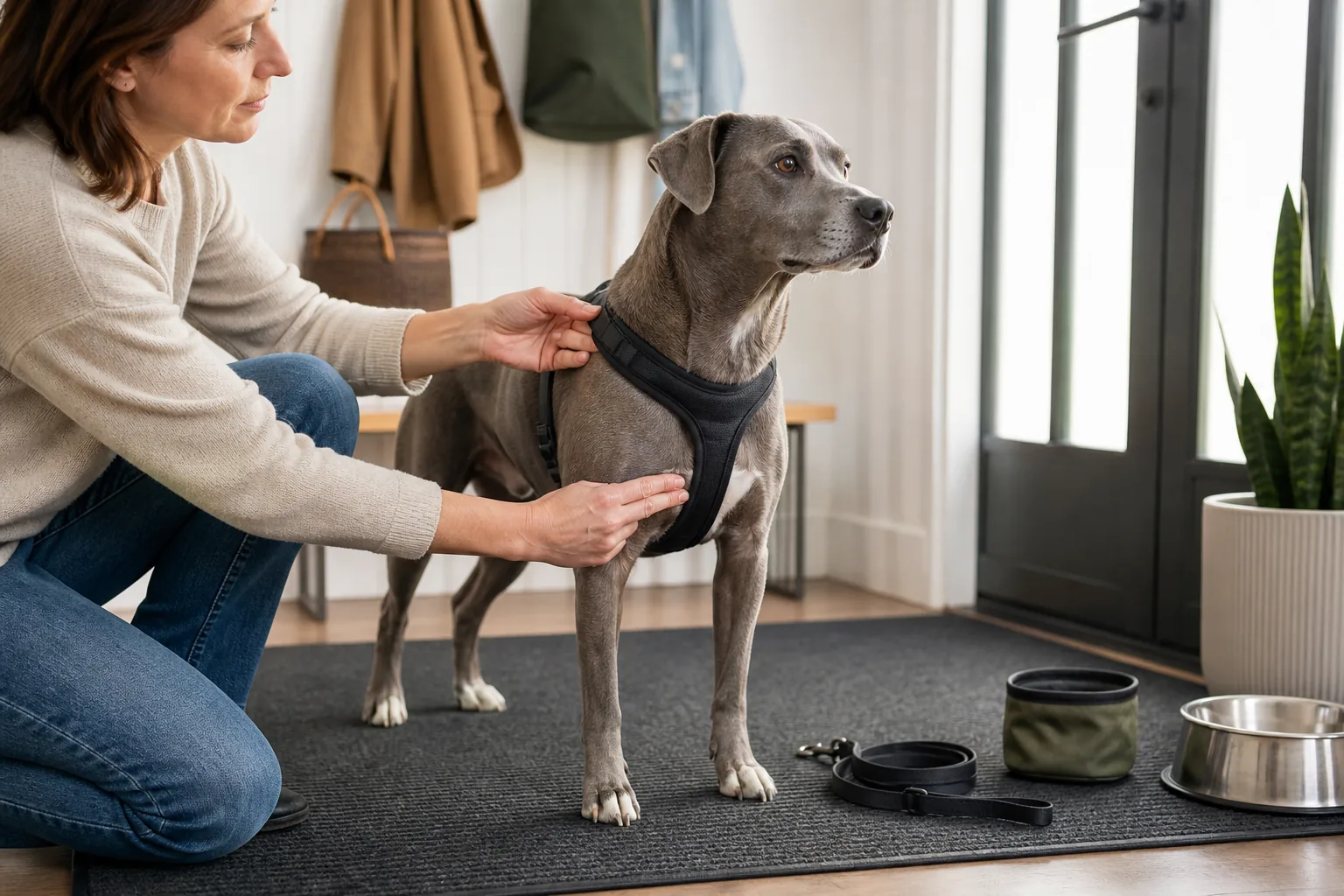
A well-fitted Y-shaped body harness often gives useful control without concentrating force on the neck. The front should allow shoulder movement, straps should not rub the armpits, and the dog should not be able to reverse out. A front attachment may help some handlers manage pulling, but fit and gait still matter; it is not an automatic training system.
A flat collar can carry identification and may suit some dogs for leash attachment, but dogs who pull hard, cough, have airway concerns, or can slip a collar need veterinary or qualified professional guidance on equipment. Harness and collar can be connected with a safety backup for an escape-risk dog.
Use a fixed-length leash long enough to create slack in the environment. A very short leash keeps mild normal movement under tension. A retractable leash teaches pressure as part of forward movement and can complicate early mechanics; it also creates handling and entanglement risks in crowded areas.
Head collars require gradual positive conditioning and careful two-point handling. They must never be jerked, because sudden force rotates the head and neck. For a powerful dog who could pull someone over, obtain hands-on reward-based instruction rather than purchasing equipment and testing it in a busy street.
Avoid slip leads used to tighten for correction, choke/check chains, prong collars, shock collars, and leash pops. Preventing access to a distraction by standing still is different from adding pain or a startling jerk.
Condition the equipment first
Do not begin with a wrestling match at the doorway. Present the harness at a distance; mark and reward looking toward it. Progress to approaching, placing the nose voluntarily through an opening, brief strap contact, fastening one clip, and wearing it for seconds indoors. The dog should be able to move away between repetitions.
Break the sequence down further if the dog ducks, freezes, mouths the harness, runs, stops taking food, or becomes frantic. Never chase the dog with equipment. Handling fear or aggression needs individualized professional support.
Once the harness predicts good things, attach the leash in a closed room and reward calm movement. Supervise continuously so it cannot catch on furniture.
Build four foundation skills indoors
Outdoor sidewalks are difficult classrooms. Start where the dog can think.
Reinforcement position
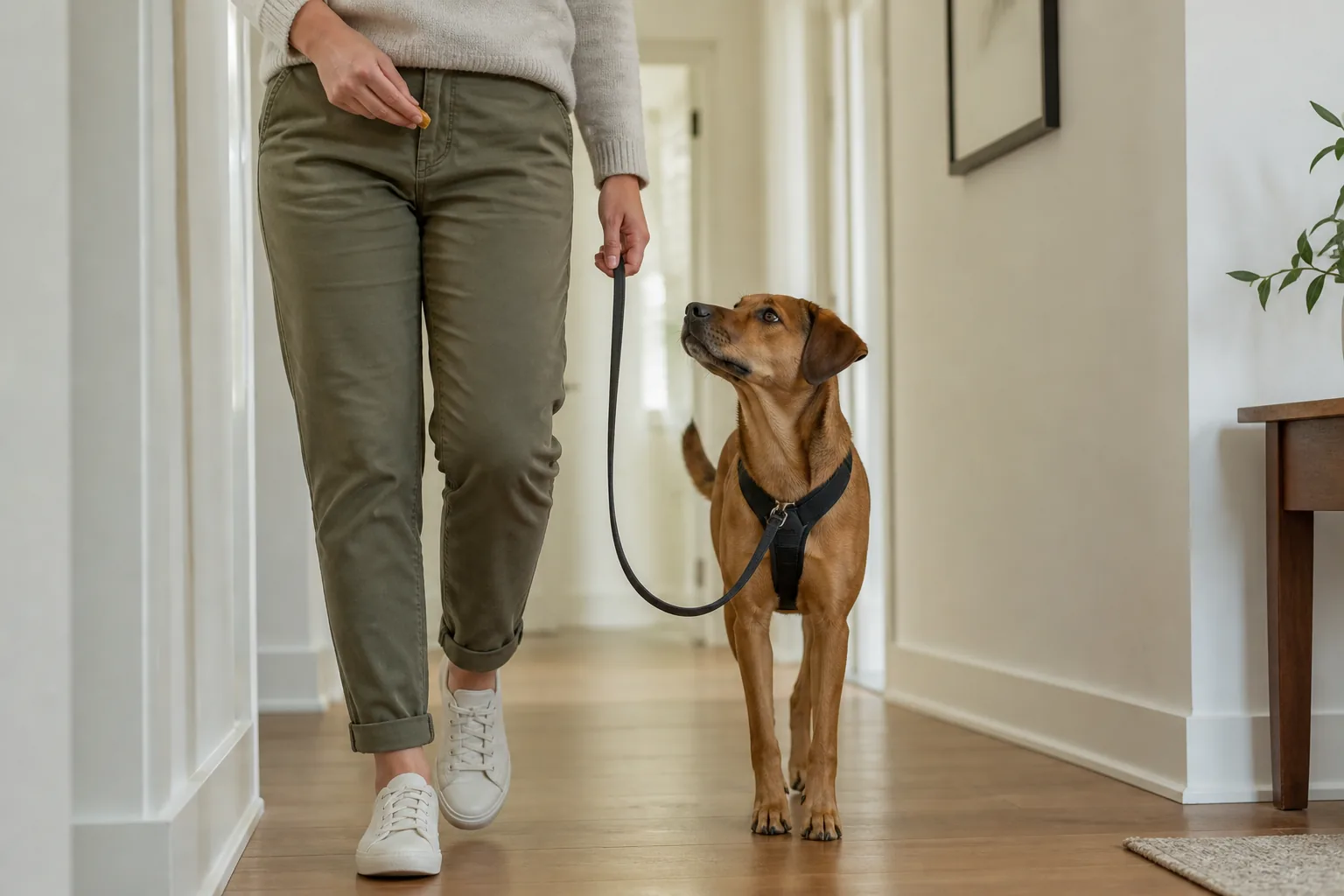
Choose where rewards will arrive—often beside the seam of your trousers. Stand still. When the dog moves into that zone voluntarily, mark and deliver food at that exact location. Toss one reset piece away, then reward the return.
Food location shapes body location. Reaching forward to feed a dog at the leash end reinforces being forward. Delivering too high can produce jumping. Keep your hand low and close to the chosen side.
One-step follow
With the dog near the reward zone, take one step. If the dog moves with you and the leash remains slack, mark and reward beside your leg. Repeat in different directions. Build to two steps, then three.
Do not lure continuously with food at the nose. A lure can start movement, but fade it quickly: empty hand movement, mark after the behavior, reward from the other hand.
Hand target
Teach a nose touch to the palm. It can reposition the dog without pulling the leash. Present the palm inches away, mark the touch, and reward. Gradually place the target at your side and in the direction of a turn.
U-turn
Say a cheerful cue such as “this way,” turn 180 degrees, and reward the dog for following. Practice before it is needed. In real life, a trained turn can create distance from a dog, vehicle, food spill, or narrow bottleneck.
Teach that leash pressure is information, not a battle
In a quiet indoor area, allow the dog to move until the leash just begins to straighten. Stop your body before hard tension. Wait without pulling back. The instant the dog turns, steps toward you, or releases pressure, mark and reward near you, then move again.
If the dog continues straining, the setup is too difficult or the reward is too weak. Shorten the distance to the target, increase your distance from distraction, use the practiced hand target, or turn away. Do not stand for minutes while the dog chokes or surges.
The leash is a safety line. It should not be the cue delivered through force.
Move through environments in stages
Use a progression:
- quiet room
- hallway or garden
- driveway or building corridor
- quiet pavement at a low-traffic time
- familiar route with moderate distance from distractions
- new locations chosen for space and exits
A new environment can reduce performance dramatically. Return to one-step rewards rather than assuming the dog “knows better.” Practice for one to three minutes and then allow an easier activity.
Do not increase distance, duration, and distraction together. Ten indoor steps do not become a ten-minute busy-street walk in one jump.
Use a high rate of reinforcement at first
On the first outdoor sessions, reward every one or two slack steps if necessary. This may feel excessive, but it makes the rule visible. As the dog succeeds, vary to three steps, five steps, a direction change, or access to sniffing.
Count treats within the daily ration and use tiny pieces. Kibble may work indoors; safe higher-value food may be needed outside. Carry enough before leaving. If the dog cannot take food that is normally valued, arousal, fear, heat, nausea, or distraction may be too high. Increase distance or end the session.
Do not lure the dog past something frightening. Food close to a trigger can pull the body forward while the dog remains afraid.
Make sniffing part of the reward system
Sniffing is a central part of walking for dogs. Use access rather than fighting it.
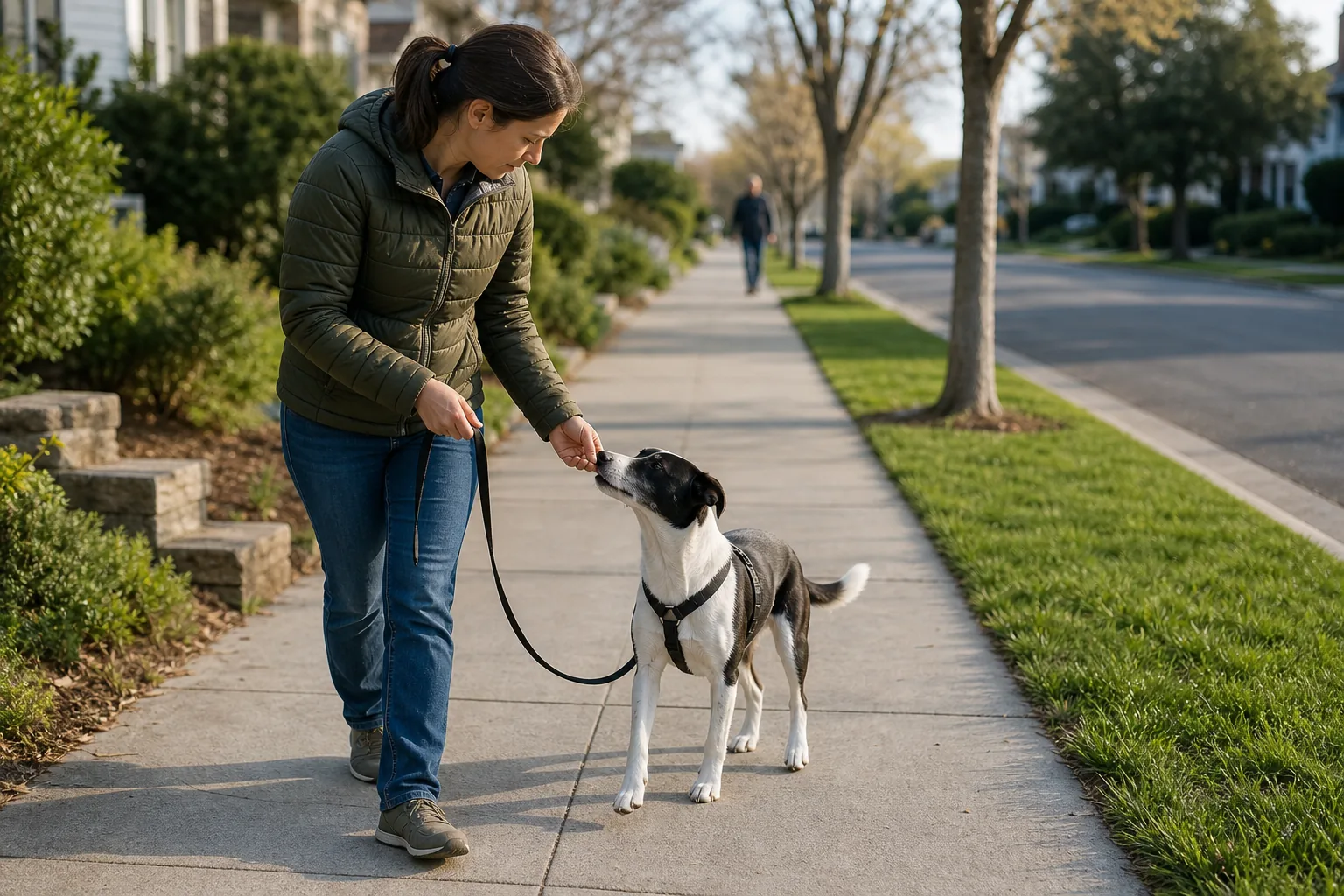
When the dog notices a safe tree or verge, wait for slack, mark, say “go sniff,” and move together toward it. If tension appears, pause or arc away, then try from an easier distance. The dog learns that slack—not harder pulling—opens access.
Build decompression into the route. A walk made entirely of close-position drills is tiring and may increase frustration. Alternate ten or twenty training steps with safe free sniffing on a longer slack leash.
Never release toward rubbish, traffic, another dog, wildlife, toxic plants, treated lawns, broken glass, or private property.
What to do the moment the leash tightens
Use one of three responses based on the situation.
Pause
Stop before being pulled forward. Wait for the dog to create slack, mark, reward near you, and resume. This works when the dog is only mildly interested and the environment is safe.
Turn
Use the practiced U-turn and move away, rewarding follow-through. This is better when waiting would leave the dog staring, lunging, or blocking a path.
Increase distance
Cross the street, step behind a visual barrier, or retreat. Fear and high arousal are not ordinary pulling lessons. Create safety first.
Avoid repeating the name or cue while the dog is unable to respond. One clear cue followed by an environmental change preserves its meaning.
Doorway pulling begins before the walk
If the leash appears only before exciting outings, equipment itself predicts arousal. Practice putting it on, delivering a reward, and taking it off without leaving. Reward four paws on the floor while you approach the door.
At an interior doorway, touch the handle, mark a moment of slack, and reward away from the opening. Open the door slightly. If the dog rushes and tension appears, close it gently and reset—without trapping, scolding, or yanking. Release through when the dog can move with slack.
Exterior doors require containment regardless of skill. Hold the leash before opening, use gates when possible, and never treat a trained pause as escape-proof.
Passing people and dogs
Do not require greetings. Many dogs walk better when passing at comfortable distance. Notice the other party early, cross or arc away, and reinforce check-ins or steady movement.
For dog-dog greetings, tangled leashes, frontal approaches, size mismatch, and unknown health or behavior create risk. A brief loose-arc greeting may be appropriate for selected compatible dogs, but it is optional. Ask the other handler and respect either dog’s avoidance.
If your dog freezes, stares, crouches, barks, lunges, growls, or cannot disengage, this has moved beyond basic loose-leash mechanics. Increase distance and obtain qualified support. Do not correct the reaction or force proximity.
Adjust the walk to the individual
Puppies need age-appropriate activity, frequent pauses, and safe exposure informed by vaccination and disease-risk advice. Adolescents may have high exploration drive and variable attention. Seniors may need shorter routes, better footing, more sniffing time, and health review.
Flat-faced dogs, dogs with cardiac or respiratory disease, overweight dogs, and dogs in hot or humid weather may tolerate less exertion. Choose cool times, carry water as appropriate, and stop for heavy panting, weakness, disorientation, vomiting, abnormal gum color, or collapse. Heat illness is an emergency.
Reactive or fearful dogs may need quiet routes, visual barriers, and temporary transport to a low-trigger area. “More exercise” in an overwhelming location can rehearse distress rather than improve it.
Separate training walks from need-fulfillment walks
A dog still needs toileting, sniffing, and appropriate physical activity while learning. If every necessary outing becomes a strict lesson, both participants may fail from fatigue.
Plan:
- one or two short skill sessions near home
- easier sniff walks in a low-distraction environment
- indoor enrichment when weather or triggers make walking unsafe
- management equipment that keeps the handler stable without causing pain
Drive to a quieter route if feasible. Use a secure yard or indoor scent game to meet some needs. Management is not cheating; it prevents constant rehearsal while skill grows.
Troubleshoot common patterns
The dog pulls only on the way out
The destination and forward motion are highly valuable. Practice doorway skills, begin with dense reinforcement, and use sniff access for slack. Make some outings short loops so leaving home does not always predict a long high-arousal route.
The dog pulls toward home
Fear, fatigue, heat, thirst, pain, or learned dinner timing may contribute. Do not automatically turn home into a pulling contest. Assess comfort and choose a shorter safer route. Veterinary review is warranted for sudden change.
The dog zigzags
Allow wider exploration where safe, then teach a brief “close” zone for narrow areas. Reward on one side and prevent crossing near traffic. A longer leash in open space may reduce conflict.
The dog bites the leash
This can reflect play, frustration, overarousal, or discomfort. Stop movement, reduce stimulation, and offer a safe alternative rather than tugging back. Review harness fit and session length. Persistent or aggressive behavior needs professional evaluation.
The dog plants and will not move
Do not drag. Check heat, surface, equipment, pain, fear, and the direction of travel. Toss a reward away from the feared direction only if that increases safety, use a hand target, or retreat. Repeated planting needs assessment.
Progress disappears outside
The environment is too difficult. Return to a quieter time or greater distance and raise reward value. Skills do not generalize automatically.
Fade food without removing reinforcement
Do not stop rewards because the dog succeeded for one week. First vary their frequency in easy settings. Continue rewarding difficult moments, new locations, close passes, and strong choices.
Life rewards can take over: moving forward, sniffing, greeting a familiar person, entering the park, or being released to explore. Praise can signal approval but may not compete with the environment alone.
Carry emergency rewards even after the skill is established. Maintenance is part of training, not evidence of failure.
A four-week starter plan
Week 1: mechanics
Condition equipment, build reinforcement position, practice one-step follow, hand target, and U-turn indoors. Sessions last one to three minutes.
Week 2: quiet transitions
Practice the hallway, garden, doorway, and a few steps outside at quiet times. Reward nearly every slack step and release to sniff.
Week 3: short route
Walk a deliberately short low-distraction loop. Alternate training sections and exploration. Record where tension starts.
Week 4: one controlled challenge
Add one mild distraction at enough distance for success. Keep duration short and return to an easier environment afterward.
This is not a deadline. Repeat a week or reduce the plan whenever the dog needs it.
Measure progress honestly
Track a fixed two-minute section:
- number of slack steps
- number of tension events
- successful recovery method
- distance from key distractions
- ability to eat and respond
- body language and recovery time
“Thirty slack steps before the first pause on the quiet block” shows change. “Better today” does not reveal which setup worked.
Video from a safe position can show handler timing and leash length. Never film while compromising traffic awareness or control.
When professional help is the next step
Seek qualified reward-based instruction when the handler is at risk of falling, equipment cannot be fitted safely, the dog reacts aggressively, fear prevents ordinary walks, predatory behavior threatens animals, or weeks of appropriate practice produce no functional improvement.
Choose someone who explains reinforcement and management, observes body language, coordinates with a veterinarian, and does not promise instant results or use pain, fear, flooding, dominance, or leash corrections.
The decision to take away
Loose-leash walking improves when the dog has a clear, valuable alternative to pulling. Fit secure humane equipment, teach the reward location and turns indoors, then take tiny pieces of the skill into progressively harder environments. Reward generously where you want the dog, make sniffing available through slack, and pause or turn before sustained tension becomes a contest.
Meet exercise and exploration needs through easier walks and enrichment while training develops. Increase distance from fear and reactivity rather than correcting it. Investigate sudden reluctance or gait change medically.
The finished skill is not a dog staring upward for miles. It is a dog and person moving safely with a mostly slack leash, communicating through practiced cues, and sharing enough freedom for the walk to remain worthwhile.