A recall is not a magic word that overrides scent, wildlife, traffic, fear, play, or years of reinforcement for running. It is a trained behavior: the dog hears a cue, turns away from the current activity, travels to the handler, arrives within reach, and stays long enough to be secured or released. Every part requires practice.
“Reliable” should mean well rehearsed in defined conditions—not guaranteed under every possible condition. No living animal is failure-proof. Physical containment remains necessary near roads, livestock, cliffs, wildlife, unfamiliar dogs, or anywhere a missed response could cause harm. A long line and fenced space let you build skill without betting the dog’s safety on hope.
This guide follows reward-based principles. The American Veterinary Society of Animal Behavior recommends reward-based methods and reports no advantage for remote shock collars over reward-based approaches in recall/stop training. Pain, fear, leash jerks, electronic collars, intimidation, and punishment after return are excluded.
Define the finished recall
Choose a clear sequence:
- handler says the cue once
- dog turns promptly
- dog moves all the way to the handler
- dog allows brief harness or collar contact
- dog receives reinforcement
- dog is secured or released with a separate cue
Many apparent recalls fail at step four. The dog runs close, takes food at arm’s length, and darts away. Train arrival and gentle contact from the beginning rather than grabbing only when fun ends.
Decide whether the everyday cue means “come near” or “come all the way and be reachable.” Use a different casual phrase if you do not need the formal behavior. Protect the formal cue from vague conversation.
Choose or repair the cue
Use one short word or whistle pattern that every household member can reproduce. It should not sound like another frequent cue. Say it once, clearly and pleasantly.
If the current word has been repeated without response, followed by scolding, or used mostly to end walks, it may have a weak or negative history. Choose a fresh cue and build it from the beginning. Do not merely shout the old word louder.
A whistle can travel farther and sound more consistent, but it is not automatically stronger. It must predict the same reinforced behavior and should be carried reliably. Keep a verbal backup for equipment failure or unexpected situations.
Find rewards that can compete
Recall asks the dog to leave something. The payment must matter in that context. Make a reward list:
- several small pieces of high-value safe food delivered one after another
- a brief tug game for a dog who releases safely
- a thrown toy in an enclosed area
- praise or social play the dog genuinely enjoys
- permission to return to sniffing or play
- moving together toward another valued activity
Food that works in the kitchen may not compete with another dog or a rabbit trail. That does not mean the dog is defiant; the competing consequence is stronger. Begin where your reward wins easily.
Count food within the daily ration and treat allowance. Tiny soft pieces allow several rewards without delaying the next repetition. Avoid foods unsafe for the individual dog or incompatible with a prescription diet.
Vary the payoff, but keep it worthwhile. A difficult recall should produce a generous result. Never show an exceptional reward and then withhold it after the dog arrives.
Teach the cue as a prediction first
In a quiet room, when the dog is already near and likely to succeed, say the new recall cue once. Immediately deliver several wonderful rewards at your body. Do not wait for a complicated response during the first pairings. The cue begins to predict value near you.
Repeat three to five times, then stop. Do several tiny sessions across days. The cue should cause an eager orientation before distance is added.
Avoid chanting the cue during meals or saying it to test whether conditioning worked. Each use should be followed by a route to reinforcement.
Build movement over one easy step
Stand one or two paces away. Say the cue, move backward, and open your posture. When the dog starts toward you, encourage without repeating the cue. Mark arrival, gently touch the harness or collar, and reward several times.
If the dog does not move, reduce the distance and distraction on the next attempt. Do not reel in a leash or advance threateningly. The setup, not the volume, must change.
Release with “go play” or another word and allow the dog to move away. The recall becomes a round trip rather than a trap.
Condition collar or harness contact separately
When the dog is relaxed, reach a few inches toward the shoulder, mark, and reward. Progress over sessions to touching the collar or harness, placing one or two fingers under it, and briefly holding before releasing. The dog remains free to move away.
Do not grab, corner, chase, or surprise. Dogs with handling fear, pain, or bite history need professional guidance. Equipment contact should be positive outside recall practice so it does not always predict restraint.
At the end of a recall, touch first and then reward. Later vary the order while keeping both reliable. This prevents the dog from snatching food and avoiding secure contact.
Play room-to-room recalls
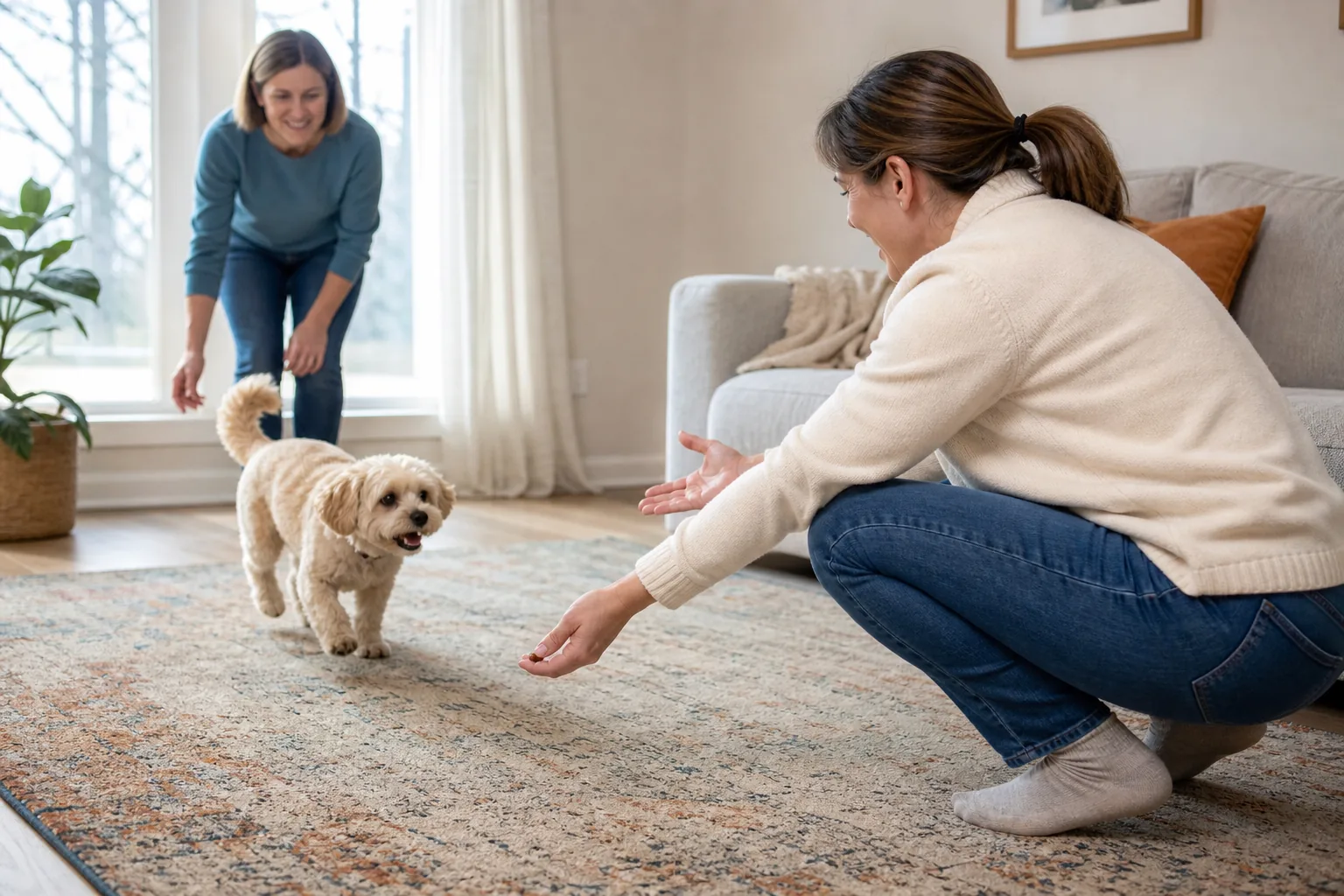
With two people, begin only a few steps apart. Person A rewards the dog, pauses, and becomes still. Person B says the cue once, moves away, and rewards arrival with contact. Then switch.
The person who is not calling should not hold food visibly, repeat the dog’s name, or compete. If the dog remains with one person, increase distance from that person or use a gate for clarity.
When training alone, call from another part of the same room, then around an open doorway. Never hide so completely that a novice dog becomes distressed.
Keep to three to six recalls. Stop while speed and confidence remain high.
Add an easy chase-me game
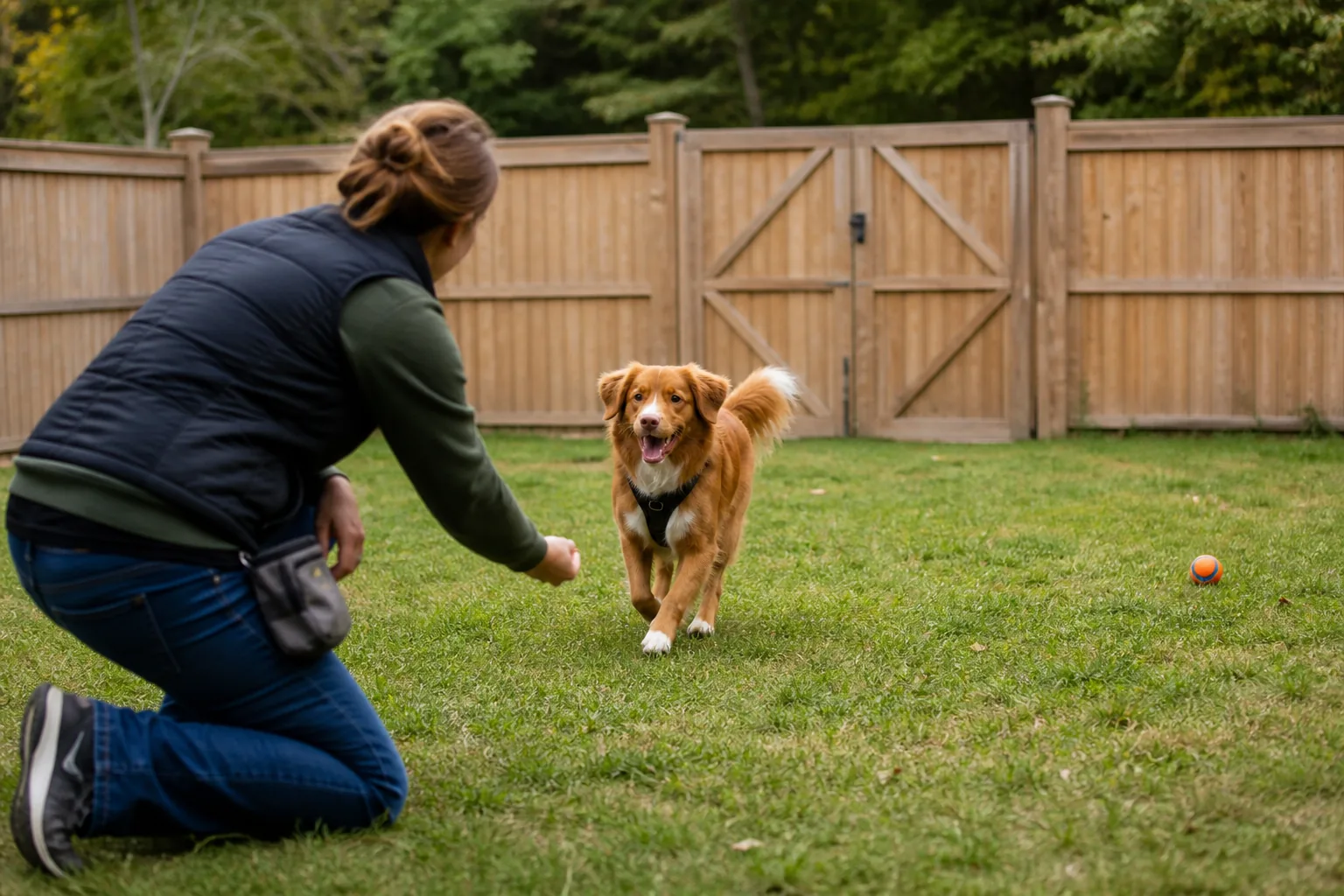
Dogs often enjoy following movement. In an enclosed safe area, say the cue and run a few steps away from the dog—not toward the dog. Mark as the dog catches up, turn sideways, contact the harness, and reward.
Do not run toward traffic, slippery surfaces, stairs, or another animal. Avoid encouraging high-speed collision; deliver low and slightly to the side. For puppies, seniors, or dogs with orthopedic concerns, use a brisk step rather than sprinting.
Never chase a dog who declines recall. Chasing can become the reward for evasion.
Move to a fenced outdoor area
Outdoors adds scent, sound, wind, space, and movement. Return to short distances and excellent rewards. Let the dog investigate briefly, then call only when success is likely—perhaps when the dog has finished sniffing and begins to look up.
After arrival, reward and release back to exploration most of the time. RSPCA and Blue Cross guidance both warn against making recall predict only the end of fun. Access to sniffing is one of the strongest real-life rewards available.
Occasionally clip the leash, reward, walk a few steps, and release again. This breaks the equation “leash attached equals outing over.”
Introduce a long line safely
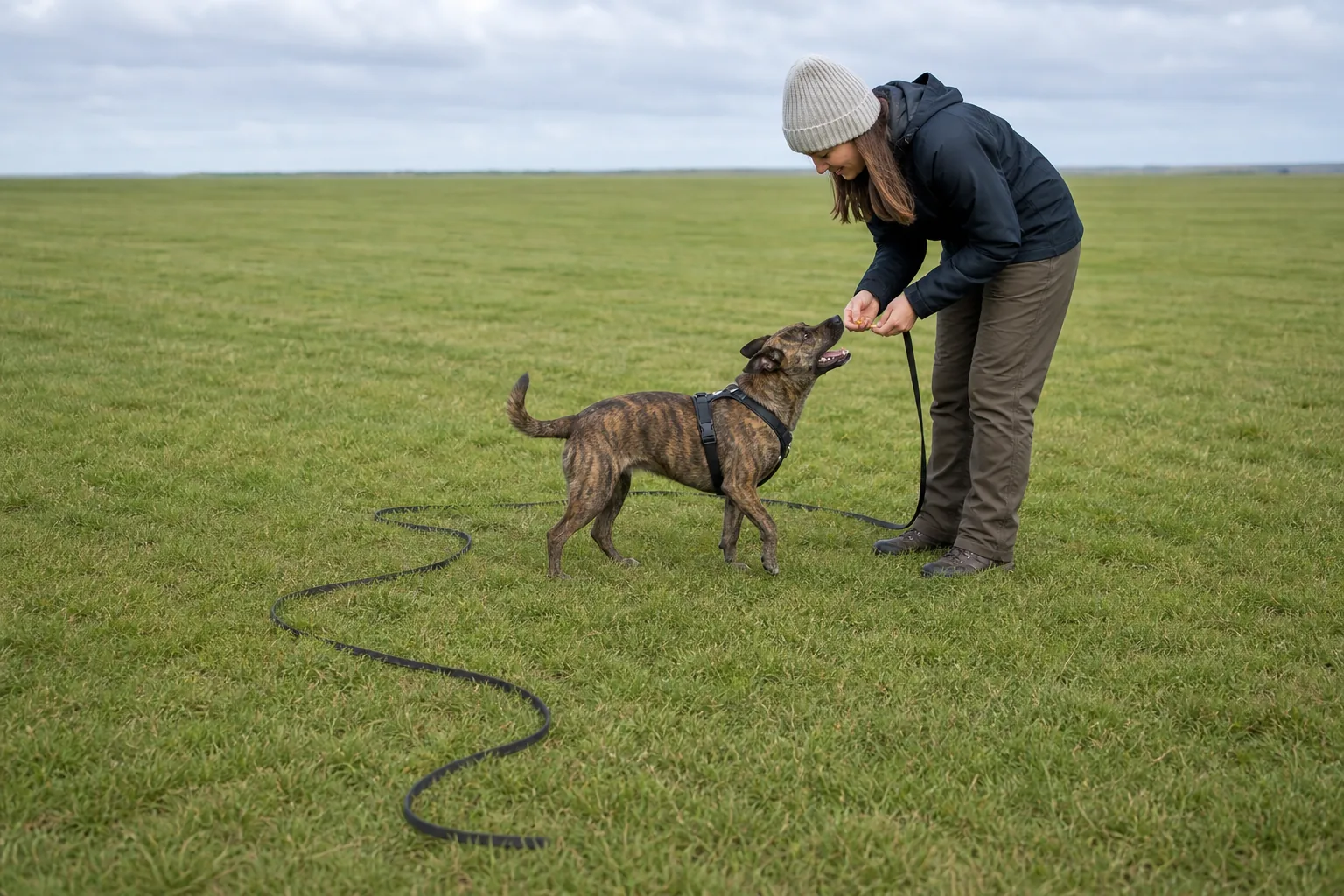
A long line offers freedom while maintaining physical containment. Attach it to a well-fitted body harness, not a collar, because a dog reaching the end at speed can injure the neck. Use it only in open space away from roads, bicycles, cliffs, water hazards, livestock, and dense obstacles.
Wear gloves if appropriate and learn to gather line in broad loops without wrapping it around hands or body. Prevent tangling around people, dogs, trees, and legs. Do not allow the dog to hit the end at full speed. Adjust working length before calling and move with the dog.
The line is a safety backup, not a device for hauling the dog in. If the cue fails, prevent escape calmly, reduce difficulty, and reset. Reeling the dog toward punishment teaches nothing useful about choosing to return.
Seek hands-on instruction if line handling feels unsafe or the dog is powerful enough to pull someone over.
Add distractions through planned distance
Create a hierarchy from easy to hard:
- stationary household object
- familiar person standing quietly
- mild food scent under secure cover
- person walking at distance
- familiar calm dog far away
- active play, wildlife, or strong scent
Your dog’s order may differ. Start far enough away that the dog can notice and still respond. Call once. If the dog succeeds, reward generously and often release to an appropriate activity. If not, increase distance and make the next repetition easier.
Do not stage wildlife, confront a reactive dog with another dog, or use food the dog might swallow from the ground. Safety and welfare set the exercise.
Only one dimension should become harder at a time: distance from handler, distraction intensity, duration of exploration, or novelty of location.
Learn when not to call
Every failed cue rehearses not responding. Avoid calling when:
- the dog is already sprinting after wildlife
- the dog is greeting or playing intensely and has not practiced leaving it
- fear has pushed the dog over threshold
- the handler cannot reinforce
- a long line is tangled or unsafe
- the dog is about to eliminate
- success would require crossing a road or hazard
Instead, use containment, move closer without chasing, create distance from danger, or wait for a moment of natural disengagement. Management preserves the cue.
In a genuine emergency, use whatever safe attention strategy is available—running away, opening a car door if the dog loves entering and traffic conditions permit, dropping food, or using an emergency cue. Safety outranks training elegance.
Create an emergency recall separately
An emergency cue is a rarely used signal paired with an exceptional payoff. Choose a distinctive word or whistle. Indoors, give the signal and immediately provide a jackpot—several high-value pieces or another extraordinary safe reward. Repeat only a few times across days.
Use it for occasional planned easy practice and true need, not ordinary convenience. Keep rewards available in known locations. Even an emergency cue is not guaranteed and does not justify off-leash exposure near hazards.
If it is used and fails, rebuild in easy settings rather than repeatedly testing it.
Do not poison the cue
Never punish after the dog comes, no matter how long it took or what happened first. The dog connects the immediate arrival consequence more readily than the handler’s anger about earlier behavior. Scolding makes future arrival less attractive.
Do not call for every nail trim, bath, medication, isolation, or departure from the park. Sometimes walk to the dog, use another trained cue, or recall, reward, and do a pleasant activity before the necessary event.
Do not repeat “come, come, come.” One cue gives one clear opportunity. Repetition teaches that the first several signals are irrelevant.
Do not lure by displaying food every time. Cue first, behavior occurs, then reward appears. If food must remain visible, return to easier conditions and fade the lure.
Troubleshoot common failures
The dog looks but does not move
Orientation exists, but distance or reward is insufficient. Move away, lower distraction, shorten distance, and reinforce the next response strongly.
The dog comes halfway and stops
Reward interim movement for a few repetitions, then require one step closer. Check whether reaching hands or past restraint makes the final approach uncomfortable.
The dog circles out of reach
Rebuild collar-touch conditioning and reward at your body. Use a barrier or narrow but nontrapping setup. Never lunge to grab.
The dog responds indoors but not outside
This is a generalization gap. Start outdoor practice as though teaching a new skill: close distance, quiet place, excellent rewards, secure line.
The dog comes slowly
Speed may reflect heat, fatigue, pain, uncertainty, surface, or low reward. Do not punish slowness. Assess health and change the setup. Reward faster examples when the dog is physically comfortable.
The dog returns only when food is visible
Hide food in a pouch or container. Use the cue, then produce the reward after arrival. Mix food with play and release-to-sniff rewards once the response is established.
The dog ignores recall during play
Practice with one familiar calm dog in a fenced area. Call during natural pauses at short distance, reward, and release back to play. Do not begin at peak chase.
Recall around fear and reactivity
A reactive or frightened dog who cannot disengage is not failing a basic obedience test. Increase distance, use visual barriers, and avoid the trigger. A recall cue can be part of a treatment plan, but it does not replace systematic behavior work.
Do not call the dog closer to something feared or use food to lure into an unsafe distance. Aggression, severe fear, predatory risk, or repeated bolting needs veterinary evaluation and a qualified reward-based behavior professional.
Decide about off-leash freedom conservatively
Before unclipping in a legal area, ask:
- Is the location securely fenced or physically separated from roads and hazards?
- Is off-leash access permitted?
- Can the dog respond around the actual distractions present?
- Is there wildlife, livestock, nesting habitat, poison bait, cliffs, water, or thin ice?
- Are unfamiliar dogs or people entitled to space?
- Does the dog have a history of roaming, chasing, fear, or escape?
- Are identification and microchip details current?
A fenced field or long line may remain the responsible lifelong choice. Off-leash status is not a graduation requirement.
Do not let a dog approach people or dogs without consent. A friendly dog can frighten someone, disrupt assistance animals, or trigger conflict.
Maintain recall for life
Practice a few easy recalls each week and reward them. Carry reinforcement on walks. Use surprise jackpots occasionally. Recall from sniffing, reward, and release again.
Revisit long-line practice after adolescence, a move, illness, long training gap, or a failure. Context and reinforcement history change.
Teach every caregiver the same cue, reward location, contact step, and release word. Inconsistent handling creates different recalls with different people.
A six-week starter progression
Week 1: cue value
Pair the cue with rewards indoors. Build one- to three-step recalls and positive harness contact.
Week 2: rooms and people
Play room-to-room recalls and short chase-me games. Keep success near 100 percent.
Week 3: fenced quiet outdoors
Return to short distances. Reward and release to sniffing. Add leash clipping without ending every session.
Week 4: long-line mechanics
Practice in a quiet open area away from hazards. Add modest distance, not strong distraction.
Week 5: planned mild distractions
Work at a distance where the dog can respond. Change only one difficulty dimension.
Week 6: generalize and review
Use several safe locations and identify weak contexts. Do not unclasp the line merely because six weeks passed.
Measure the behavior
Record:
- location and distance
- distraction present and its distance
- response to first cue
- turn latency
- full arrival and contact success
- reward used
- whether the dog was released
“Nine of ten first-cue arrivals from 15 feet in the fenced garden” is evidence. “Usually comes” is not enough for a safety decision.
When to get professional help
Seek a qualified reward-based trainer when the dog repeatedly escapes, handlers cannot manage the line safely, predatory chase is strong, the dog avoids approach or handling, or the environment prevents controlled practice. Involve a veterinarian for sudden response change, hearing or vision concerns, pain, cognitive change, fear, or aggression.
Avoid trainers who guarantee recall, use shock or painful collars, stage dangerous failures, or describe fear and escape as dominance. A professional should explain management, reinforcement, criteria, and realistic limits.
The decision to take away
A strong recall is built by making one cue clear and consistently valuable. Begin at arm’s length, reward full arrival and gentle equipment contact, release back to good activities, and expand through rooms, fenced spaces, long-line work, and planned distractions.
Call only when the dog can reasonably succeed. Do not repeat, punish the return, or make every recall end fun. Use containment when stakes exceed training.
Reliability grows from thousands of safe reinforced choices. It never removes the handler’s responsibility to assess roads, wildlife, other animals, local rules, and the individual dog before offering freedom.